





Upgrades for Second-Gen
Camaros & Early Novas

Custom Exhaust








 TOC
TOC
Cover image by Fuelish Media.










“Rotten” Rodney Bauman, Jefferson Bryant, Tommy Lee Byrd, Ron Ceridono, Ron Covell, Grant Cox, Fuelish Media, John Gilbert, Tavis Highlander, Jeff Huneycutt, Barry Kluczyk, Scotty Lachenauer, Patrick Lauder, Jason Lubken, John Machaqueiro, Ryan Manson, Jason Matthew, Josh Mishler, NotStock Photography, Todd Ryden, Jason Scudellari, Jeff Smith & Chuck Vranas – Writers and Photographers
Travis Weeks Advertising Sales Manager
Patrick Walsh Sales Representative
ads@inthegaragemedia.com
AllChevyPerformance.com
ClassicTruckPerformance.com
ModernRodding.com
InTheGarageMedia.com
inthegaragemedia.com “Online Store”
For bulk back issues of 10 copies or more, contact store@inthegaragemedia.com
info@inthegaragemedia.com
Editorial contributions are welcomed but editors recommend that contributors query first. Contribution inquiries should first be emailed to info@inthegaragemedia.com. Do not mail via USPS as we assume no responsibility for loss or damage thereto. IN THE GARAGE MEDIA, INC. reserves the right to use material at its discretion, and we reserve the right to edit material to meet our requirements. Upon publication, payment will be made at our current rate, and that said, payment will cover author’s and contributor’s rights of the contribution. Contributors’ act of emailing contribution shall constitute and express warranty that material is original and no infringement on the rights of others.

Copyright (c) 2026 IN THE GARAGE MEDIA, INC.
PRINTED IN U.S.A.


 firing up
 BY NICK LICATA
was recently watching a documentary that recounted the origin of surf music, and it made me wonder how rock ’n’ roll became the default soundtrack to hot rodding.
In the early days of Southern California’s surf culture, the sound of a Stratocaster plugged into a Fender Twin Reverb put the guitar center stage. The sometimes dreamy, sometimes quick-picking staccato sound became synonymous with the surf culture. That musical style became the perfect soundtrack to early surf films of the 1950s and ’60s. That unique sound eventually exploded into a commercial phenomenon.
Like surfing, hot rodding never lived in silence. From the moment young gearheads started swapping cams and chasing speed on dry lakes and two-lane blacktops, there was always music humming in the background. Think American Graffiti where early rock ’n’ roll music sat alongside the voice of Wolfman Jack, magically accompanying the cruising scenes as if it was being piped in through speakers all along the boulevard like today’s outdoor shopping mall.
Early on, cars delivered tunes through an AM radio and a small dash-mounted speaker. In early hot rods, there was only the rhythm of an engine at idle echoing through a pair of uninhibited exhaust headers. Eventually, rock music and fast cars grew up together, inseparable and perfectly tuned.

 PARTS BIN



For more information, contact FiTech Fuel Injection by calling (951) 340-2624 or visit fitechefi.com.


For more information, contact Summit Racing by calling (800) 230-3030 or visit summitracing.com.


For more information, contact ARP by calling (800) 826-3045 or visit arp-bolts.com.


 CHEVY CONCEPTS
InTheGarageMedia.com


 Text & Rendering by Tavis Highlander
utternut Yellow has to be the ultimate color for a sleeper restomod Nova. With relatively few exterior mods, this 1967 Nova absolutely fits that vibe. From the outside your only clues as to the car’s potential will be the stance and Schott wheels. Pop the hood and you’ll get the full story. A backdated LS engine completes the whole vintage look but with modern performance. Sheetmetal-like DSE inner fenders and a smoothed firewall lets you focus on that detailed powerplant.
 FEATURE
 Images by THE AUTHOR
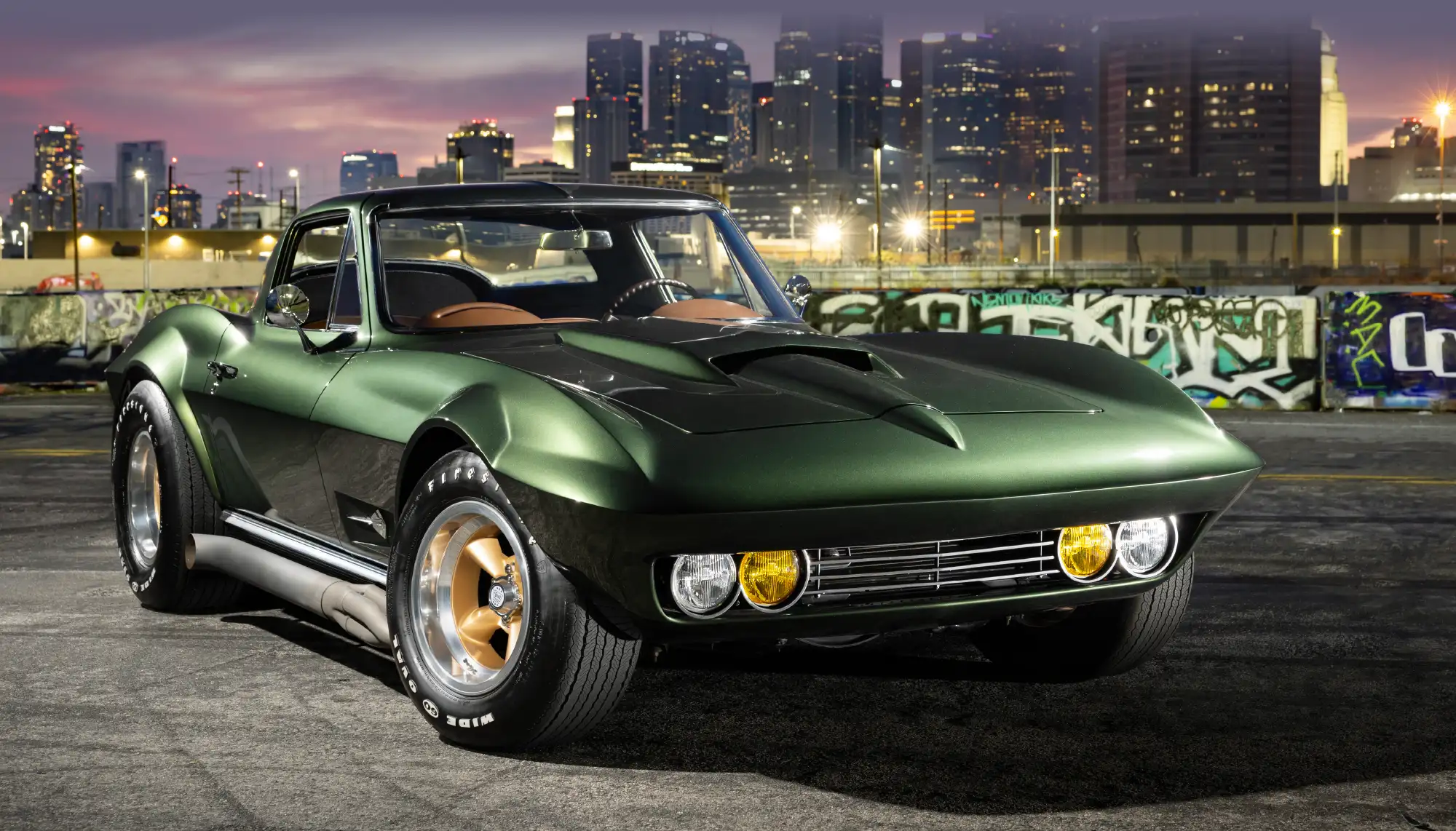
here’s just something about vintage Corvettes that elevates the excitement level of performance junkies and Chevy purists alike. Fred “Digger” Graves, a retired Los Angeles County fire captain, can personally back that claim up. Fred has had an eye for cool cars and hot rods since he was a kid, but as he matured, he developed a special love affair for Vettes of all varieties.
“From the first time I went for a ride in a 1963 Corvette, I was immediately hooked,” Fred exclaims. “I couldn’t stop thinking about buying one, and that was the first thing I did when I came home from Vietnam in 1968. I ran out and got myself a 1965 Corvette Sting Ray coupe.” Owning his dream car was just as exciting as Fred expected, but he realized it was time to let go of it once he began planning to leave for college. Becoming a firefighter/paramedic felt like the natural next step post-military service, so off Fred went without his car but with plans to purchase another as soon as he was able.
 Tech
Tech Images by Roadster Shop
n past articles we looked at some of the preliminary work being done by Roadster Shop on this outstanding 1965 Corvette. This time, we’ll take a close look at the intricate radiator fan shroud, the all-stainless exhaust system, and the aluminum pan that seals off the bottom of the body at the rear.
This car uses a temperature-controlled SPAL electric fan for the radiator, along with the belt-driven fan on the front of the engine. The electric fan helps manage coolant temperature, even when the car is idling for long periods and after the engine is shut off. There is precious little room under the hood of this car, so great care was taken to position each component with adequate clearance, ensuring nothing looks crowded or out of place.
The first step was mounting the electric fan on the back side of the radiator, accomplished by making a shallow perimeter frame from sheet aluminum. Next, the circular portion of the shroud was formed by putting a 1-inch flange on a strip of aluminum and shrinking the flange to create the round shape. Once the part was accurately formed and sized, the seam was welded and metal-finished.


 FEATURE
 Images by Chris Shelton
his is the classic story of the one that got away. Mardy Betschart was gifted with a great business mind and a natural ability to hustle. I first noticed it back in high school where we met. He always worked hard and traded for cool stuff—even owning a 10-second drag car. Arguably, his best trade came after he parted ways with a mustard-yellow Toyota pickup. The prize? An arrow-straight, jet-black 1967 Nova. The car was the envy of our school. Even in the ’80s, clean mid-year Novas were hard to come by. It looked good and ran an honest low, 13-second e.t. while smoking the tires.
Right after high school, Mardy bought a house, got married, and was working hard at his career. The Nova sat neglected in his backyard, so I swooped in and grabbed the forgotten high school hero car. I breathed new life into it and had great success showing and racing it, but it was still known as “Mardy’s car.” I later sold it.

 TECH
TECH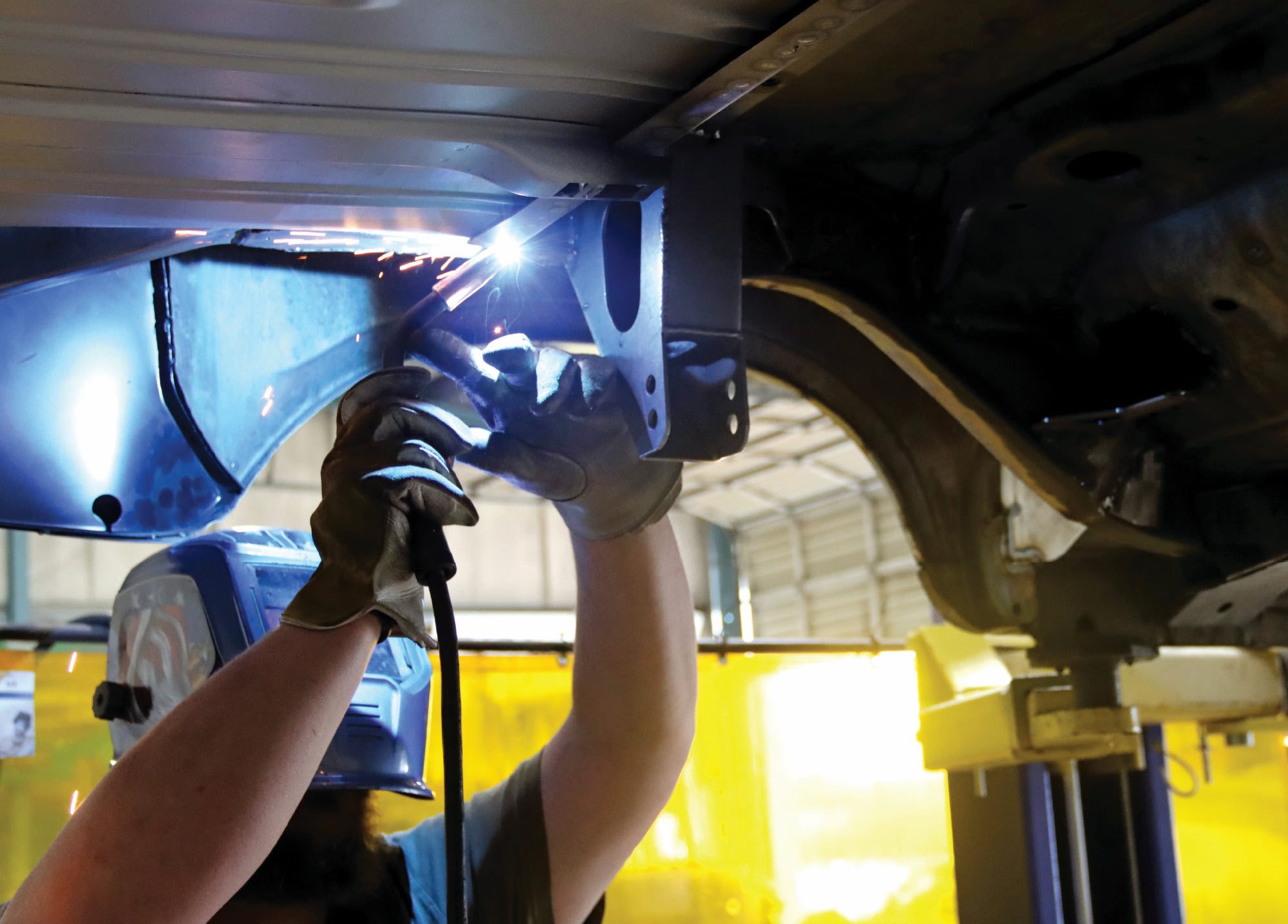 Images by Chadly Johnson
ugene, Oregon, is known for a number of things: it’s home to the University of Oregon Ducks, there are coffee shops everywhere, and the classic movie Animal House was filmed there. Most important to us is that nestled on the edge of town is one of the premier restoration and hot rod shops in the country: MetalWorks Classic Auto Restoration. Something interesting is always happening inside owner Jon Mannila’s facility, and we can always count on our man on the scene, Chadly Johnson, to keep us dialed in on the latest action. The most recent activity brought together MetalWorks’ ace fabricator Dave Williams, a Detroit Speed & Engineering (DSE) QUADRALink rear suspension kit, and a 1963 Chevy II—and we had a front-row seat to follow it all unfold.
General Motors unveiled the Chevy II in 1962 as a compact car aimed at competing with their own Pontiac Tempest and Oldsmobile F85 as well as the Ford Falcon and others. The little Chevy was well received, and the available 153ci four-cylinder engine and the 194ci inline-six certainly appealed to the those looking for an economical grocery getter. But when the 283ci V-8 was offered as an option in 1964, hot rodders took notice and they really perked up when the 350hp 327 became available in 1967. These little nondescript Chevys were often described as wolves in sheep’s clothing.


 FEATURE
 Images by Patrick Lauder
eeing the high school seniors drive their cool muscle cars into the student lot every morning was the motivation a young Kenneth Anabeza needed. Cars loaded with loud V-8 engines and fat tires were rolling thunder—a sound and sight he wanted so desperately to take part in. “I told myself once I’m able to save enough money, I’ll get a cool car just like those guys,” he remembers. It’s been 22 years since those cars rolled in and out of his high school, but Kenneth finally made good on that vow with a Craigslist-sourced 1967 Camaro—a first-gen he was finally able to stash away the funds to acquire.
The Online photos made the Camaro look honest, maybe needing a little tidying up here and there, nothing a few Saturday afternoons and a fresh set of plugs couldn’t fix. Kenneth bought it, and like many Online romances, the truth hid under layers of paint. A detailer killed the illusion in a single pass around the sheetmetal, informing Kenneth that the body was more filler than steel—an old story in old metal, but never a fun one to discover when you just dug deep into your pockets to fulfill one of your dreams.
 TECH
TECH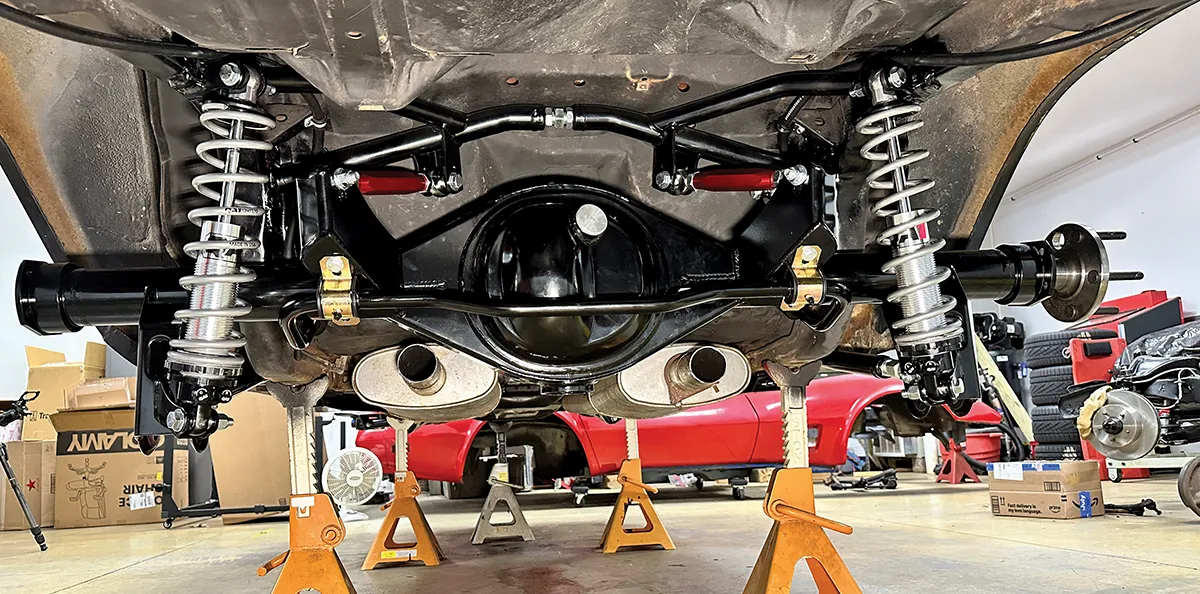 Images by THE AUTHOR
n the first installment of our 1978 Camaro buildup, we laid out our plans for a complete suspension upgrade thanks to a Level Two handling kit from QA1 along with a massive upgrade in braking capabilities and an all-new system from Wilwood. By the way, we’re also using a built third member for our 9-inch rearend from Quick Performance and new 18-inch wheels from Rocket Racing Wheel.
In that issue, we also managed to do a few baseline braking tests, stripped the old stock suspension out from under the Camaro, and even got the new QA1 suspension installed up front. This time around we’re tackling the rear suspension and also installing the new, high-strength 9-inch rearend.


 FEATURE
 Images by JASON MATTHEW
orman Watson grew up in a household where cars were a big part of life due to his dad being in the used car business back in the late-1960s and 1970s. He informed us that over 100 cars cycled through the Watson driveway during those years. Sunday drives were a family tradition and never boring due to the variety of cars taking part in the exercise. But through that diverse assortment it was the 1969 Camaro that burned deeper into Norman’s memory than the rest.


 TECH
TECH
 Images by The Author
t can be argued that the first-series (1970-73) second-gen Camaro is the most beautiful Camaro ever designed. True, the first-gen Camaro (1967-69) styling is also gorgeous, but the complete restyling of the second-gen brought undeniable benefits through the end of the run in 1981: a front steer gearbox, wider track width, radial-tuned suspension with improved geometry, better insulation, and tons of options, to name a few.
The Rally Sport option is primarily cosmetic, but it was a styling home run that holds up today and makes a fun modification to any second-gen model. Our car is a prime candidate for this nose conversion, since the 1974 model still had the small back window carried over from the 1971-73 body design. The rear conversion involves lots of cutting, replacement, modifications, and welding, but the front is primarily bolt-on, especially if you have a 1974-77 car where the fenders match the first-series design. That’s what we’ll walk you through in this article, pointing out the basic steps, parts, and pieces you’ll need, along with what you can reuse, and what you’ll need to buy to complete the conversion.
This car made its way to us from Derek Bieri, host of Vice Grip Garage on YouTube. We traded favors and parts and I got this thing for a song. I never intended to fully restore it, but the small rear window and very solid spring pockets and framerails convinced me to go the full-9 on this car. Auto Metal Direct (AMD) has everything I need to transform it into the image of a 1970 RS—but not as a clone, just my version of the best second-gen styling. The AMD catalog along with the GM service manual I found on eBay for $9 has been essential for reassembly and reference.


 FEATUREImages by The Author
ometimes in life, that one thing that eluded you when you wanted it most can turn up when you least expect it. When the opportunity arose for Stephen Fisher, he took it into his own hands and landed the car that he had been hunting for the better part of a decade. Although it wasn’t the exact car he’d been searching for, the moment he laid eyes on it, he wasn’t about to let it get away.
“I had been looking for a gasser for about nine years,” Stephen says. “I was searching for a 1955 Chevy two-door coupe—one without the rear wheelwells cut, and I wasn’t having much luck. I also like coupes better than sedans, so that was another variable.
After blowing up the 454ci big-block in his hot-rodded Caprice, Stephen started roaming the want ads and the Internet for a suitable replacement. “I came across one near Maple Grove Raceway and quickly struck a deal with the owner,” Stephen says. “The next day my friend George Anderson and I went to purchase the engine. When the owner opened his garage, sitting next to the engine was this beautiful gasser-style 1957 Chevy. I freaked out!
 TECH
TECH

 Images by The Author
iberglass is a very misunderstood material. Most people can just think of the itch, followed by the sticky mess and simply don’t want to fool with it. The reality is that it is far more forgiving than metal, but repairing fiberglass is where many DIYers get spooked. Fiberglass moves differently than metal, so bodyworking it requires different materials and techniques. The fibers swell in the heat and can print through paint in the sun, but that goes away in the shade. Fiberglass sticks to itself quite well, but it has to be properly prepped to get solid adhesion. These inherent differences tend to scare off less-experienced body shops from working on the early true fiberglass Corvettes (1953-72).
BMF Bodies LLC builds replacement bodies and repair panels for C1 Corvettes (1953-62), as well as custom work. We visited the shop to document a front clip replacement on a 1962 Corvette. This car had been poorly repaired 30-plus years ago, and most of the bonds had failed. The crew at BMF Bodies stripped the original panels and showed us the entire process. This is something that anyone with basic bodywork and fabrication skills can do, you just need some patience and a couple of special tools.


Advertiser
- American Autowire27
- Art Morrison Enterprises29
- Auto Metal Direct21
- Automotive Racing Products31
- Billet Specialties69
- Borgeson Universal Co.25
- Classic Industries43
- Classic Performance Products4-5, 89, 92
- Dakota Digital91
- FiTech EFI77
- Forgeline Motorsports87
- Golden Star Classic Auto Parts6
- Goodguys7
- Hemmings45
- Holley Performance Products39
- Lokar2
- National Street Rod Association57
- Powermaster Performance87
- Schwartz Performance89
- Scott’s Hotrods77
- Specialty Auto Parts USA, Inc.59
- Steele Rubber Products9
- That’s Great News89
- Triple Crown of Rodding, LLC47
- Tuff Stuff Performance Accessories59
- Wilwood Engineering11