

ACP department heading TECH
InTheGarageMedia.com
1963 chevy II rear suspension upgrade
1. Dave Williams Of MetalWorks Classic Auto Restoration handled the installation of a Detroit Speed & Engineering (DSE) QUADRALink rear suspension kit under a 1963 Chevy II.
Rearend Redo
Installing Detroit Speed & Engineering’s QUADRALink Suspension for Chevy IIs
By Ron Ceridono Images by Chadly Johnson
E

ugene, Oregon, is known for a number of things: it’s home to the University of Oregon Ducks, there are coffee shops everywhere, and the classic movie Animal House was filmed there. Most important to us is that nestled on the edge of town is one of the premier restoration and hot rod shops in the country: MetalWorks Classic Auto Restoration. Something interesting is always happening inside owner Jon Mannila’s facility, and we can always count on our man on the scene, Chadly Johnson, to keep us dialed in on the latest action. The most recent activity brought together MetalWorks’ ace fabricator Dave Williams, a Detroit Speed & Engineering (DSE) QUADRALink rear suspension kit, and a 1963 Chevy II—and we had a front-row seat to follow it all unfold.

General Motors unveiled the Chevy II in 1962 as a compact car aimed at competing with their own Pontiac Tempest and Oldsmobile F85 as well as the Ford Falcon and others. The little Chevy was well received, and the available 153ci four-cylinder engine and the 194ci inline-six certainly appealed to the those looking for an economical grocery getter. But when the 283ci V-8 was offered as an option in 1964, hot rodders took notice and they really perked up when the 350hp 327 became available in 1967. These little nondescript Chevys were often described as wolves in sheep’s clothing.

While the little V-8–powered Chevy IIs had lots of performance potential, the rear suspension with monoleaf springs wasn’t able put the power to the ground. Those flimsy springs would deflect, allowing the rearend to “wrap up,” causing severe wheel hop. It wasn’t unusual for a V-8–powered Chevy II to litter the asphalt with broken driveline components. Of course, in days past, there were all sorts of attempts to solve the problem. Slapper bars were one of the most common, but today there is a much more sophisticated means to upgrade that woefully inadequate stock rear suspension thanks to DSE’s QUADRALink rear suspension system.

DSE’s QUADRALink is a parallel four-link system designed to provide the best possible handling and axle control without restricting suspension travel. The long links stabilize the rear axle, eliminating the Chevy IIs propensity for wheel hop while also maintaining the proper pinion and U-joint angles. Thanks to DSE’s patented Swivel-Link rod ends all four links can twist, allowing the suspension to fully articulate without the use of spherical rod ends that can be noisy and wear out rapidly. To locate the rearend laterally, an adjustable Panhard bar is used.

In stock form the Chevy II’s monoleaf rear springs are rated at 95 lb/in. While the soft springs were great for a squishy ride, they were also responsible for the wild wheel hopping dance these cars were known for. The QUADRALink system does away with the leaf springs in favor of coilover shocks that feature “Detroit Tuned” valving. These shocks are available in non-adjustable, single-adjustable (rebound only), double-adjustable (compression and rebound), and double-adjustable with remote canisters that have all the qualities of the double-adjustable shock and incorporate a gas-charged bladder to provide high-frequency and low-speed dampening control.

As a companion to the QUADRALink suspension kit, DSE offers 18-gauge steel inner wheel housings (mini-tubs) that are 2½ inches wider than stock. Designed to accommodate wider tire and wheel packages, they allow the use of tires as wide as 295 for the 1962-65 Chevy II, and 315 for the 1966-67 Chevy II. Included with the mini-tubs are laser-cut “closeouts” to box the trimmed framerails.

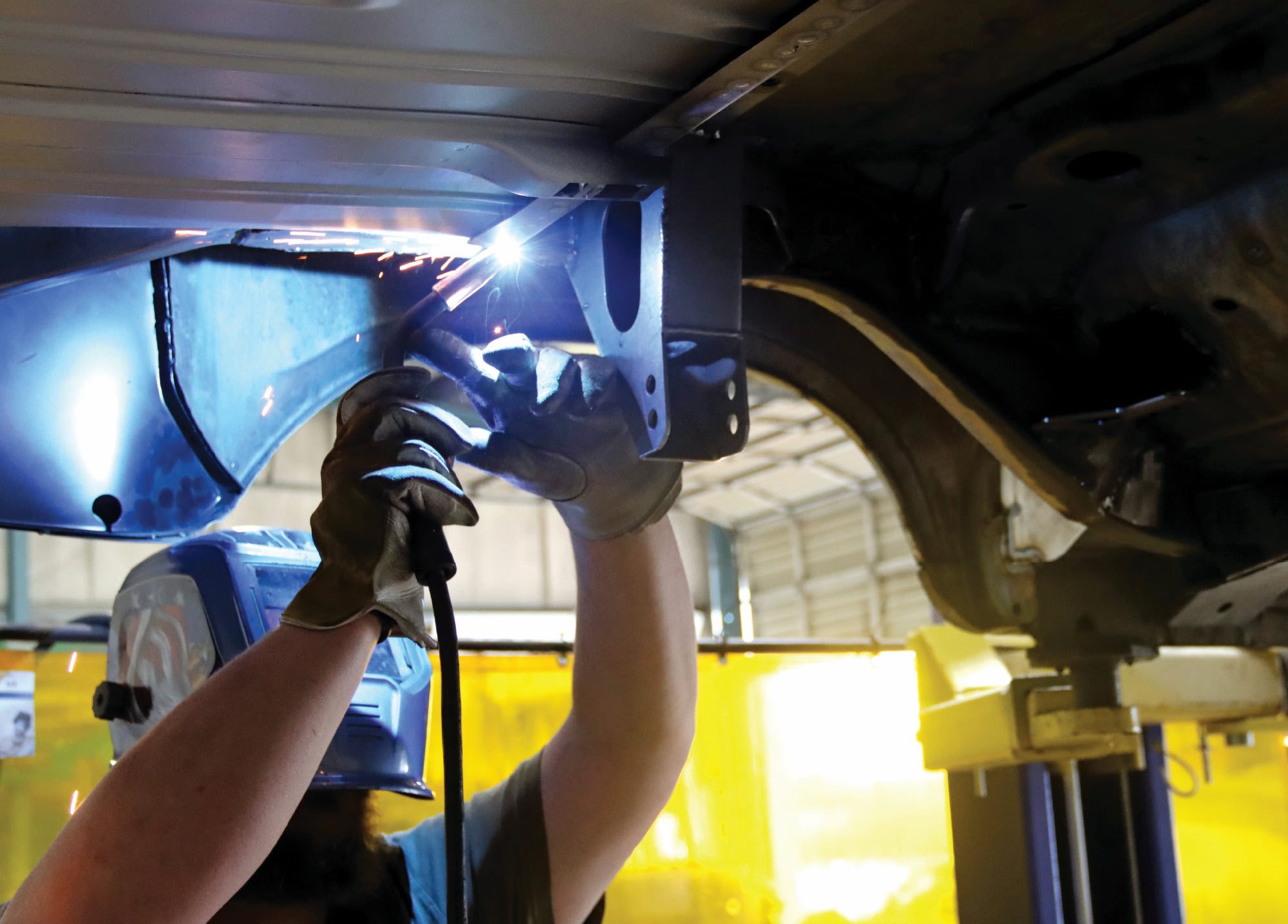
Like most of MetalWorks’ ground-up projects, this 1963 Chevy II was acid-dipped to strip it down to bare metal. Once out of its chemical bath, Williams modified the rear framerails, added the mini-tubs, and welded the DSE crossmembers and mounting brackets in place. Although modifications to the floorpan are required, the rear seat is retained, requiring only minor modifications to the mounting brackets.

DSE’s QUADRALink kits come with precision-formed brackets, grade 8 hardware, necessary templates, and in-depth instructions. With MetalWorks expertise and DSE’s quality components, this Chevy II is well on its way to maximizing its performance potential and becoming a seriously bad wolf, with or without sheep’s clothing.

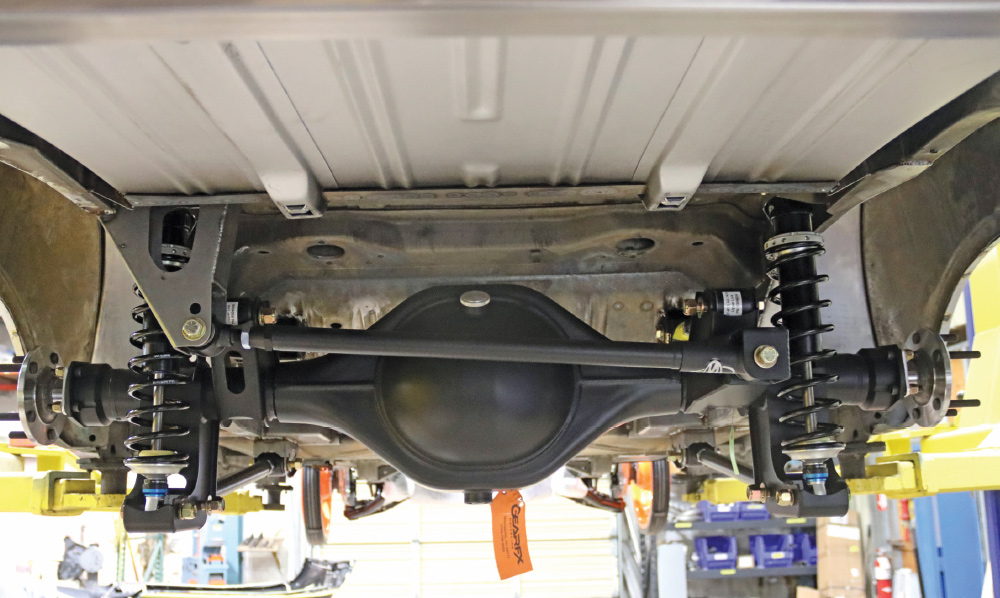
1963 Chevy II rear suspension upgrade showing black differential housing, coilover shocks, tubular control arms, and rear sway bar installed under the car
2. The completed DSE rear suspension system (PN 041707DS) includes four links, Panhard bar, sway bar, and coilover shocks.
 components for a high-end suspension upgrade
3. Like all DSE suspension kits, all brackets are precisely formed and complete instructions are included.
underside of a car chassis, specifically the rear subframe area undergoing structural reinforcement welding
4. In addition to the rear suspension components, this car received DSE’s mini-tub kit, which includes close-outs (boxing plates) to enclose the narrowed framerails.
structural component on the underside of a vehicle undergoing fabrication or restoration, likely a frame rail crossmember
5. The trunk floor is cut to allow the installation of the DSE crossmember that reinforces the rear frame section and includes upper shock mounts. Note the two rectangular holes that have been cut in the floor.
reinforcement plates being welded onto the underside of a car chassis
6. Here the right-side upper shock mount that is part of the new crossmember can be seen. A series of plug welds help secure the crossmember to the floor.
BMW E46 rear subframe reinforcement bracket
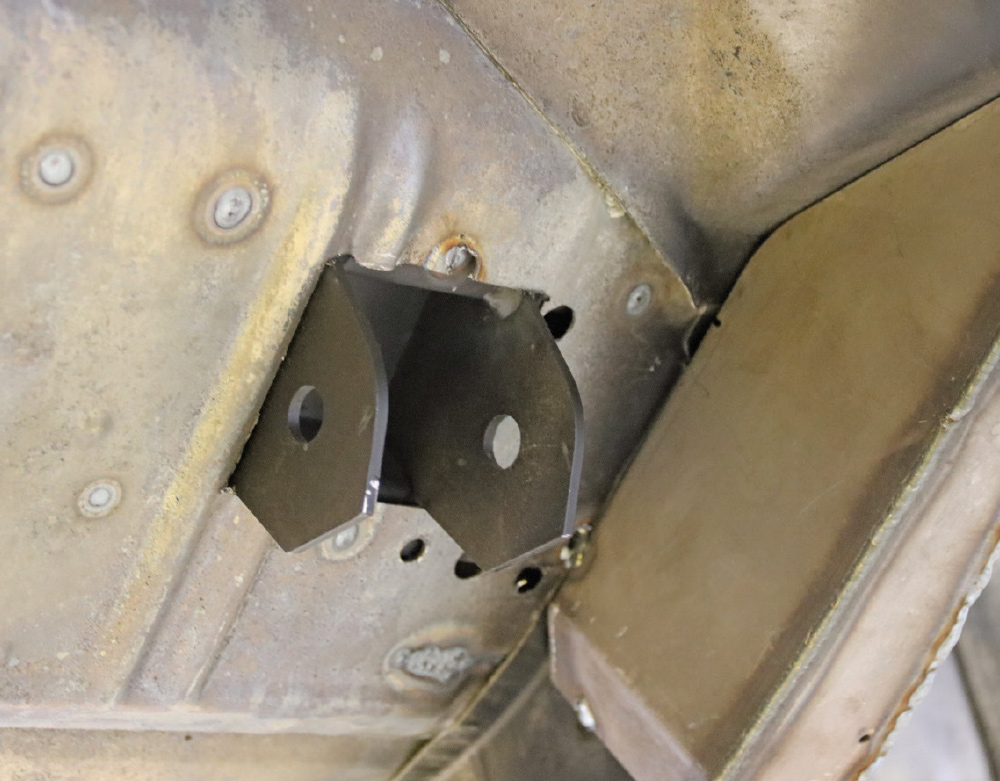
7. The new DSE front link crossmember is installed from inside the car—the mounting brackets for the links fit through the holes cut in the floor.
custom-welded structural reinforcement brace
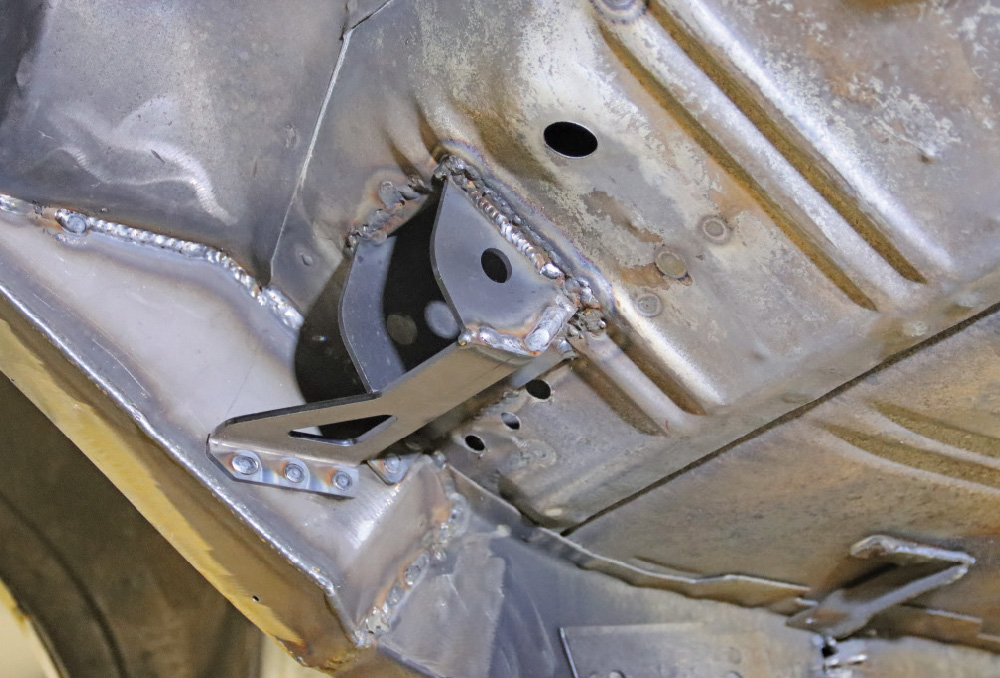
8. For added strength, the supplied inner reinforcement plates were welded to the factory framerails. In addition, gussets are included to tie the front link brackets to the inner framerails.
heavy-duty shackle relocation kit
9. To support the lower link brackets, “torque boxes” are welded to the floor and framerails.
subframe connectors and specialized suspension brackets
10. During installation, the lower link brackets are located off the original spring hangers then welded to the new torque boxes and original framerails.
adjustable rear leaf spring shackle hanger
11. The front lower link brackets are welded to the torque boxes and the factory framerails. Once installed, the original spring hangers are removed.
heavy-duty control arm bracket
12. DSE’s adjustable track bar bracket is welded to the factory framerail and the DSE crossmember.
adjustable thrust arm kits
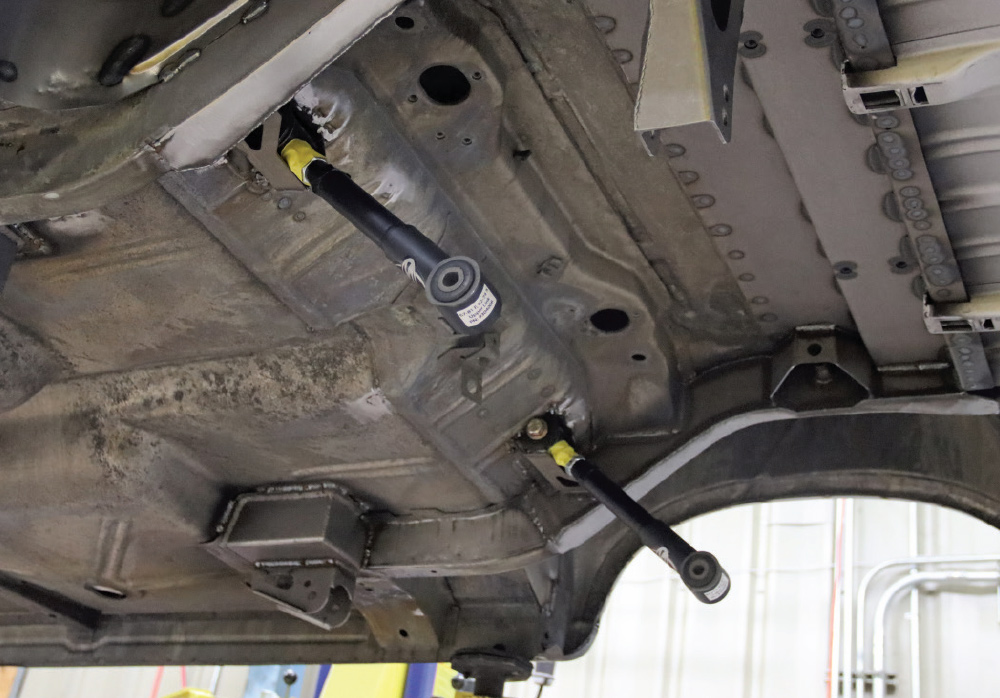
13. All four links in the QUADRALink system use long-lasting, high-durometer rubber bushings. The patented Swivel-Link rod ends allow the suspension to fully articulate with no binding.
Detroit Speed Ford 9-inch QuadraLink Narrowed C6 Floater Axle Housing
14. DSE supplied the 9-inch axle housing with all the necessary brackets welded in place.
undercarriage undergoing rear suspension upgrades, featuring a triangulated four-link system and a rear differential axle
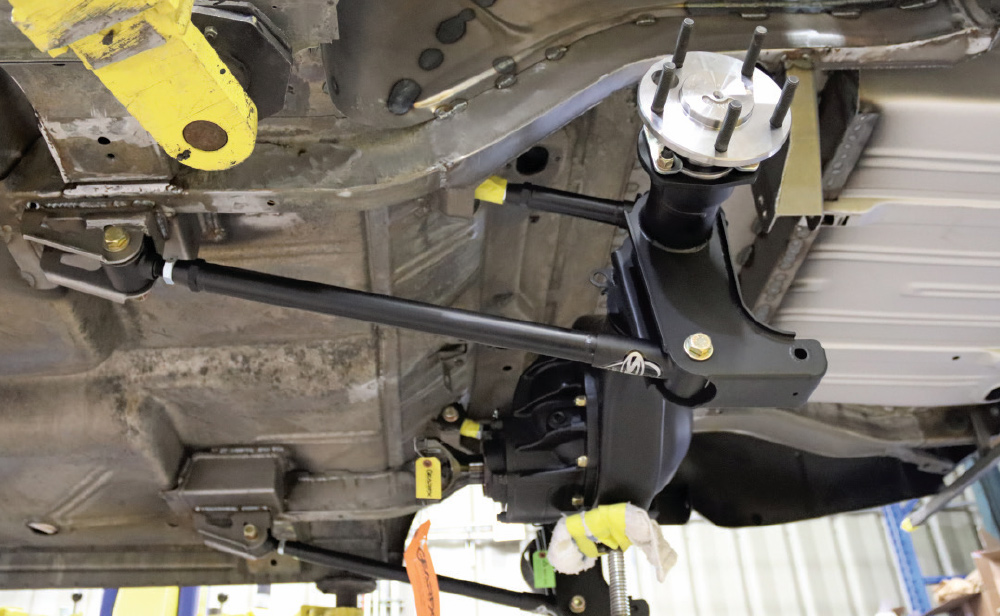
15. The threaded ends on the links allow for pinion angle adjustment and fine-tuning the wheelbase.
3-link or 4-link coilover system designed to replace traditional leaf springs
16. All the DSE links are powdercoated black. To provide additional tire clearance the lower links are set inboard.
automotive 4-link rear suspension system being installed
17. Here, Williams jacks up the rear axle to install the DSE coilovers. And yes, the shock bodies do go at the top.
a car coilover shock absorber system
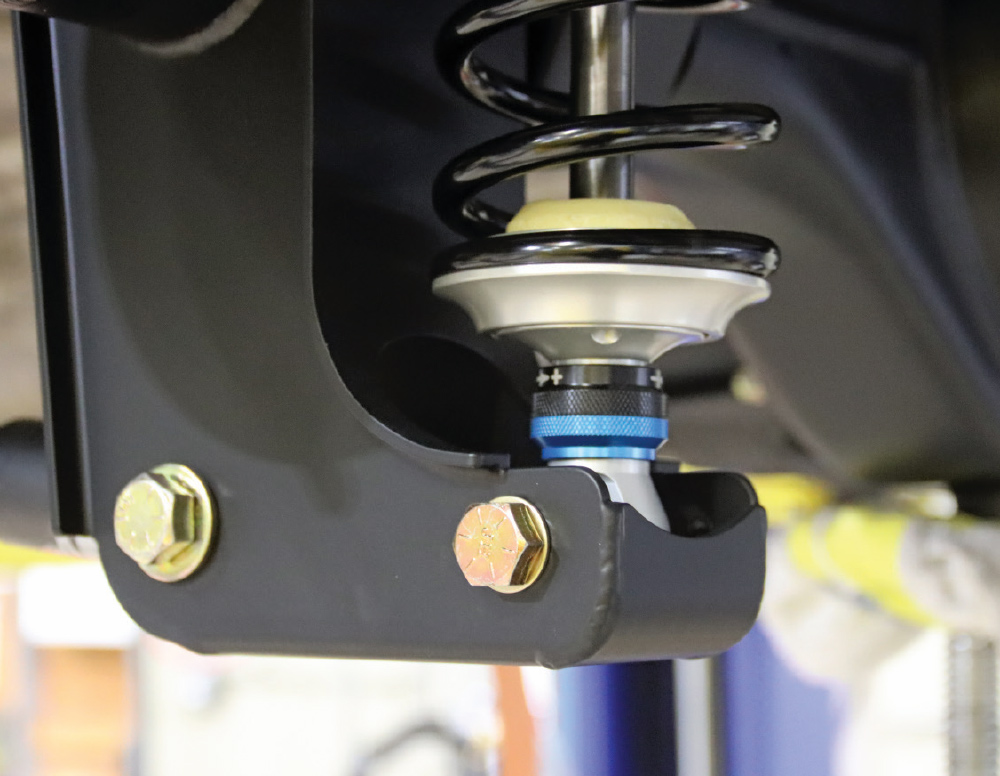
18. The bottom of the coilovers mount to the lower link bracket on the axle housing. The shock’s rebound is controlled by the knob at the lower shock mount. The knob rotates clockwise to increase the damping and counterclockwise to decrease.
an aftermarket 4-link rear suspension system with coilover shocks
19. Williams attached the track bar to the bracket on the left side of the chassis. The mounting point is adjustable to compensate for ride height changes and roll center control.
rear suspension and axle assembly
20. DSE’s aluminum body shocks come with 175-lb/in springs. When mini-tubs are installed, a Holley narrow fuel tank (PN 080184DS) is required.
automotive sway bar, designed to reduce body roll and improve vehicle handling
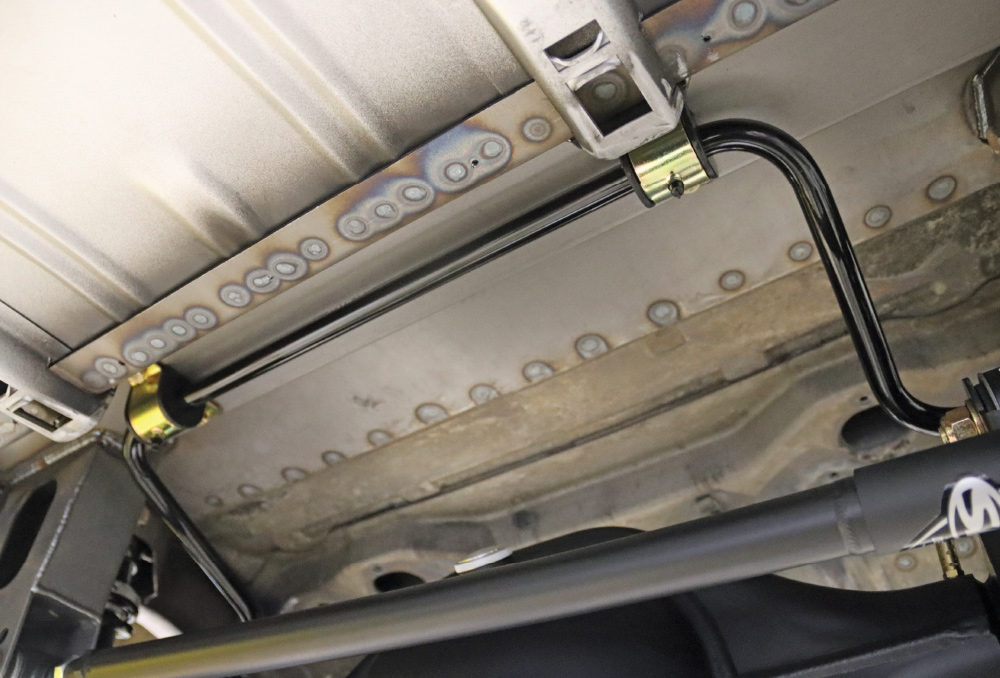
21. The final component to be installed is the rear antiroll bar. While the MetalWorks’ crew makes everything look easy, DSE cautions that all work should be performed by a qualified welder.