

 FEATURE
 Images by JASON MATTHEW
orman Watson grew up in a household where cars were a big part of life due to his dad being in the used car business back in the late-1960s and 1970s. He informed us that over 100 cars cycled through the Watson driveway during those years. Sunday drives were a family tradition and never boring due to the variety of cars taking part in the exercise. But through that diverse assortment it was the 1969 Camaro that burned deeper into Norman’s memory than the rest.

Then, like lots of loves, it ended badly. The car was wrecked, and the money to fix it wasn’t there. Norman sold it for $600—a number that still stings decades later. “I didn’t like the green interior back then,” he laughs. “Now I realize how cool it actually was.”

Roughly 25 years ago, it was Norman’s brother who stumbled across another ’69 Camaro. This one was buried deep inside a garage in Lowell, Massachusetts. It was an abandoned father-and-son project, partially disassembled and left to quietly age unattended. Norman’s brother, who owned a landscaping business, knew exactly what the car would mean. He made a deal with the owner to trade some landscaping work in exchange for the Camaro. The owner agreed, and the car was heading to a new home and fresh lease on life.
The Camaro was rescued but sat in storage in New Hampshire for the next 21 years. During that time, Norman’s brother died, and the car’s meaning shifted. It was no longer just another project or nod to his youth—it became a connection. A responsibility and a reminder. “That’s what really pushed me to finally move forward with it,” Norman says. “I didn’t want it to just sit forever.”

That search led Norman to Jeff Buchak and the crew at Paradigm Automotive Restoration in Closter, New Jersey.
Feeding off of Norman’s ideas, Paradigm went into the build with a clear philosophy: honor the car’s late-’60s identity while quietly improving everything underneath. No gimmicks or trendy concoctions. Just a Camaro built the way it should have been if 1969 had a little more time and better hardware.
At the heart of the build is a 383ci small-block, assembled by Paradigm with machinework handled by Charlie at Olsen Engines, in Nyack, New York. It’s a traditional combination done right—4.030-inch bore, 3.75-inch stroke, and 10.5:1 compression. A Comp camshaft gives it attitude without ruining street manners, while ported stock cylinder heads keep the visual footprint honest.
Fuel and air come through an Edelbrock Air Gap intake topped with an Edelbrock Endurashine 650-cfm carburetor, while exhaust exits through Hooker factory-style manifolds feeding a custom 2.5-inch exhaust system tamed with Flowmaster mufflers. It’s internally subtle yet authoritative enough to remind you it’s there. The engine is dressed with modified stock valve covers, slightly taller than factory, and topped with a factory-style air cleaner.

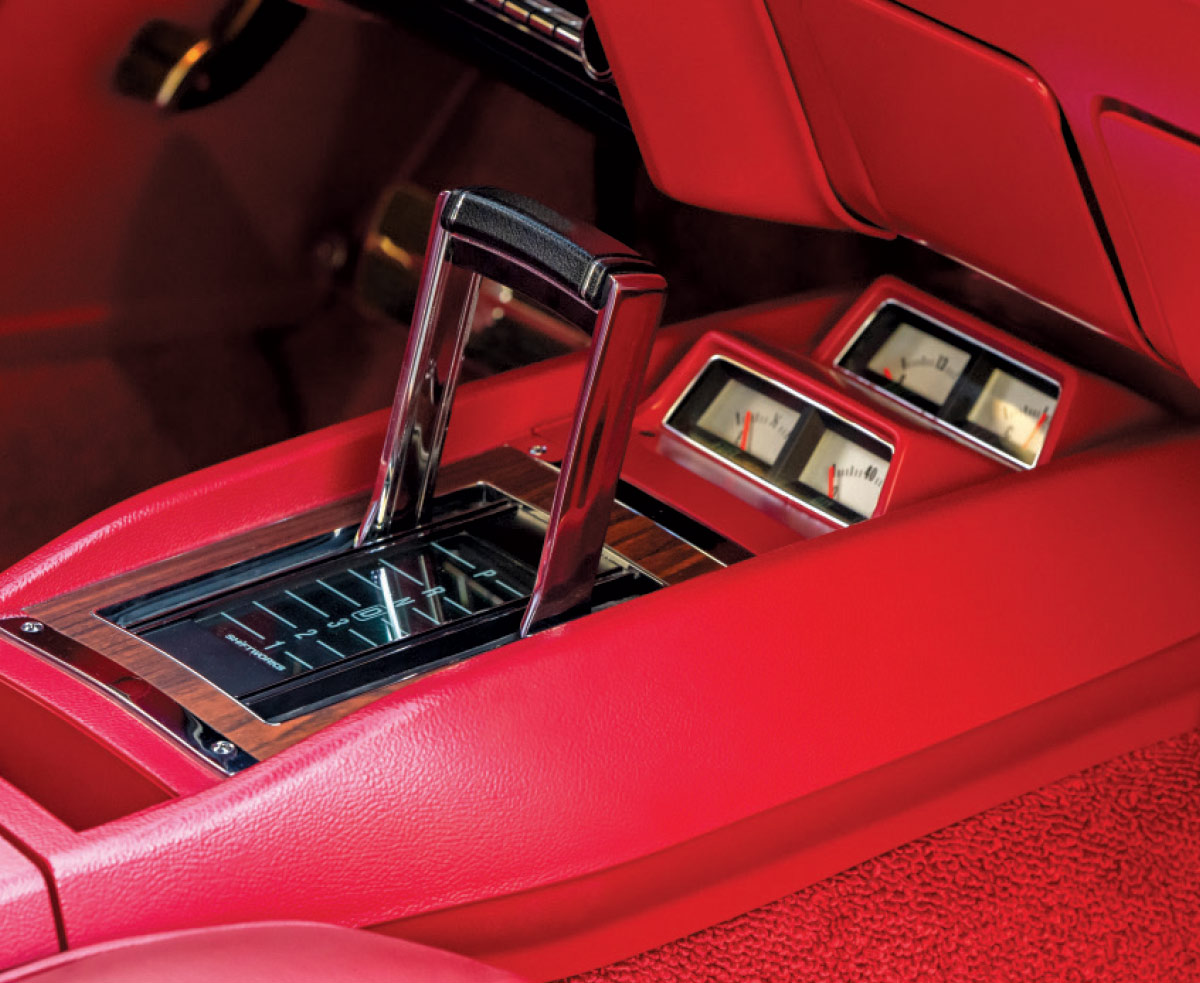

Backing the small-block is a TCI-built 700-R4 automatic with a 2,500-stall converter, shifted through a classic horseshoe handle that feels exactly right in a 1969 Camaro. Power is sent down a driveshaft from Driveline Service in New Jersey into a GM 12-bolt rear housing, Yukon 3.73 gears, and Truetrac limited-slip.
The chassis received similar treatment. Up front, Ridetech tubular control arms, coilovers, and 2-inch drop spindles modernize the suspension geometry, while a Borgeson quick-ratio steering box tightens everything up. Out back, Detroit Speed & Engineering narrowed leaf springs and Ridetech adjustable shocks maintain the Camaro’s traditional layout while improving control.
Braking is handled by Baer hardware—11-inch rotors and four-piston calipers up front, 10-inch rotors out back activated by a Wilwood master cylinder. The ensemble is not exotic, but it’s exactly what the car needs.
Wheel choice plays a big role in the Camaro’s personality. Wheel Vintiques 17-inch steelies—9 inches wide up front, and massive 12 inches in the rear keep the look rooted in muscle car tradition. Michelin Pilot Sports fill the arches with modest 235s up front and steamroller-like 335s out back.

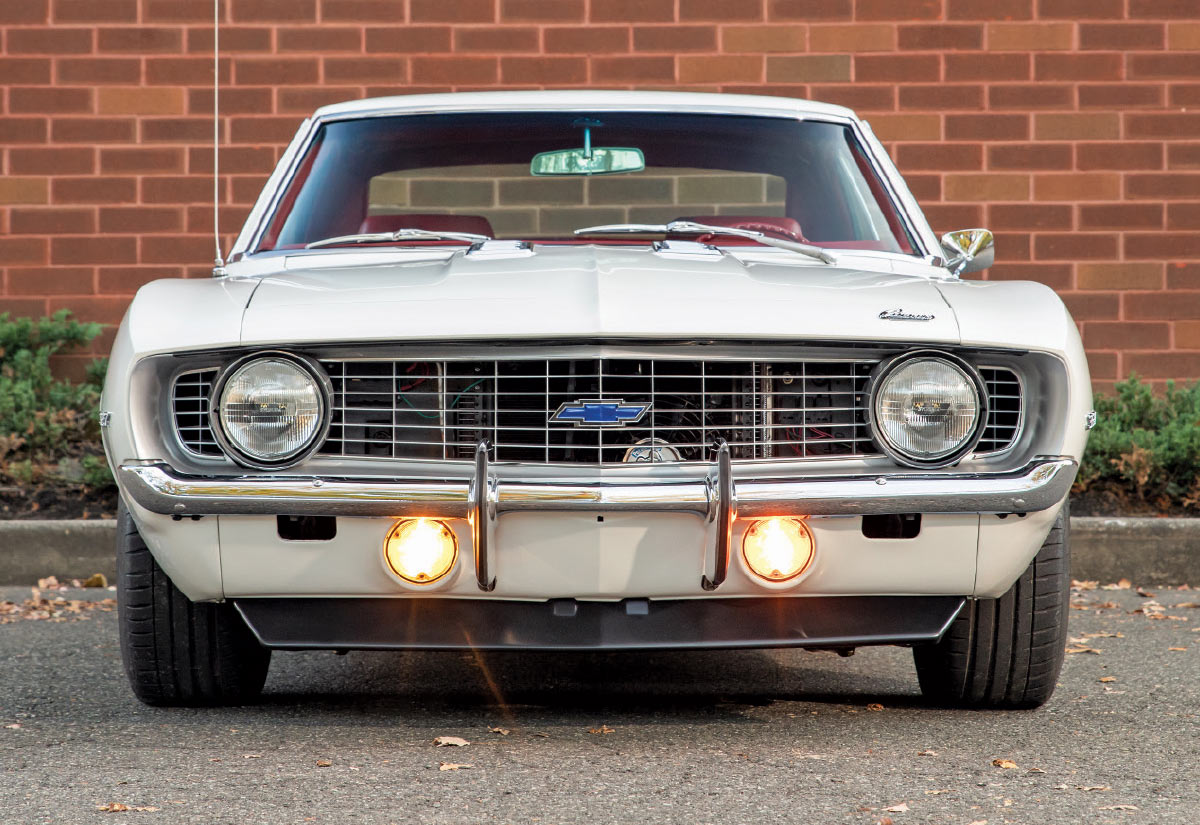
Paradigm sprayed the shell in PPG Dover White with a level of care that sharpens every body line without erasing the Camaro’s factory personality. The grille, bumpers, and lighting remain stock, while panel gaps and one-piece fender extensions clean up the visual flow.
Looking back, Norman admits the project wasn’t the easiest path. “If I were doing it again, starting with a car in better condition would have made more sense,” he says. “But this one meant more.”
Every time the small-block fires, it reconnects Norman to his brother, and to that white Camaro with the green interior he lost years ago. This one doesn’t replace it. Yes, the lines are straighter. The ride is better. The power is stronger. But the feeling—the reason it all mattered—hasn’t changed at all.


Vehicle: 1969 Camaro
Type: Small-block
Displacement: 383 ci
Compression Ratio: 10.5:1
Bore: 4.030
Stroke: 3.75
Builder: Paradigm Auto Restoraton (Closter, NJ)
Machine Work: Charlie at Olsen Engines (Nyack, NY)
Camshaft: Comp
Cylinder Heads: Ported stock
Induction: Edelbrock Air Gap intake, Edelbrock Endurashine 650-cfm carburetor
Exhaust: Hooker stock-appearing manifold, custom 2.5-inch exhaust, Flowmaster Hushpower mufflers
Air Cleaner: Factory style
Valve Covers: Modified stock (3/4-inch taller)
Accessory Drive: Vintage Air Front Runner
Ancillaries: Noble Speed Equipment spark plug wires, Champion aluminum radiator, Derale fan
Output: 450 hp, 485 lb-ft
Transmission: TCI 700-R4
Torque Converter: TCI 2,500 stall
Driveshaft: Driveline Service of New Jersey
Rear Axle: GM 12-bolt, Yukon 3.37 gears, Truetrac limited slip posi, stock axles
Front Suspension: Ridetech tubular control arms, Ridetech coilover shocks, 2-inch drop spindles, Borgeson quick-ratio steering box
Subframe Connectors: Ridetech
Brakes: Baer 11-inch rotors, four-piston calipers front, 10-inch rotors, single-piston calipers rear, Wilwood master cylinder
Wheels: Wheel Vintiques Steelie 17×9 front, 17×12 rear
Tires: Michelin Pilot Sport 235/45R17 front, 335/35R17 rear
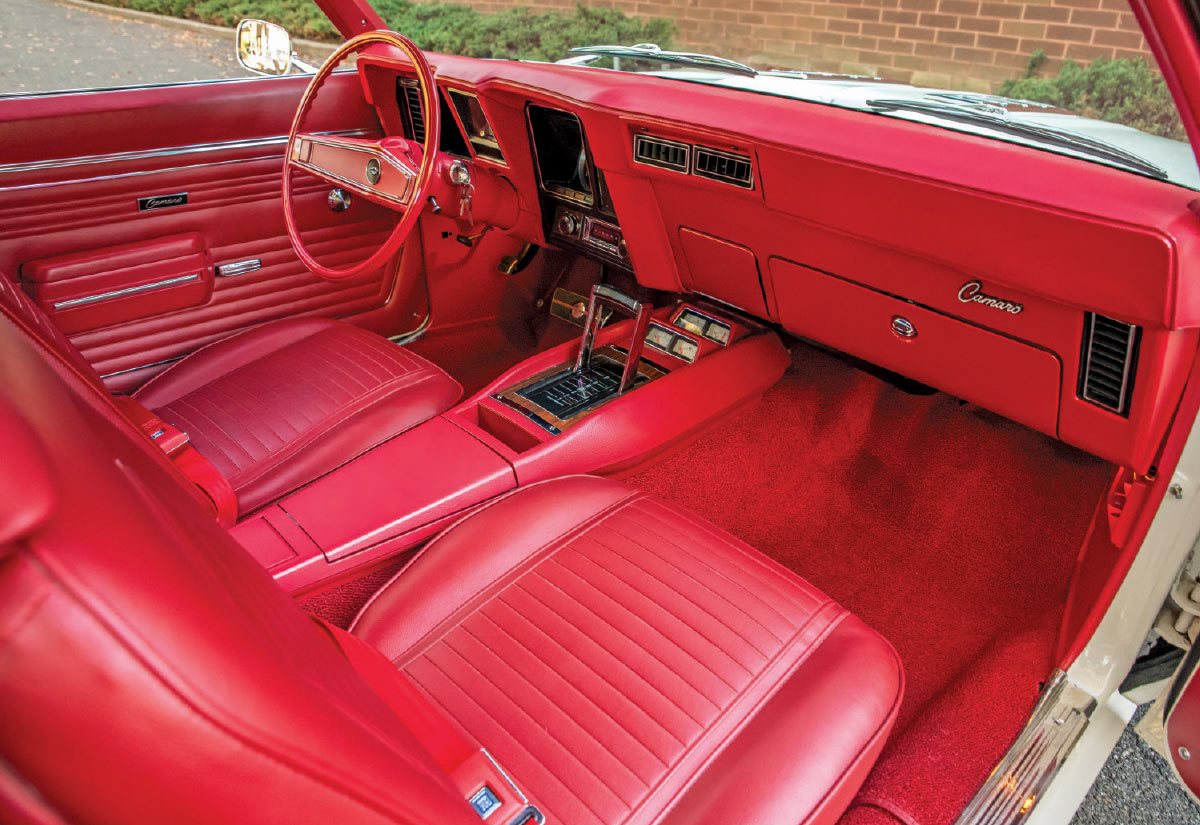
Upholstery: Red vinyl and red stock carpet
Installation: Mitch’s Kustoms (Monson, MA)
Door Panels: Stock (Heartbeat City)
Insulation: Dynamat
Seats: Stock
Seatbelts: GM
Steering: Stock column, stock steering wheel
Shifter: Horseshoe
Dash: Stock from Heartbeat City
Instrumentation: Stock
Wiring: American Autowire
HVAC: Restomod Air
Control Panel: Restomod Air
Entertainment System: Custom Autosound head unit, Kicker speakers by Paradigm Auto Restoration
Bodywork and Paint: Paradigm Auto Restoration
Paint: PPG Dover White
Grille: Stock
Bumpers: Stock
Illumination: Stock
Body Mods: Gapped and body lines sharpened, one-piece fender extensions