

 FEATURE
 IMAGES BY LUKE MUNNELL
ome owners take their projects down to the bare bones in one fell swoop while others allow their projects to evolve over time, changing personalities with every new engine, suspension upgrade, and late-night wrenching sessions. Such was the case with Jarred Connor’s blown 1966 Chevy Nova that took a mere 26 years to get where it is today.
Calling it a 26-year build sounds a bit misleading as the car has rarely stood still. It’s been a constant work in progress, serving as a father-and-son project, a weekend race car, street cruiser, a testbed for increasingly wild combinations, and finally, the blown big-block bruiser you see here. Every version was enjoyed before the next, making the journey every bit as rewarding as the destination.


Powered by a mild 350ci small-block Chevy backed by a TH350 equipped with a manual valvebody, the Nova still wore its original paint and matching interior. It wasn’t perfect but it was a solid driver begging for more horsepower.
It quickly became a fixture at local cruises and Thursday night trips to Irwindale Raceway’s eighth-mile strip where Jarred and Wayne spent countless evenings seeing what the little Chevy could do.
“It was a fun car to drive,” Jarred remembers. “After a few years we decided to tear it apart and build it as my high school daily driver.”
Then reality entered the conversation.
Wayne remembered his teenage son had already been caught doing celebratory burnouts in the family driveway while his parents were away. Unfortunately, for Jarred, the neighbors weren’t entertained by the smoke fest and volunteered that information.
After some thought, Wayne decided handing a powerful muscle car to a 16-year-old with a proven burnout addiction probably was not a great parenting decision. The Nova quietly rolled into the garage where it sat for a few years.
“Enough” horsepower became, “what if?” That answer arrived in the form of a centrifugal supercharger; unfortunately, so did catastrophic failure.
The boosted 383 ventilated the block with enough enthusiasm to convince everyone it was time for something more serious.
A Paul Gricher Racing Engines 565ci big-block making roughly 800 hp found its way between the fenders, giving the Nova a totally different personality. It remained in the car for several years before Jarred decided to go in a different direction.
“I’ve always wanted a car with a roots blower,” he says. “But I also wanted something I could actually drive.
Mission accomplished.
The engine in it now starts with a Dart tall-deck block assembled by Teague Custom Marine in Valencia, California. Inside spins a Bryant Racing crankshaft connected to Carrillo rods and CP pistons, creating 565 ci with a 9.5:1 compression ratio designed to consume E85.
A custom-ground Teague camshaft works with Dart aluminum cylinder heads while a Blower Shop tall-deck intake supports twin Holley Dominator 1,050-cfm carburetors. Towering above everything is the centerpiece of the entire build: a Littlefield 14-71 supercharger.
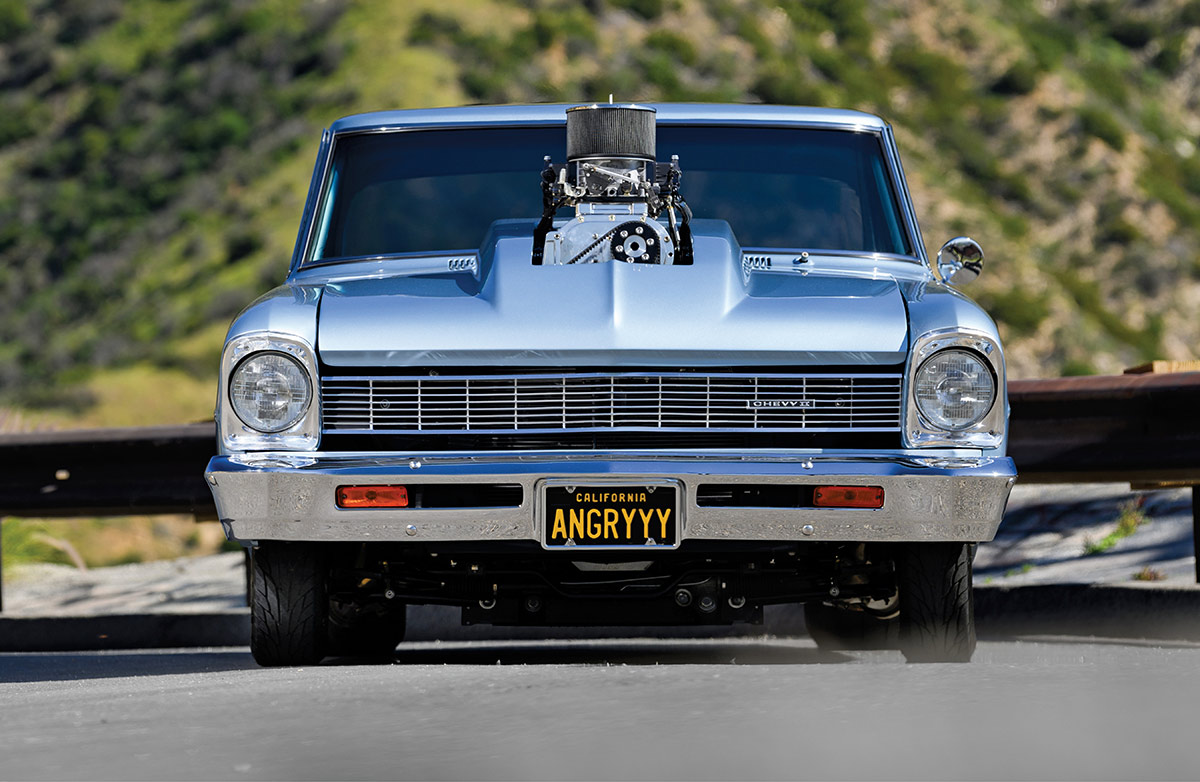
Dyno numbers check in at 1,135 hp and 1,038 lb-ft of torque.
Despite the potent output, Jarred has accumulated roughly 5,000 street miles with the combination.
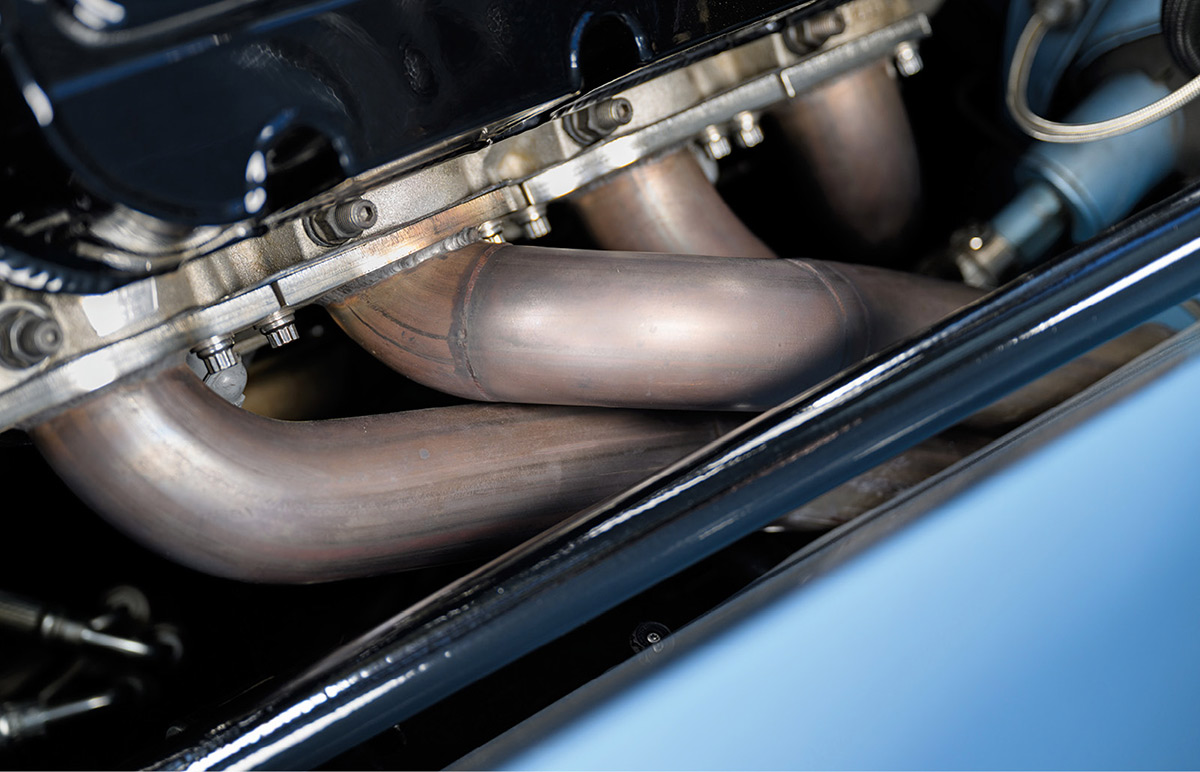
Custom stainless headers feed a full 4-inch exhaust built by LPRacing in Chino, California, before the gases exit through a pair of SpinTech 9000 Super Pro Street mufflers. It’s not exactly subtle, but neither is a polished 14-71 poking through the hood.
All that power travels through a Hughes Performance–built 4L80E transmission paired with a 2,600-rpm stall converter before reaching a Currie 9-inch loaded with 4.11 gears and 31-spline axles.
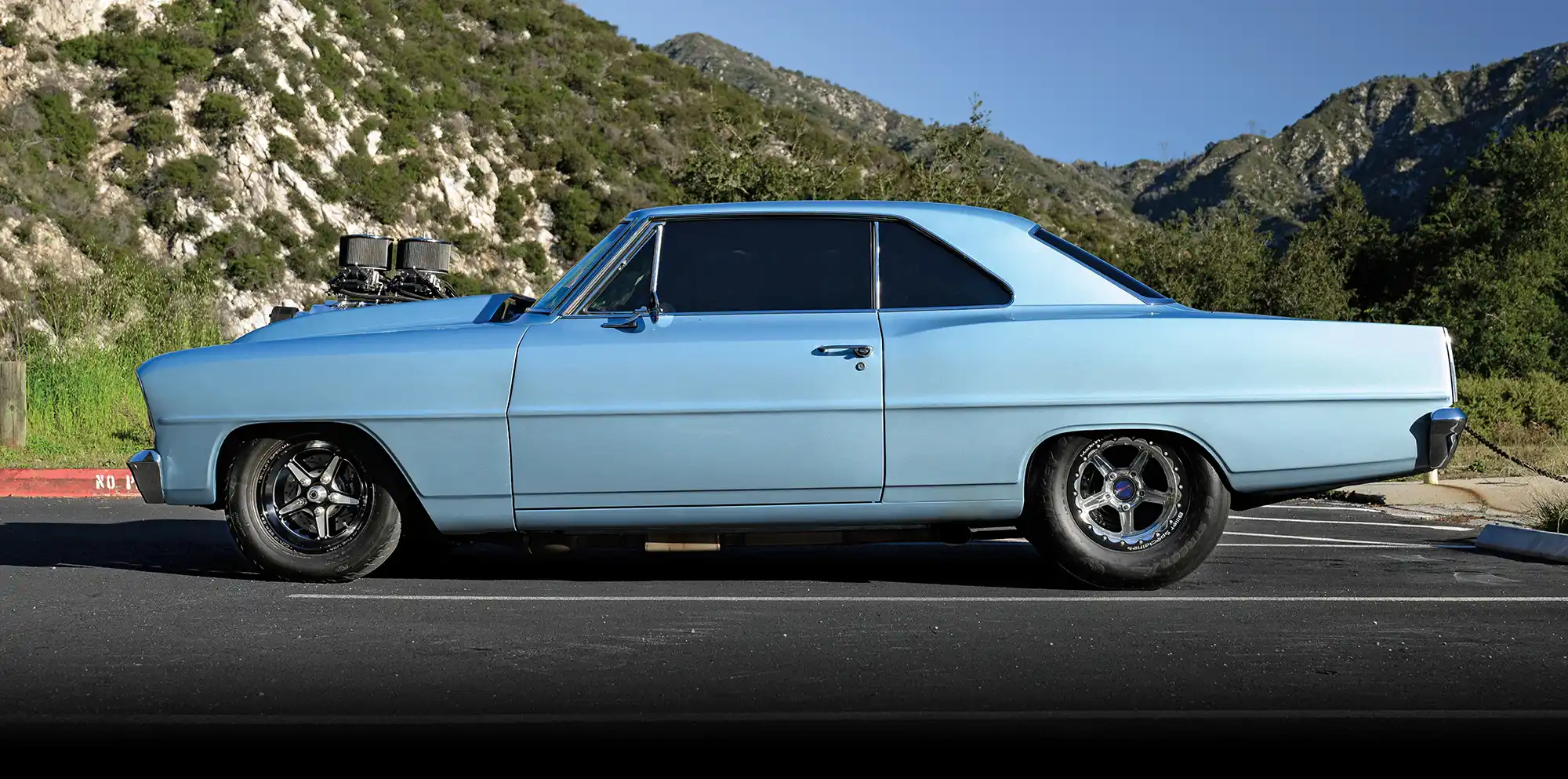
Knowing the factory Nova chassis was never intended to handle four-digit horsepower, the car underwent a comprehensive chassis makeover. Mark Eddy of Eddy’s Rod Shop handled much of the heavy fabrication, reworking the firewall, enlarging the transmission tunnel, and installing the driveline components. A TCI Mustang II front clip, Ridetech coilovers, and TCI subframe connectors modernize the front suspension and stiffen the unibody, while a TCI four-link locates a Currie 9-inch housing that plants the massive rear Mickey Thompson rubber with authority.

Dane Fetherolf of D1 Performance took on the fuel and electrical system, ensuring the car gets plenty of swill and enough spark to keep everything in proper running order.
Still in its original patina-covered skin and somewhat dilapidated interior, Jarred realized the car wasn’t going to take home any best-in-show awards. Not having to worry about chips and scratches were attractive attributes, but while attending the Goodguys car show in Del Mar, California, they decided it was time to give the Nova a makeover inside and out to give it the proper appearance it deserved.
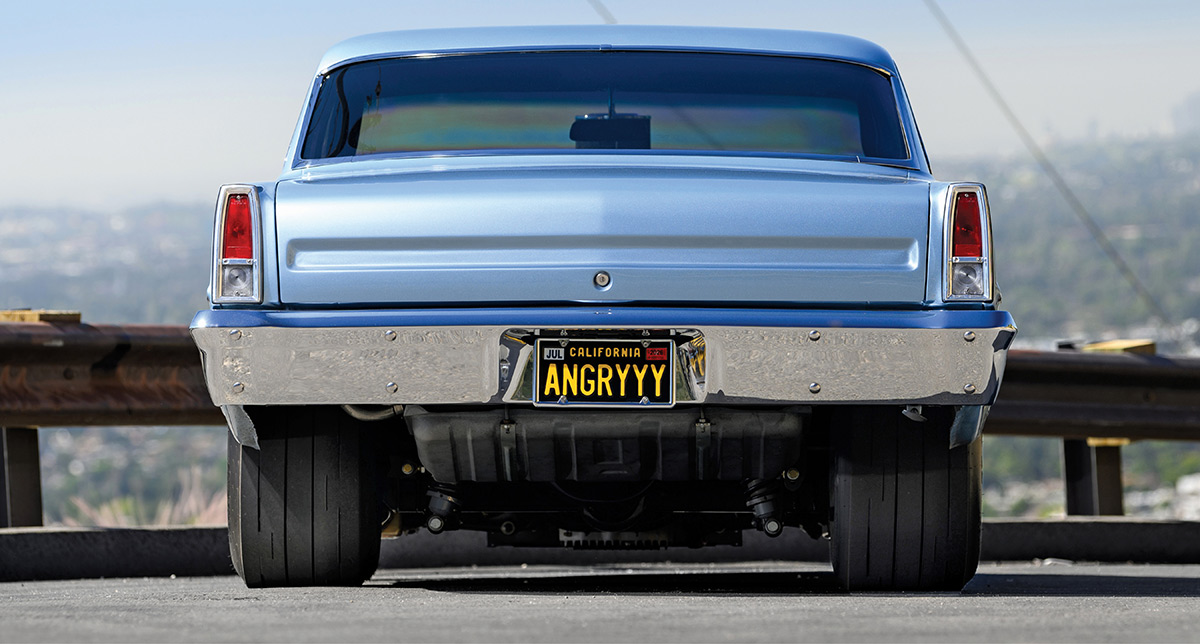
In 2019 the Chevy headed to Joe’s Autobody in Temple City, California, where the body was carefully smoothed and gapped before receiving a fresh layer of PPG Mist Blue Metallic. Along the way the antenna hole disappeared, the deck molding was shaved, the fuel door and badges were eliminated, creating a cleaner, more contemporary profile without losing the Nova’s unmistakable identity.


For climate control, Jarred kept it old school: windows down, windwings open.
Looking back over 26 years, Jarred doesn’t dwell on horsepower numbers, paint quality, or any single version of the Nova. Instead, he remembers weekends spent in the garage with his dad and close friend Joseph Eddy, solving problems one bolt at a time and watching the car evolve through each new chapter. “The Nova has been an absolute joy to drive,” Jarred says. “The attention it gets at car shows and cruises makes all the work worthwhile. But the best part of this journey has been building it alongside my dad and creating memories I’ll always cherish. The Nova now produces more than 1,100 hp, but the real power comes from the people behind the build, standing around it with greasy hands, trading ideas, turning wrenches, and creating memories that will outlast any engine combination.”

VEHICLE: 1966 Chevy Nova
TYPE: Dart Chevy tall deck
DISPLACEMENT: 565 ci
COMPRESSION RATIO: 9.5:1
STROKE: 4.375 inches
MACHINE WORK AND BUILDER: Teague Custom Marine
ROTATING ASSEMBLY: Bryant Racing crankshaft, Carillo rods, CP pistons
CAMSHAFT: Teague custom grind
CYLINDER HEADS: Dart CNC aluminum
INDUCTION: Blower Shop tall-deck intake, two Holley Dominator 1,050-cfm carburetors built by PC Carbs
POWER ADDER: Littlefield 14-71 supercharger
EXHAUST: Custom stainless headers, stainless 4-inch exhaust by LPRacing (Chino, CA), SpinTech 9000 Super Pro Street mufflers
VALVE COVERS: Custom-fabricated aluminum
AIR CLEANERS: K&N
ACCESSORY DRIVE: CVF V-belt pulley system
HOOD HINGES: Eddie Motorsports
ANCILLARIES: Meziere water pump, Mattson’s Custom Radiator aluminum, 8mm MSD wires, Aeromotive 20-gallon fuel cell with integrated in-tank fuel pump combined with 16-gallon stock tank, ProForm ECM fans
OUTPUT: 1,135 hp at 6,500 rpm, 1,038 lb-ft at 4,800 rpm
TRANSMISSION: GM 4L80E by Hughes Performance
TORQUE CONVERTER: Hughes 2,600 stall
REAR AXLE: Currie 9-inch, 4.11 gears, 31-spline axles
FRONT SUSPENSION: TCI Mustang II front clip, Ridetech coilover shocks
REAR SUSPENSION: TCI four-link, Ridetech coilover shocks
SUBFRAME CONNECTORS: TCI
BRAKES: Wilwood 10.5-inch rotors, two-piston calipers front, factory GM drums rear, ABS master cylinder
WHEELS: Billet Specialties Street Lite 15×4 front, 15×10 rear
TIRES: Mickey Thompson 26×6 R15 front, 28×12.5 R15 rear
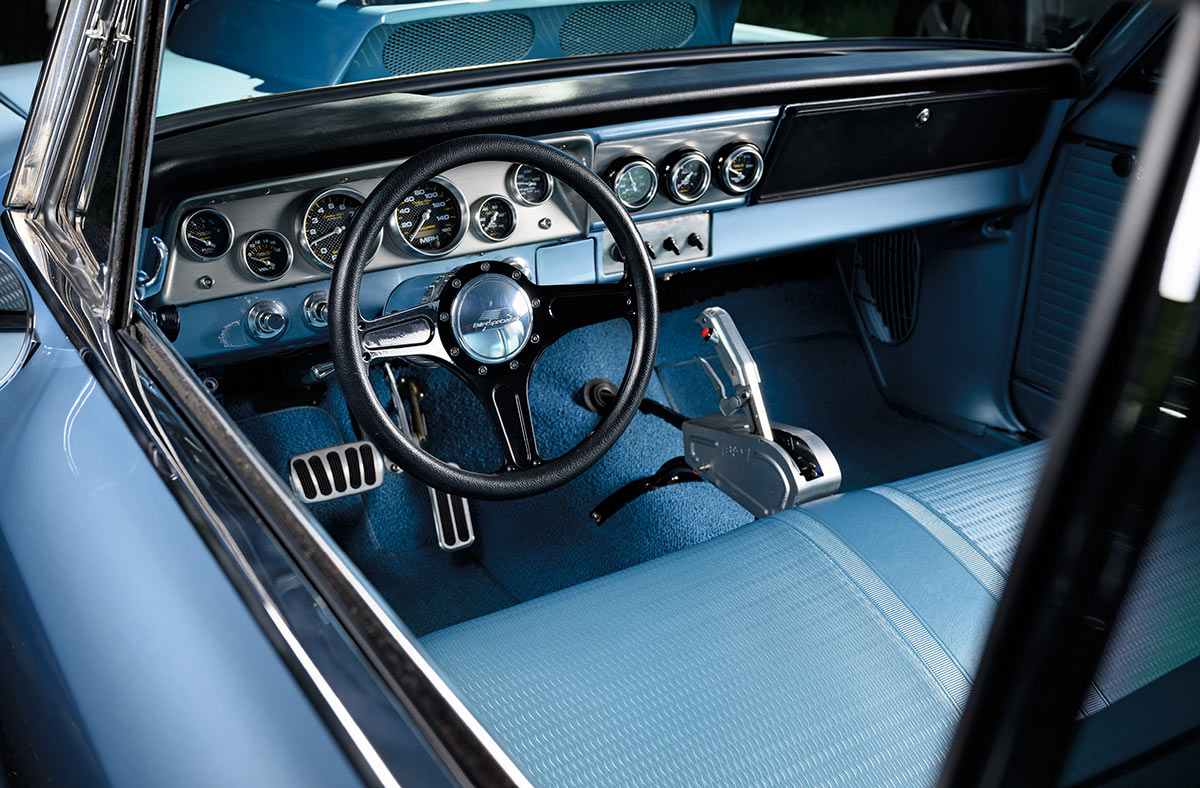
UPHOLSTERY: Classic Industries OE-style by owner
CARPET: Blue loop
SEATS: Stock bench
STEERING: Flaming River column, Billet Specialties steering wheel
SHIFTER: B&M
DASH: Stock
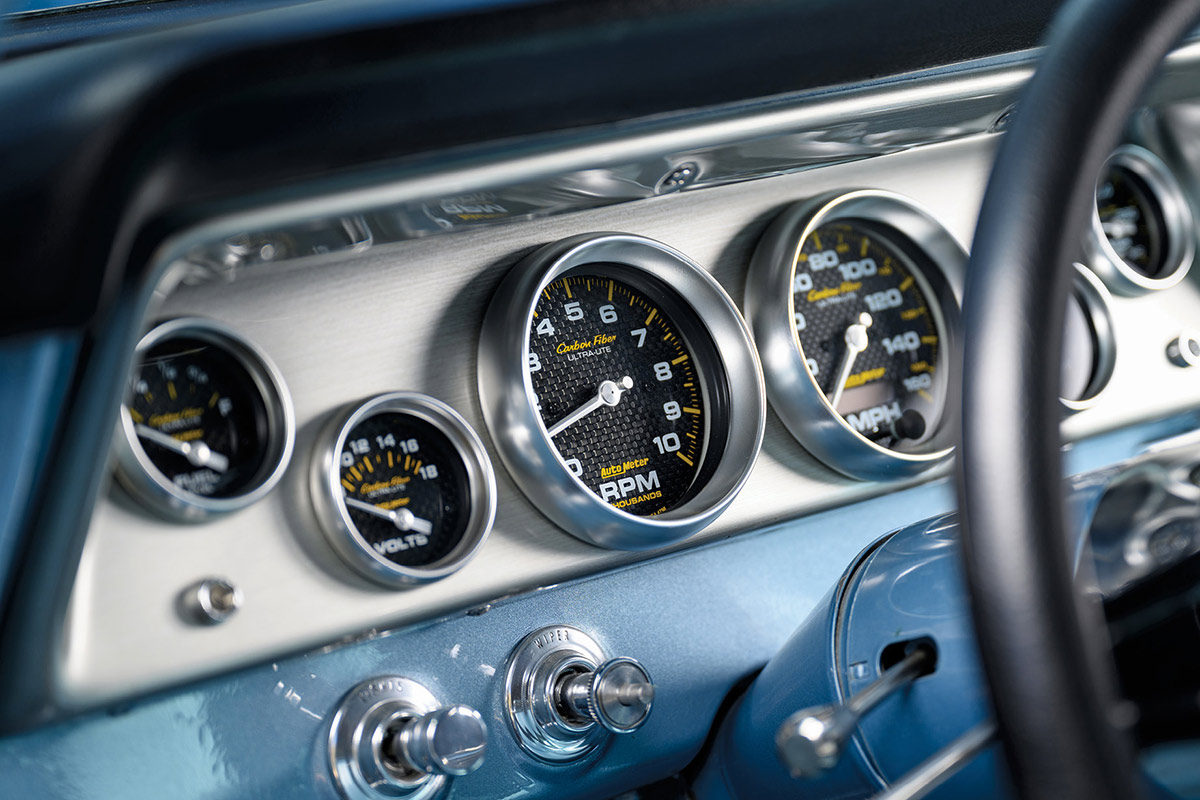
INSTRUMENTATION: Auto Meter Carbon Fiber Series
WIRING: American Autowire
HVAC: Windows down, windwings open
ENTERTAINMENT SYSTEM: Nope
BODYWORK AND PAINT: Joe’s Autobody (Temple City, CA)
PAINT: PPG Mist Blue Metallic
HOOD: Harwood fiberglass
GRILLE: Stock
BUMPERS: Stock
HEADLIGHTS: Stock
TAILLIGHTS: Stock
BODY MODS: Filled antenna hole, filled in deck molding, deleted badges, filled gas door