






On The First Try

Contouring & Tucking

Preview Issue





 TOC
TOC
Cover image by NotStock Photography







“Rotten” Rodney Bauman, Jefferson Bryant, Tommy Lee Byrd, Ron Ceridono, Ron Covell, Grant Cox, Fuelish Media, John Gilbert, Tavis Highlander, Jeff Huneycutt, Barry Kluczyk, Scotty Lachenauer, Patrick Lauder, Jason Lubken, John Machaqueiro, Ryan Manson, Jason Matthew, Josh Mishler, NotStock Photography, Todd Ryden, Jason Scudellari, Jeff Smith & Chuck Vranas – Writers and Photographers
Travis Weeks Advertising Sales Manager
Patrick Walsh Sales Representative
ads@inthegaragemedia.com
AllChevyPerformance.com
ClassicTruckPerformance.com
ModernRodding.com
InTheGarageMedia.com
inthegaragemedia.com “Online Store”
For bulk back issues of 10 copies or more, contact store@inthegaragemedia.com
info@inthegaragemedia.com
Editorial contributions are welcomed but editors recommend that contributors query first. Contribution inquiries should first be emailed to info@inthegaragemedia.com. Do not mail via USPS as we assume no responsibility for loss or damage thereto. IN THE GARAGE MEDIA, INC. reserves the right to use material at its discretion, and we reserve the right to edit material to meet our requirements. Upon publication, payment will be made at our current rate, and that said, payment will cover author’s and contributor’s rights of the contribution. Contributors’ act of emailing contribution shall constitute and express warranty that material is original and no infringement on the rights of others.

Copyright (c) 2026 IN THE GARAGE MEDIA, INC.
PRINTED IN U.S.A.


 firing up
 BY NICK LICATA
ack on August 1, 1981, at 12:01 a.m. Eastern Time, MTV debuted in the United States, launching with the now-iconic “Video Killed the Radio Star” by the Buggles. To be fair, video never did kill the radio star, but it did introduce a powerful platform that pushed rock and new wave acts to focus more deliberately on image and eventually video production. That worked great for some acts while not so much for those artists who lacked the personality or image geared toward MTV’s younger demographic. Unfortunately, or fortunately, depending how you look at it, hardly anyone noticed when MTV shape shifted to whatever it is now on December 31, 2025. To most Gen Xers, the demise of MTV actually came years ago with the arrival of YouTube and similar Online outlets, which allowed users to watch their favorite videos whenever they wanted. I guess you could say YouTube killed the music video channel.
In a similar vein, technology has quietly highjacked one of my favorite in-dash audio platforms, but before I get into that, let me offer a little history on automotive listening devices. When it came to bringing along our favorite tunes in cars, Chrysler introduced the Highway Hi-Fi system as a factory option in select 1965 models. Built by CBS and RCA, it played special 7-inch vinyl records mounted under the dash. The tonearm was spring-loaded and designed to withstand bumpy rides without sending the needle screeching off the record. Temperamental in nature, it vanished by 1959.
A more practical 4-track in-car tape player was introduced a few years later. By the mid-1960s the 8-track tape player came along. It was somewhat clunky and the tapes eventually wore out, but it was considered revolutionary for the time.

 PARTS BIN







 CHEVY CONCEPTS
InTheGarageMedia.com


 Text & Rendering by Tavis Highlander
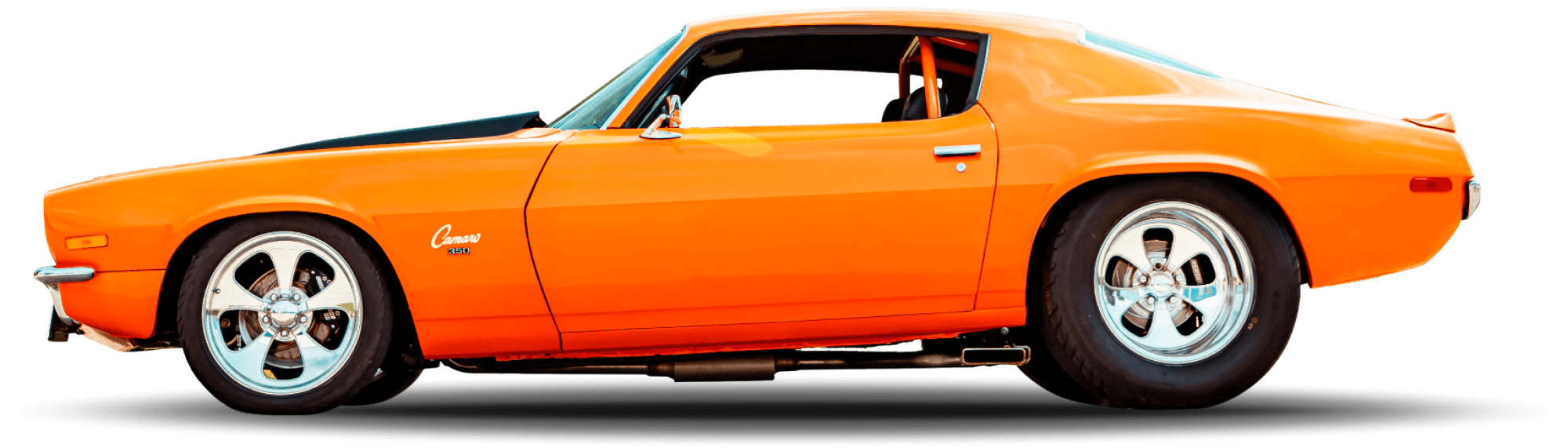
his DSE-built 1969 Camaro packs lots of refinement into an understated package. Modern touches like flush-mounted glass, Dapper Lighting LED projectors, and a Munssey Evolution hood add a high-tech edge. Tucked bumpers and charcoal-centered Forgeline GA3 wheels maintain a slick yet aggressive appearance.
Underhood, a Wegner Supercharged LS3 topped by a massive Whipple Blower sits nestled amongst the modified sheetmetal. Engineered for a clean look, the engine bay features a custom-routed intake tucked into the fender, customized Wegner valve covers, and an Anvil Auto firewall.
 FEATURE
 Images by NotStock Photography
elly Clark has spent most of his life fixing what breaks. As a journeyman plumber by trade, about six years ago he shifted gears and became owner of a small dump truck operation in Rocky Mount, Missouri. He’s good with his hands but has no formal training when it comes to building cars, but that didn’t stop him from taking on this 1955 Chevy 210 from the ground up. The car was literally in pieces when he started on the seven-year endeavor, and he basically learned what he needed to along the way.
Kelly did not go to trade school for hot rodding. He never apprenticed under a master builder. What he had instead was curiosity, stubbornness, and family history welded to a Tri-Five Chevy. His uncle owned a body shop when Kelly was growing up, and there were always cool cars around. That early exposure led to Kelly’s first real job in the same shop where he learned the skills associated with bodywork and became quite proficient at the craft. But a full, ground-up build? That was something else entirely, and it would take a very special car to make him try: The same car his parents drove on their wedding day.

 TECH
TECH

 Images by The Author
etting up the heartbeat for any project leaves you an endless possibility of performance options, starting with your chosen power nailed to the chassis. Should you go old school with a hopped-up small-block, heavy-breathing big-block, or a more modern LS? If you’re looking for a vintage vibe with a modern twist, there are plenty of options to bring that cutting-edge modern engine a nod to the past that’ll have viewers scratching their heads when sneaking a peek under the hood of your classic Chevy.
On a recent visit to Chris Cerce Customs in Taunton, Massachusetts, we met with shop owner, Chris Cerce, who had just taken delivery of a fresh Chevrolet Performance 430hp LS3 long-block packed with a speed shop full of factory go-fast goods. Deep inside a cast-aluminum block with six-bolt, cross-bolted main caps, you’ll find a nodular iron crank linked to powdered metal rods wearing hypereutectic aluminum pistons generating a solid 10.7:1 compression. A hydraulic roller cam sets the beat while a set of cast-aluminum rectangle port heads with 68cc chambers generates plenty of power. To get the updates rolling, an Ultra Low Profile FiTech Plus LS Swap Oil Pan replaced the factory unit. This updated the system to a 6.10-quart capacity with high-quality, cast-aluminum unit construction, complete with sump baffle, pickup tube, sump plug, oil filter stud, and oil passage cover.


 FEATURE Images by The Author
G-Body Chevy With a Big-Block Punch
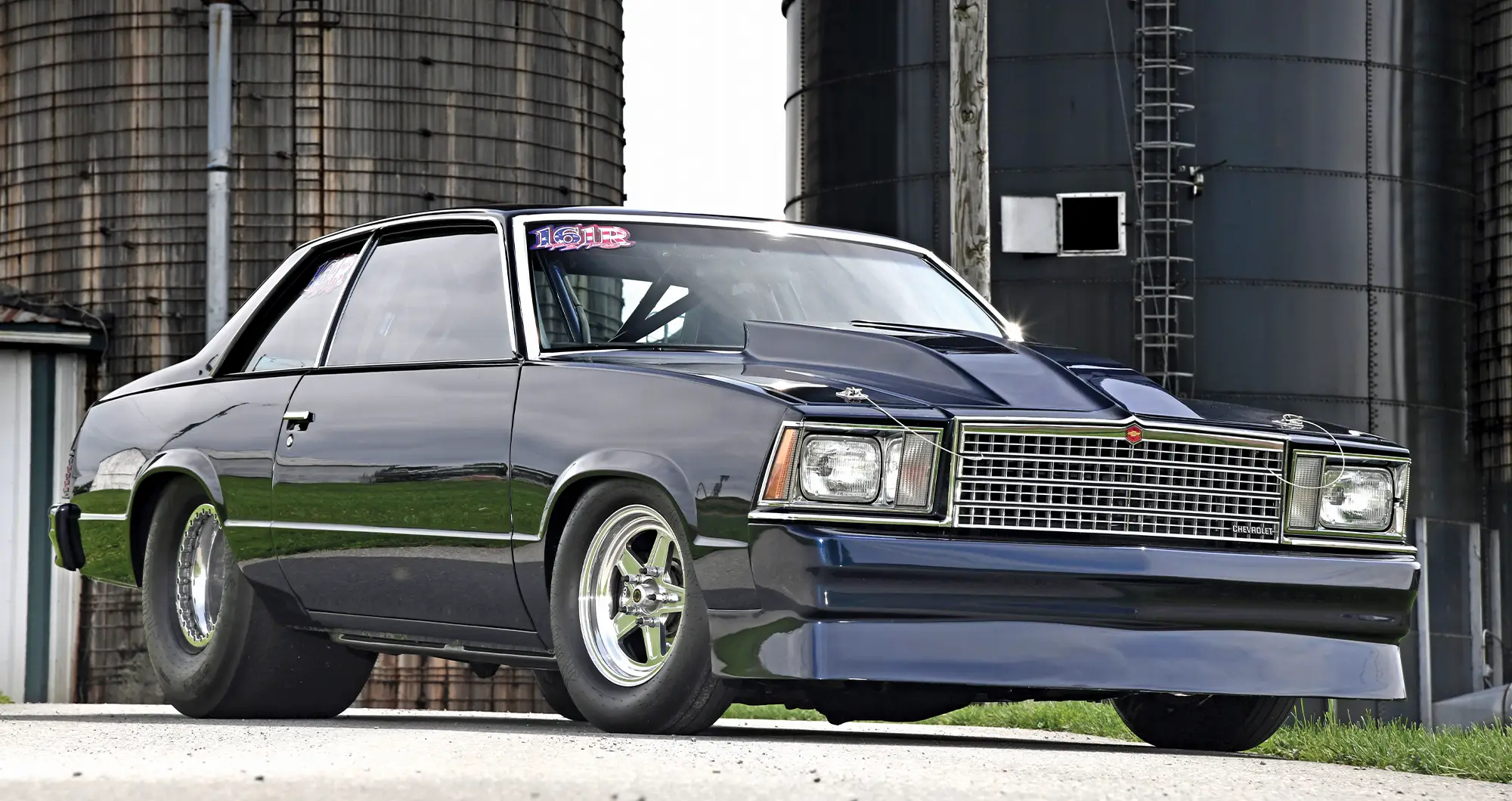
on Edwards’ earliest motorhead-infused memories go back to his youth when his father piloted a modified 1956 Chevy around their neighborhood. “My dad and both of my uncles had Chevys, so I was surrounded by them.” Ron fondly remembers. “So, when I started driving, all I ever owned were Bowties. They were always more cost-friendly to make horsepower.”
Following his love for speed, power, and its related mechanicals, Ron later became a top-tier transmission specialist, working for himself and a few high-end specialty shops on the East Coast. He’s always gotten a kick out of helping his fellow enthusiasts get the most out of their performance engines one gear at a time.
 Tech
Tech Images courtesy of Roadster Shop
he final chapter in Roadster Shop’s 1965 Corvette build focuses on a detail that can separate a good car from an exceptional one: the bumpers. While bumpers are frequently treated as bolt-on components, this project demanded far more. To achieve the tight, integrated look expected at this level, both the front and rear bumpers were extensively reshaped to sit closer to the body and follow its contours with precision.
Work began on the front bumpers, focusing on the downward-pointing strakes beneath the horizontal sections. The team decided that lengthening the strakes would allow them to tie in with the body more smoothly. The strakes were carefully cut away from the main bumper to make the rework more manageable.
To ensure consistency, a pattern was taken from an original strake to capture the factory character. That pattern was then revised to establish the new length and refined contour. Using this updated pattern, new blanks were cut from cold-rolled steel sheet. The blanks were notched along the outer edges, allowing the metal to be shaped into the required contours without introducing unwanted distortion.
 FEATURE
 Images by THE AUTHOR
llan Patterson is a legendary figure in drag racing. For decades he’s been known not just as a winning driver but as a respected and meticulous engine builder, a man whose name carries weight in pits across the country. As the founder of Patterson Elite Performance, his engines have powered countless champions but before all that, Allan was simply a Kansas kid who couldn’t stay away from the dragstrip.
It all started in 1960, when a 15-year-old Allan, still too young to legally drive, had already built himself a Flathead-powered 1940 Ford sedan. He knew the car belonged on the dragstrip, so he talked his cousin into towing it to Great Bend, Kansas, home of the first NHRA U.S. Nationals in 1955. Fifty miles from the track, the tow rig gave up, forcing Allan to unhook his pride and joy and drive it the rest of the way.
 TECH
TECH Images by Jason Scudellari
hen Ross Berlanga brought this 1971 Chevrolet El Camino home in 1992 it was by all accounts in sad shape. The engine was junk, the body was rough, and the interior was destroyed, but Ross saw the potential of this diamond in the rough. Over the years the front suspension was updated with tubular upper and lower control arms, airbags were added all around, and Ross and his uncle, Mark Berlanga, straightened the body and covered it in 1992 GM Turquoise Metallic. A fresh fuel-injected small-block was installed, followed by the next major performance enhancements: the addition of Wilwood dropped spindles and disc brakes on all four corners.
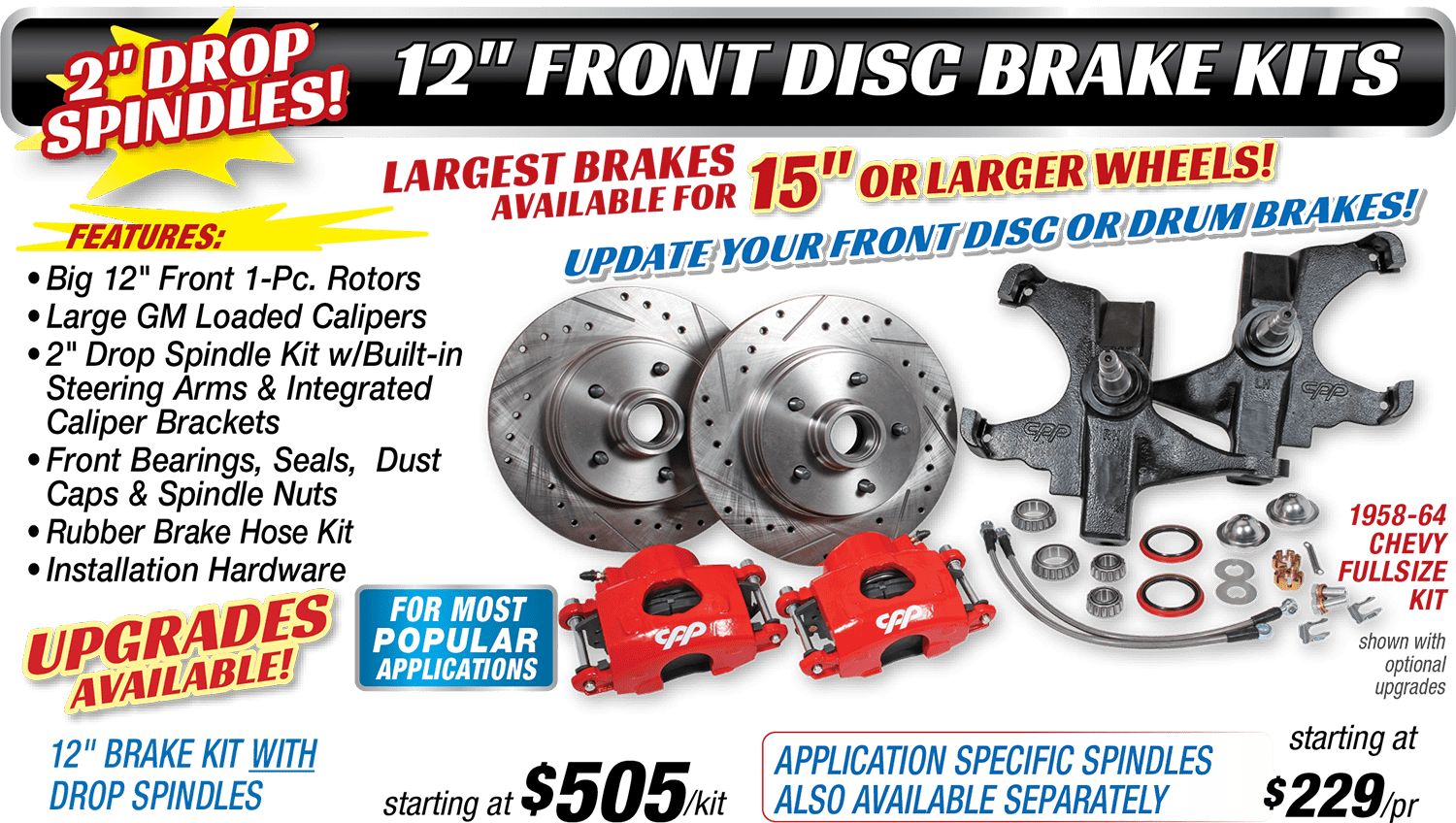
For the brake update, the El Camino was delivered to Jason Scudellari at HB Hot Rod in Huntington Beach, California. Scudellari began the transformation by installing a pair of Wilwood’s AFX Pro Spindles (PN 831-15890). These high-strength steel spindles use the original bolt-on steering arms and are specifically designed for use with Wilwood’s disc brake kits. These spindles provide a 2-inch drop-in ride height for a more aggressive stance without affecting steering geometry. In addition, they are taller than the factory spindles, which raises the roll center and decreases camber change through the suspension’s range of movement. That’s suspension speak for saying these spindles improve handling dramatically.


 FEATUREImages by The Author
f you were lucky enough to have been present for the muscle car era, you remember the car that made an impact on you. It may have been a high-winding L79 car, or it could have been an axle-snapping big-block, but one thing is for sure—you remember it. For Jim Reynolds, who his friends call “Cat,” there were some local examples that fed his gearhead appetite, but the one that means the most is the 1967 Chevelle SS396 on these pages. It’s a car that was used for daily transportation, a little bit of street racing, and it even played a role in his wedding day back in 1990 when he married his wife, Patricia. Today, the car is restored and better than ever, thanks to a few great friends who remember the car in all of its various stages.
Cat’s journey with this Chevelle began in November of 1969. He was 17 years old and hustling hard at the local grocery store, working as many hours as he could get and mowing yards on the side. At the time, his household included a 1955 Chevy and a 1962 Impala, but his hard work inspired the idea of finding something a little more modern. Lucky for him, used cars were awesome in the late ’60s and he found a big-block Chevelle that was within his reach. The ’55 was sacrificed as a trade-in, and the resulting monetary contribution came out to $95.95 per month. He drove the car every day for seven years, muscling through the OPEC oil crisis, rising insurance costs, and what he thought was expensive high-test gasoline.
TECH
 Images by The Author
his is a generational story. For those readers long in tooth who grew up with carbureted engines with distributors, this story may seem simplistic. But consider that there is a whole generation of car guys weaned on LS engines fitted with distributorless ignition. Now consider those enthusiasts faced working on a small-block Chevy and having to correctly time the distributor to the engine. But even for our more veteran readers, there may be a tip or two here that you could employ. Or maybe you just want to see if we can detail this procedure correctly. That is a great sport for older readers.
For the sake of this story, we will address this as if this is a new engine that is complete except for a distributor installation. We chose this approach because for a fresh build, the engine needs to fire on the first or second revolution of the engine. This requires accurate ignition timing so it will fire instantly.
We will also make a couple of assumptions. First is that the harmonic balancer and timing tab are correct and that zero timing or top dead center (TDC) is accurate. If you are not sure, this would be a good time to ensure its accuracy. The next assumption is that our distributor functions properly and will trigger the spark when properly timed. The distributor in this story employs a PerTronix ignition point conversion that we’ve tested to ensure it sparks when triggered.

 FEATUREImages by PATRICK LAUDER
ike many kids who came of age in the ’80s, Glenn Peralta’s destiny was quietly written somewhere between a mixtape and a set of Cragars. Those teenage years, heavy with influence and ambition, have a way of hardwiring the brain. Music dictates the clothes, the hair, and the attitude. Cars, when the right one appears at the right moment, become something deeper. For Glenn, the spark came from both bloodline and backyard.
“In the early ’80s my uncles had several classic muscle cars,” Glenn recalls. “That definitely fueled my interest. But there was also this Camaro in my neighborhood, owned by a teenager down the street. Every day on my paper route I’d ride past it and slow down, just to look.”

 event
event
 IMAGES BY The Author
hile the Midwest and East Coast were enduring one of the longest and coldest Januarys on record, it was a very different story out West. Things were heating up, literally and figuratively, at the 76th Annual O’Reilly Auto Parts Grand National Roadster Show (GNRS) held at the Fairplex in Pomona, California. The weather was uncharacteristically warm for late January, with the weekend temps hovering in the mid-to-upper 80s. The show itself … hot, as always.
The GNRS once again delivered the best muscle cars, hot rods, and of course, roadsters on the planet. For the 76th time, the coolest vehicles in the country made their way West, continuing a longstanding legacy of showcasing the very best in the classic car and hot rod world.
From its humble beginnings in 1950, as the National Roadster Show, this once-modest gathering has evolved into the premier event for hot rodders, car builders, and classic car enthusiasts alike. Today, the GNRS stands as the benchmark for craftsmanship, creativity, and automotive passion.


11479 Sixth St., Rancho Cucamonga, CA 91730


Advertiser
- AMERICAN AUTOWIRE45
- ART MORRISON ENTERPRISES31
- AUTO METAL DIRECT9
- AUTOMOTIVE RACING PRODUCTS7
- BOESE ENGINEERING89
- BORGESON UNIVERSAL CO.39
- CLASSIC INDUSTRIES23
- CLASSIC PERFORMANCE PRODUCTS4-5, 89, 92
- CUSTOM AUTOSOUND81
- DAKOTA DIGITAL91
- EDDIE MOTORSPORTS85
- FITECH EFI61
- FLAMING RIVER INDUSTRIES13
- FORGELINE MOTORSPORTS71
- GOODGUYS ROD & CUSTOM ASSOCIATION59
- GRANATELLI MOTOR SPORTS, INC.71
- LOKAR2
- NATIONAL STREET ROD ASSOCIATION57
- POWERMASTER PERFORMANCE81
- SCOTT’S HOTRODS85
- SPECIALTY AUTO PARTS USA, INC.89
- SPEEDTECH PERFORMANCE USA73
- SUMMIT RACING EQUIPMENT11
- TRICK FLOW SPECIALTIES61
- TRIPLE CROWN OF RODDING, LLC55
- VINTAGE AIR6
- WILWOOD ENGINEERING29