

ACP department heading TECH
InTheGarageMedia.com
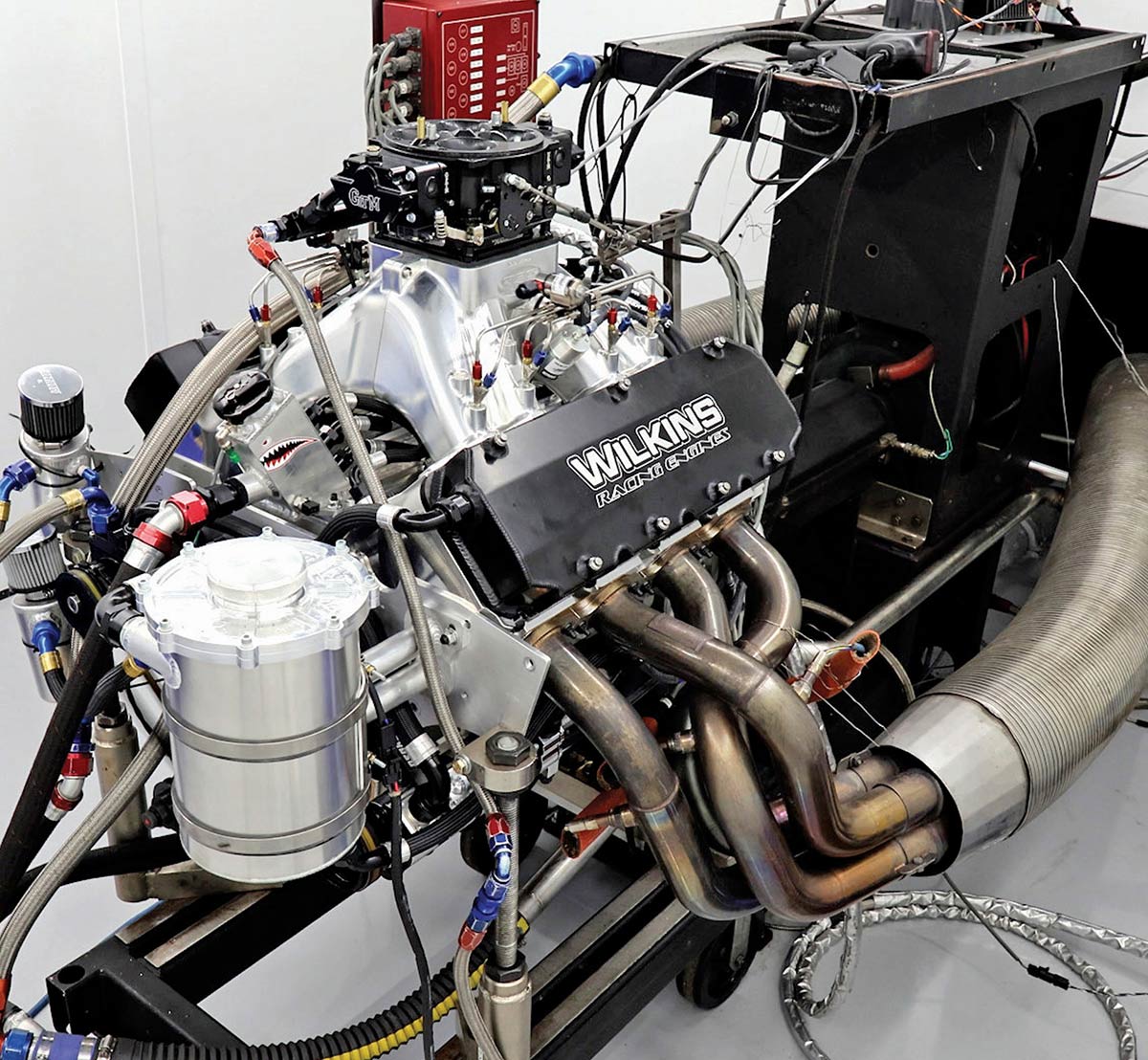
High-performance 648ci big-block engine on an engine stand.
1. Wilkins Racing Engines’ 648ci big-block pulls out all the stops to hit 4.50-second passes on the eighth-mile for an entire season without rebuilds.
Rocket Science
Wilkins Racing Engines Shows Us The Top-Level Tricks When It Comes To Building Ultrahigh-Performance Racing Engines
BY JEFF HUNEYCUTT IMAGES BY THE AUTHOR
T

here is certainly a time and place for pulling an iron-block 5.3 out of a pickup truck or a work van and throwing it into your beater along with a low-buck turbo of unknown origin you found on eBay. The bottom-dollar ethos is a cornerstone of hot rodding, and that should never go away.

But sometimes you want to push a few boundaries.

Drag racing is all about exploring the boundaries when it comes to how far you can push engine parts to maximize speed, even if that means occasionally blowing up. But you can’t win championships if you are scattering your connecting rods across the track too often. So, if you are into the science of building rockets that consistently cross the finish line ahead of your opponent, quality and precision become pretty dang important.

If you are into bracket racing, especially on the East Coast, then you’ve probably heard of Sandy Wilkins and Wilkins Racing Engines. He specializes in big-inch nitrous engines and is especially strong in Top Sportsman, Top Dragster, and other bracket classes. Wilkins makes no bones about the fact that he builds a premium product, and he told us straight up that his entire business is targeted for racers looking to win championships.

So, no corners are cut. Ever. Wilkins, who has built everything from NASCAR Cup, to top-level off-road, to drift engines, has such a strong dedication to perfect engine assembly he regularly fabricates his own checking tools. His attention to detail is off the charts.

We understand that most of our readers assembling engines in their home shops won’t go to this level of detail, but we thought you might be interested in seeing just some of what Wilkins Racing Engines does as a part of building one of their bracket racing big-blocks. Every engine is built with the intention that it should be capable of winning track championships, and that means it has to reliably run a full season of practice laps, qualifying, and racing all the way to the final rounds without a rebuild.

Because, as Wilkins says, “Doing it right the first time might be expensive, but it’s still a heck of a lot cheaper than multiple rebuilds.”

We joined Wilkins for a 648ci big-block build that will be racing in bracket classes with a quick 4.50-second index in eighth-mile racing. This build uses one of JLine Performance’s new aluminum blocks and a set of Brodix head castings CNC-ported with Wilkins Racing Engines’ own 484 Max head design. There’s also a simple nitrous setup that Wilkins says is mostly there to help tune the engine to hit the index when the track conditions or weather changes.

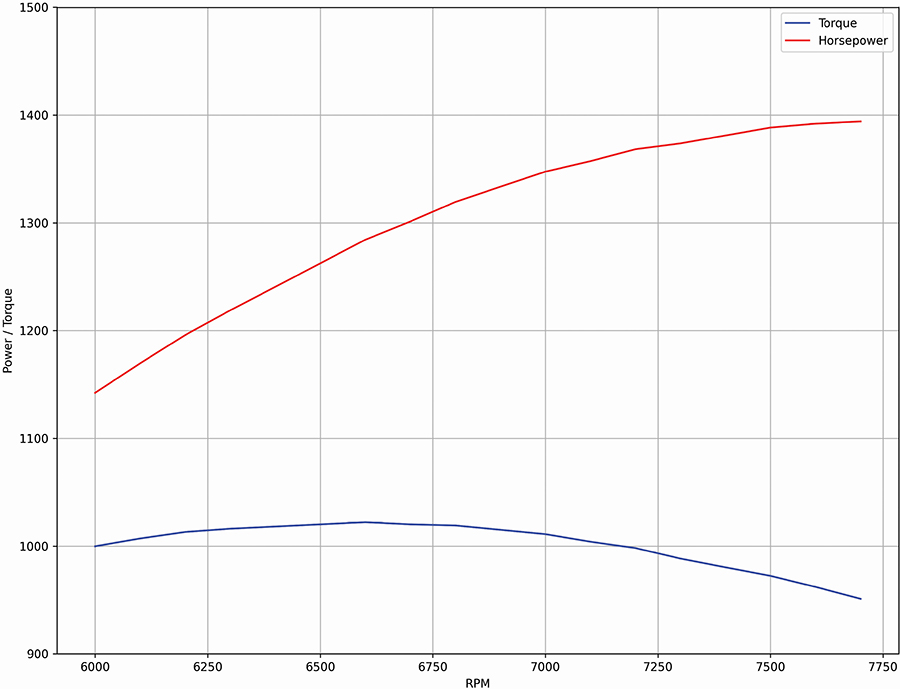
On the dyno, this proved to be a high-revving combo, thanks to the free-breathing 484 Max cylinder heads. It put up peaks of 1,022 lb-ft of torque at 6,600 rpm and 1,394 hp when Wilkins pulled back on the handle at 7,700 rpm—and that’s with no nitrous and burning VP Q16 race fuel thanks to the 16:1 compression ratio.

Since this is a competition engine, Wilkins wants to keep a few of the specifics, like the cam specs, to himself. He’s invested quite a bit into R&D, so we’ll respect his wishes but there’s still plenty to learn. Follow along and check out this unique build and the incredible amount of detail that goes into making sure it can punch consistent timeslips lap after lap.

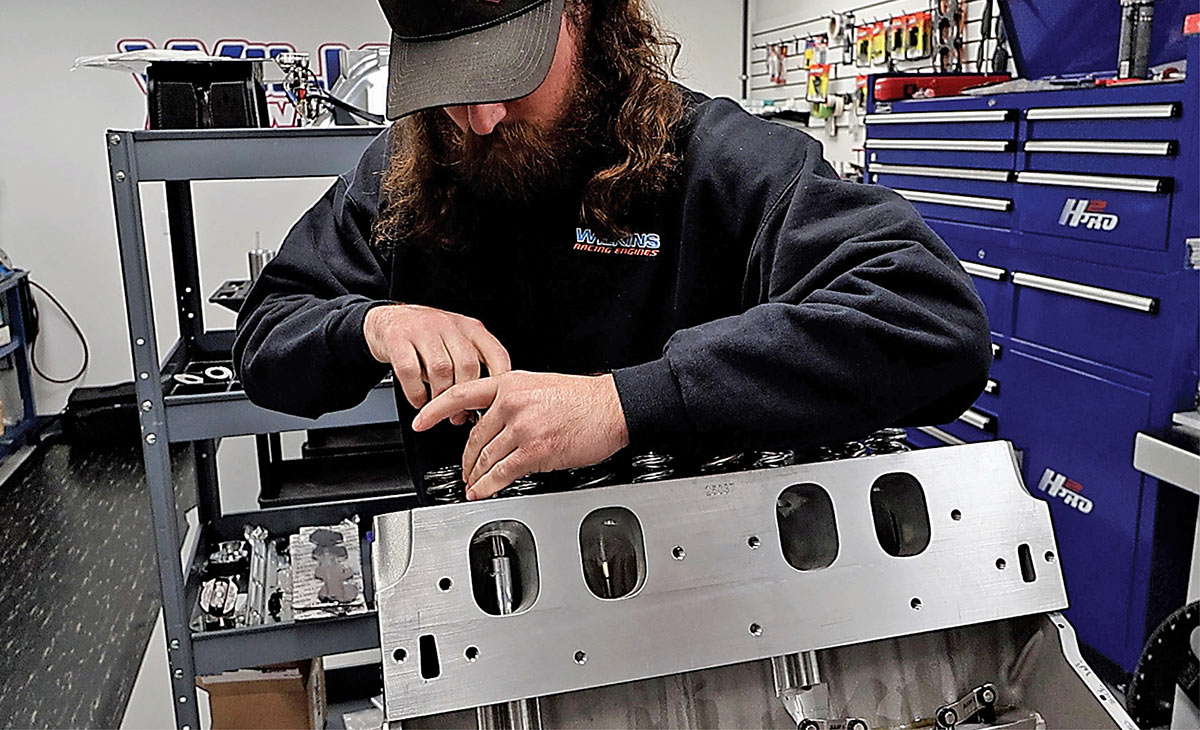
Close-up of a bare aluminum Chevy big-block engine block.
2. Since retiring as a full-time driver in Pro Stock, drag racer Jason Line has been building JLine Performance, manufacturing high-performance blocks and cylinder heads. This is one of JLine’s newest aluminum Chevy big-blocks, a no-holds-barred race block optimized for performance, including O-rings, super high-quality sleeves, and most of all, head boltholes perpendicular to the deck of the block to work with Wilkins’ 484 Max cylinder heads.
Crankshaft journal with unique rear main seal assembly attached.
3. To improve sealing so that the dry-sump oil pump (and the vacuum pump) can produce more vacuum in the crankcase, Wilkins uses a unique rear main seal. The two-piece seal is held in place around the rear main journal with a band, and then the entire assembly gets clamped in place between the block and the main cap.
Technician lowering a crankshaft into an engine block's bearing saddles.
4. Zack Thomas gently lowers the Callies Magnum series crankshaft into the bearing saddles. The crank has 4.875 inches of stroke, and the main bearings Wilkins is using are from Mahle with a Calico coating.
Set of black undercut main studs on a blue surface.
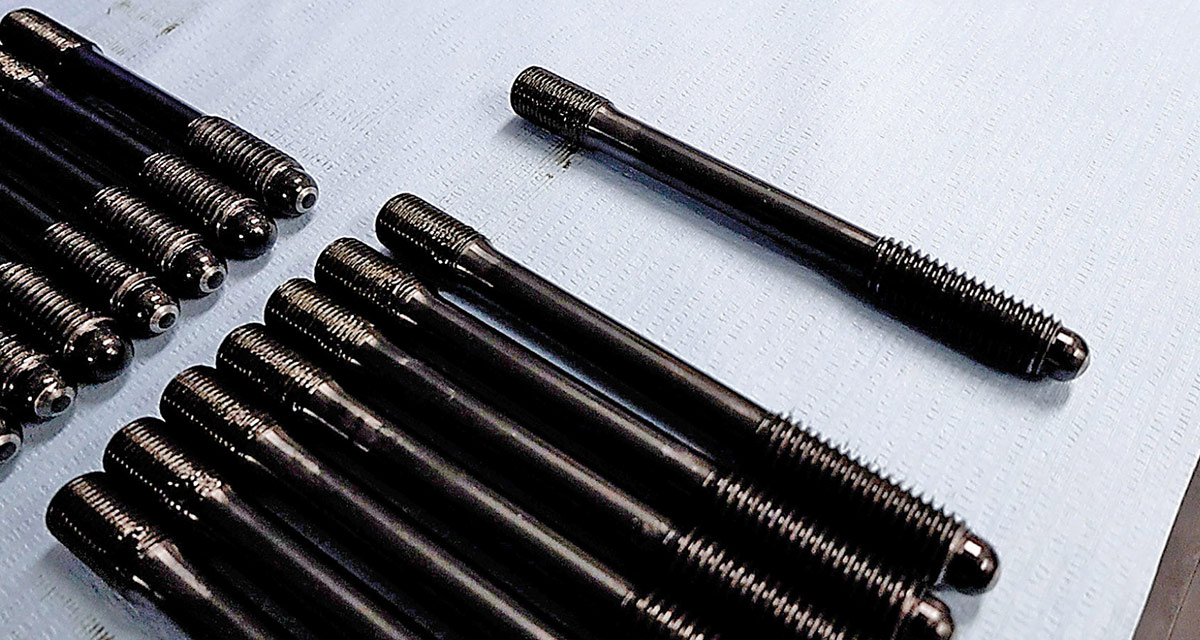
5. Undercut main studs are more difficult to manufacture but they even out the clamping load from cap to cap, and in this case the main caps have been cut and sit lower to the block and the nuts cannot jam against the root of the threads and give a false torque reading.
Inserting a 60mm solid roller camshaft into an engine block.
6. We can tell you the camshaft is a 60mm solid roller that Comp Cams has helped develop with Wilkins specifically for this type of engine. Because this is a race engine, Wilkins prefers to keep the cam specs to himself, but he did say that the total valve lift is less than the height of the Statue of Liberty but taller than a bullfrog’s butt.
Using a dial indicator to check camshaft endplay on a block.
7. A Jesel belt drive setup will link the cam to the crankshaft. Wilkins knows exactly how much camshaft endplay he wants and uses a dial indicator to determine how many shims he needs before installing the rest of the belt-drive assembly.
Measuring belt tightness with a special soundwave tool on an engine.
8. The distance between the crankshaft and camshaft centerlines can grow a lot as an aluminum block gets to race temp. So, it is critical to get the right belt length. If the block expands and the belt gets too tight, you can kill bearings. Wilkins uses a special tool that uses soundwaves to measure belt tightness. By flicking the belt, the pickup measures the oscillations and gives a very accurate reading. No guessing what each engine needs.
Advanced cam timing setup with dial indicators and a large degree wheel.
9. Wilkins’ cam timing setup is one of the most advanced we’ve ever seen. He’s fabricated a mounting plate that locates the dial indicators over the intake and exhaust lifters directly in line with the lifter angle and modified a pair of lifters with flat tops so he knows his readings are exactly the same every time. He also uses a solid pointer that bolts to the block, which eliminates the potential movement of a wire like most engine builders use. That giant degree wheel provides much greater resolution when you are trying to be accurate within a 1/2 degree or less than a cheap 12-inch-diameter wheel.
Checking piston-to-valve clearance using clay on a piston top.
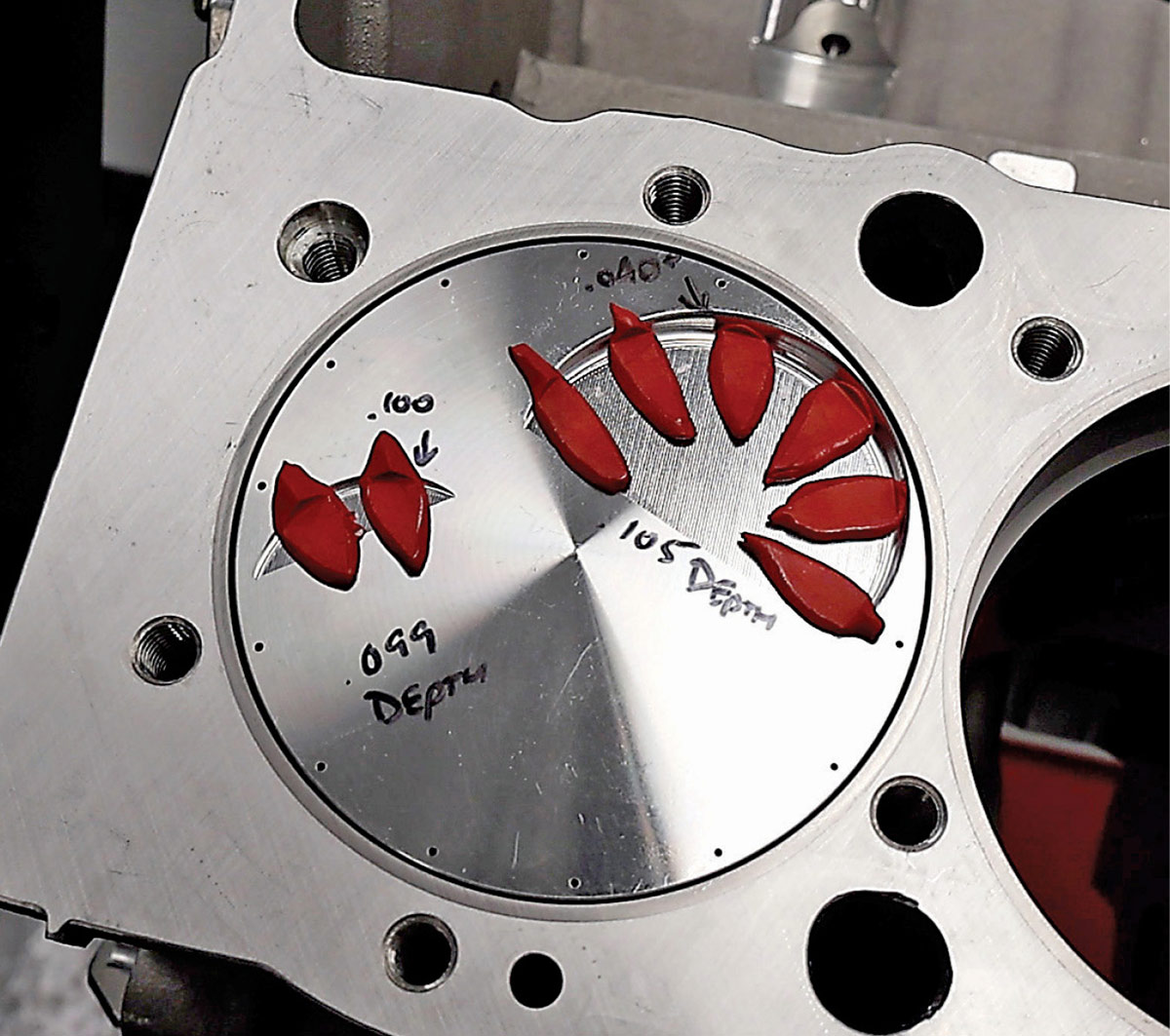
10. A dial indicator is great for checking piston-to-valve clearance, but Wilkins is looking for more information than just that one measurement. So, he goes old school and uses clay so he can check both piston-to-valve and the radial clearance around the valve pockets because he’s looking to dial in just the right amounts. Too little clearance and you risk bending a valve, but too much is just giving away compression and horsepower.
Callies Ultra Enforcer steel I-beam connecting rod attached to a piston.
11. The connecting rods we are using are Callies Ultra Enforcer steel I-beams that have a twisted cap for extra cam clearance in a stroker build like this. The pistons are from Diamond and have a diameter of 4.600. This is a slipper-skirt design with inboard wristpin bosses to help cut weight in both the piston and the steel wristpins.
Measuring rod bolt length with a stretch gauge against a standard.
12. When checking rod bolt stretch, most builders zero out their stretch gauge against the rod bolt then measure stretch after it has been installed in the rod. Wilkins prefers to zero against a standard and measure the rod bolt length both before and after installation. He does all 16 bolts this way. It is more work, but this method allows him to recheck bolt stretch during rebuilds to see if the bolts have stretched during operation.
View of the crankshaft and main caps inside an engine block.
13. With the short-block complete, attention is turned to the dry-sump oil pan. This is a two-piece pan that’s nice and wide to both reduce windage and allow the drag race team to change out a burned piston at the track quickly and easily. There’s no oil pan gasket used here. Wilkins says since this section won’t be removed, a simple bead of silicone is more reliable.
Bottom section of a two-piece dry-sump oil pan being handled.
14. The bottom section of the pan seals with an O-ring to make removal and reinstallation as simple as possible.
Installing an oil pan pickup with a mesh screen.
15. Each of the pickups features screens to make sure no trash is able to make its way through the oil pump. Also note that every fitting on the oil pan as well as the block are ORB fittings with an O-ring to provide the seal. Pipe threads like you find on most AN fittings taper, so if they are over-tightened it can lead to cracks in the block, which will lead to leaks.
Multilayer steel head gasket positioned over engine cylinders and studs.
16. Wilkins has his own multilayer steel head gaskets made to his specs by Cometic. One change versus typical off-the-shelf head gaskets is the holes that allow coolant to pass from the water jackets in the block to the cylinder heads are sized to meter the correct amount of flow specifically for this engine.
Underside of a cylinder head showing titanium intake and exhaust valves.
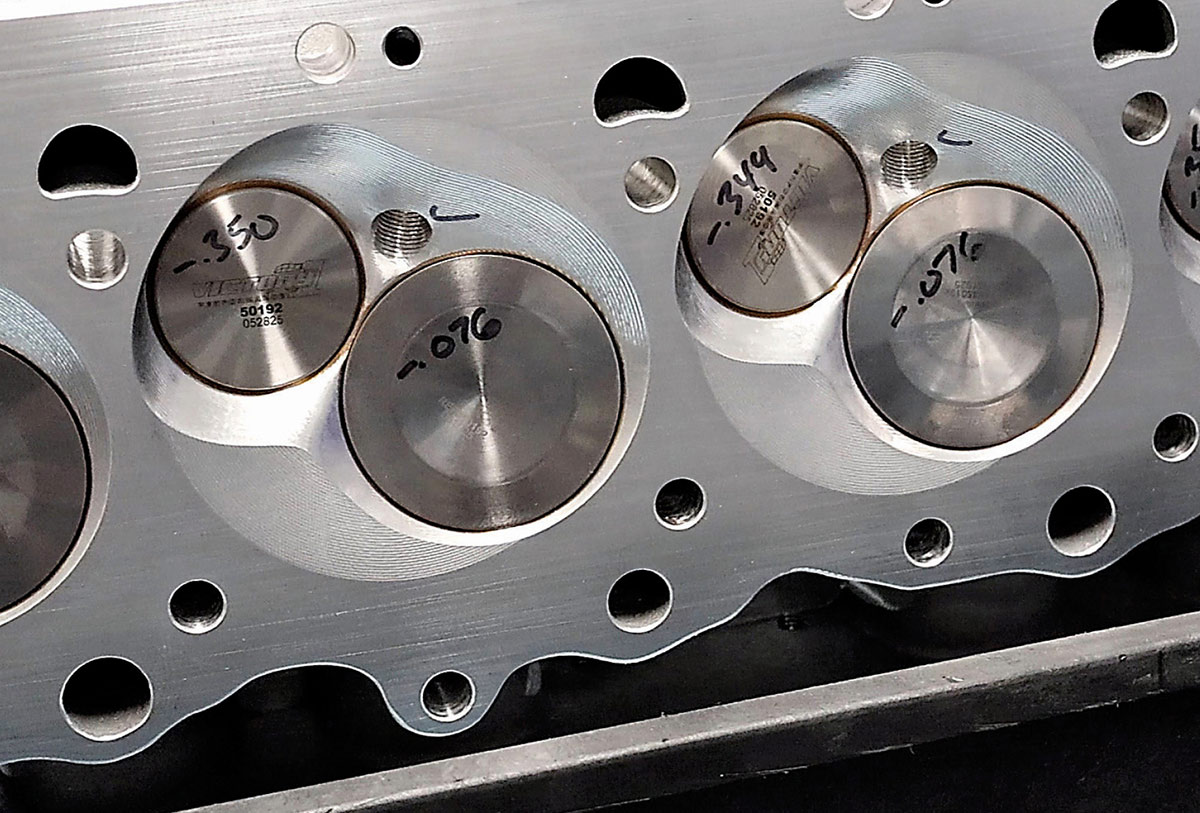
17. Each valve is checked and marked for valve drop. The valves in these 484 Max (named for the 4.840-inch bore spacing) cylinder heads are titanium. The intakes are sized at 2.550 inches while the exhausts are 1.810. You can also see that the combustion chambers have been softened by tapering the quench area to very mildly create a wider, milder combustion chamber. In high-performance nitrous engines this is important to reduce the chances of detonation.
Top view of cylinder head showing valve springs and titanium retainers.
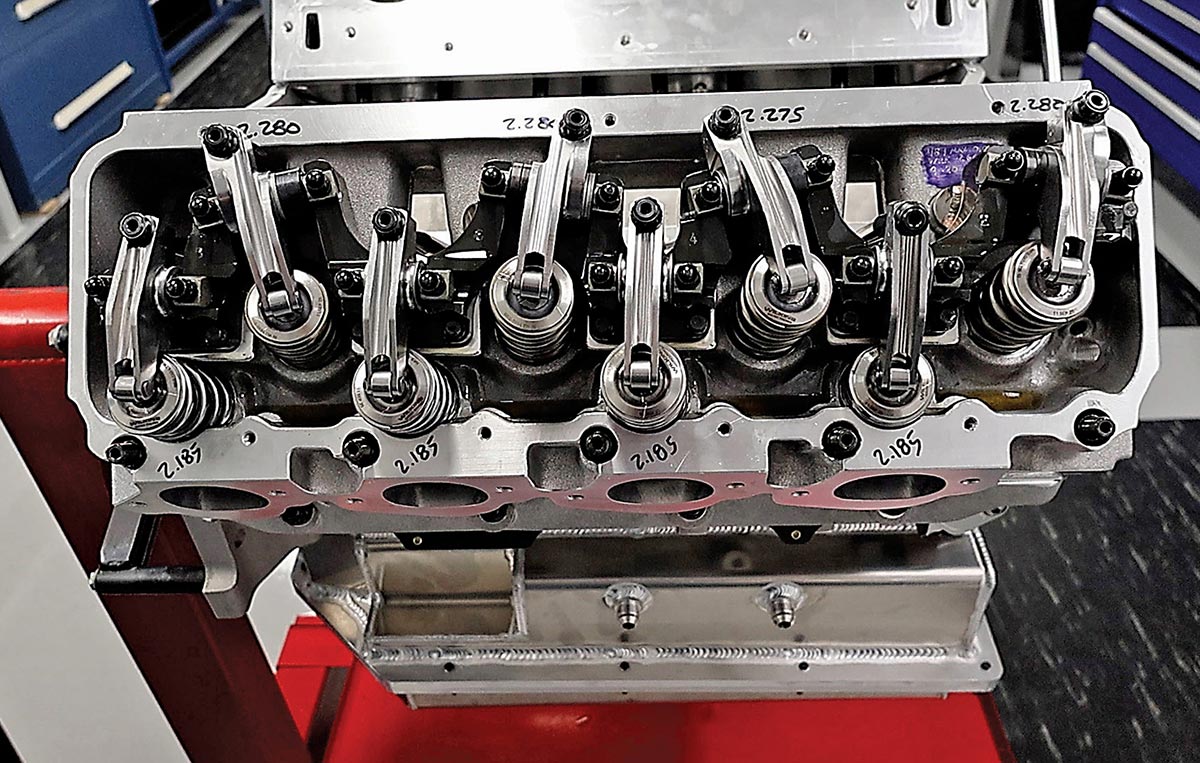
18. Up top, the springs are from PSI Springs and held in place by custom titanium retainers by Wilkins Racing Engines. The valve stems are maybe bigger than you might think for high-end racing at 5/16 inch for the intakes and 11/32 for the exhausts, but the thicker stems are necessary to keep from bending with the large valve diameters and also help move head from the valve through the guide and into the water jacket into the cylinder heads. Also, notice the hole in the head in the upper righthand corner that extends into the intake port. That’s necessary to access one of the head studs.
Looking through the entrance of a cylinder head intake port.
19. Here is an angle looking through the entrance of the intake port. With these heads, the ports are given priority over everything else. So, when some of the intake ports want to be in the same spot as the head studs, you make it work. Since almost all the air and fuel flows over the top half of the port, a slight disruption in the floor of the port doesn’t hurt anything.
O-ringed port plug welded to the underside of a rocker stand.
20. O-ringed plugs are fabricated to fit the holes and perfectly match the profile of the ports and then welded to the underside of the rocker arm stands.
Placing rocker arm stands onto a cylinder head.
21. The rocker stands complete with port plugs drop right into place.
View of the intake port roof with a plug installed.
22. Here’s a look at the roof of the port with the plug in place. The hole to the left will be filled by the rocker stand bolt.
Detailed view of pushrod routing and steel Jesel rocker arms.
23. The intake ports also affect the pushrod routing. The steel Jesel rocker arms utilize a variety of offsets and angles to straighten up the pushrods as much as possible to clean up the valvetrain geometry.
Tall billet intake manifold from MBE installed on an engine.
24. A very tall billet intake manifold from MBE can route an absolute ton of air and fuel to the cylinder heads. There is no water crossover. Instead, hoses route coolant from both the front and back of the heads to a water manifold at the front. You can also see the nitrous system that has been set up.
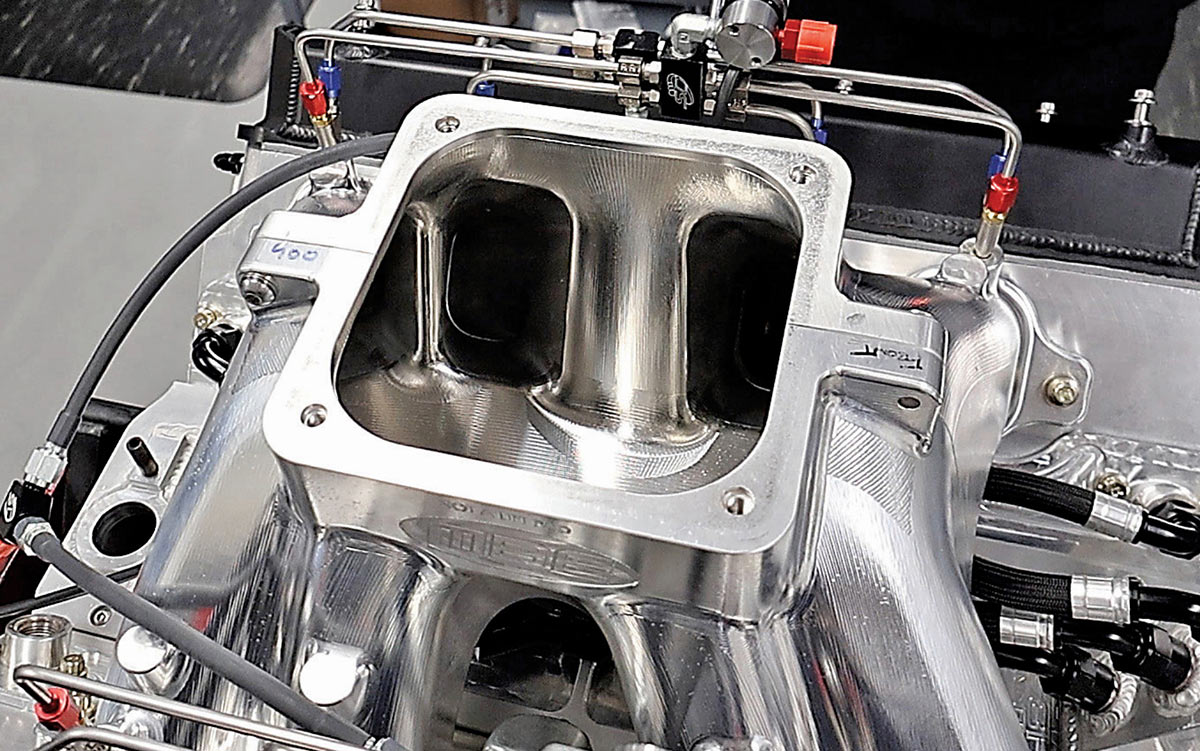
Looking down the throat of a billet intake manifold.
25. A quick look down the throat of the intake manifold shows an impressively straight flow path from the carburetor right into the combustion chambers.
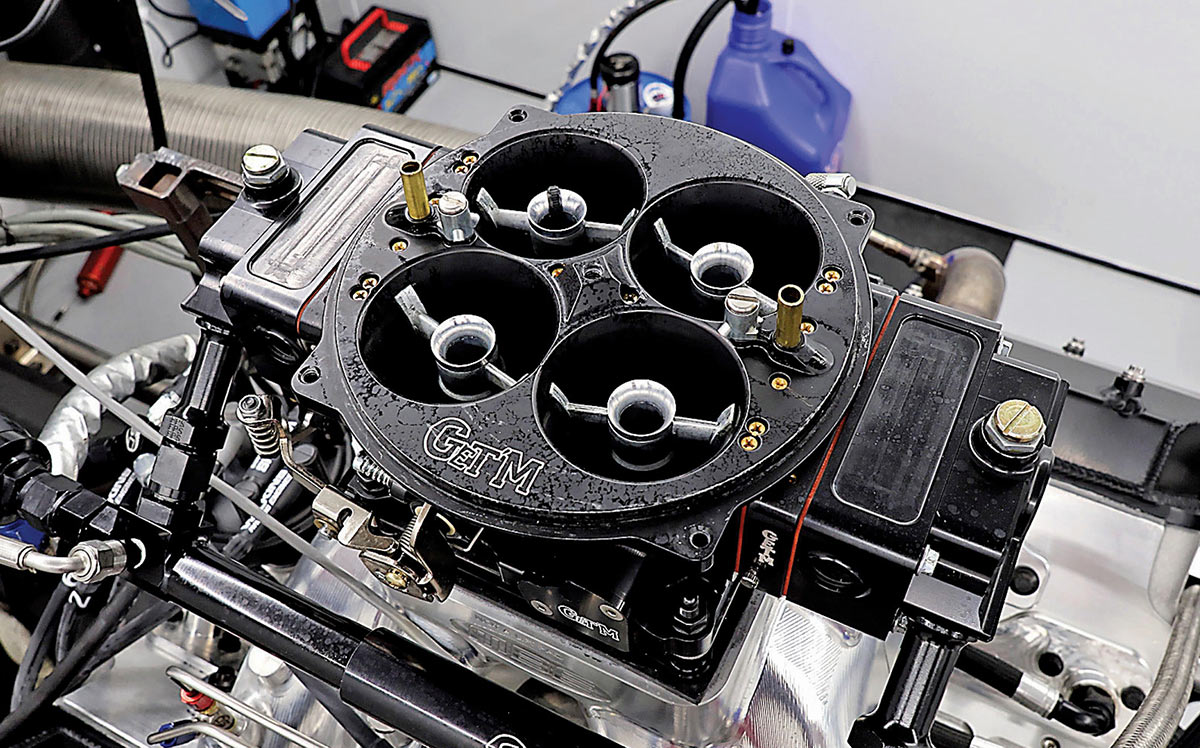
Top view of a dominator-sized four-barrel carburetor from Get’M Performance.
26. The dominator-sized four-barrel carb from Get’M Performance is rated for 1,700 cfm.
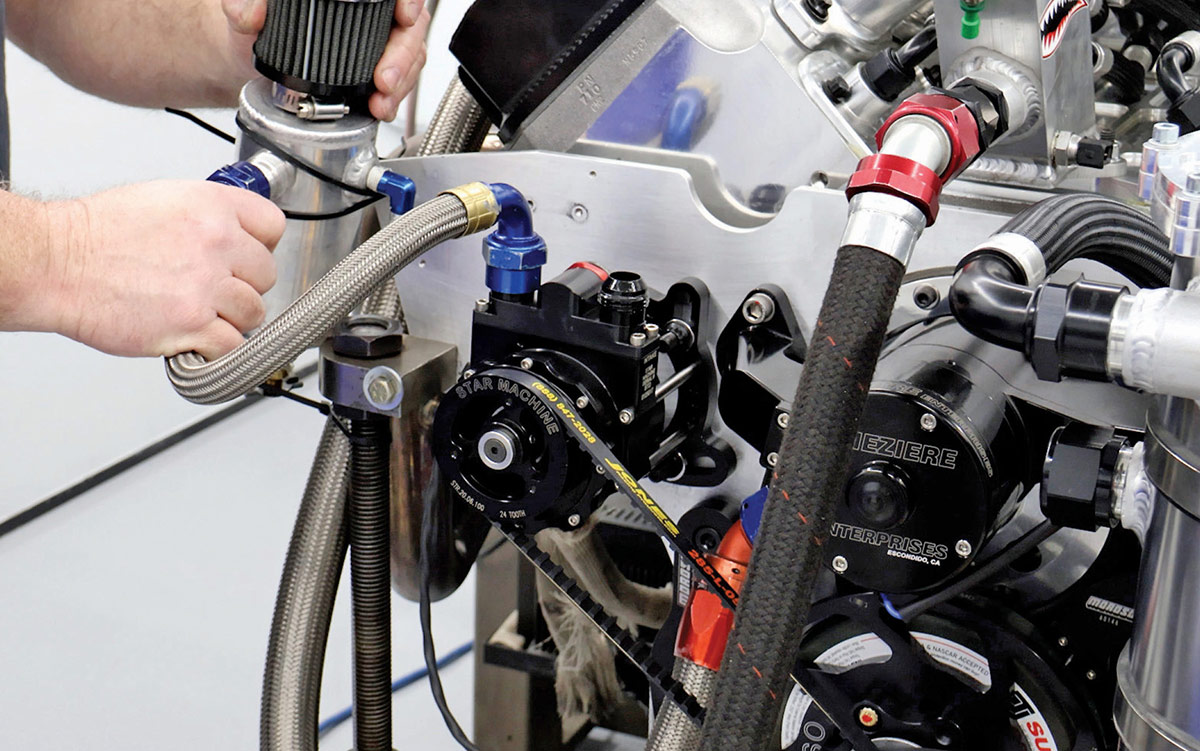
Plumbing a vacuum pump for the dry-sump oiling system.
27. The dry-sump oiling system will pull vacuum in the crankcase, but in drag racing more is always better, so Wilkins also plumbed up a vacuum pump.
Complete high-performance engine on a dyno stand ready for testing.
28. We ran the engine on the dyno with fuel only and made peaks of 1,394 hp and 1,022 lb-ft of torque. Wilkins says the nitrous will likely only be used when weather or track conditions are poor and they need just a touch more to make the 4.50-second index.
line graph showing torque and horsepower
In The Garage Media
Jesel logo

(732) 901-1800
jesel.com
Wilkins Racing Engines