




Burn Rubber
Third-Gen Camaro
Engine Upgrade
We Build a
Wild, 1,394hp,
648ci Big-Block

Preview Issue





 TOC
TOC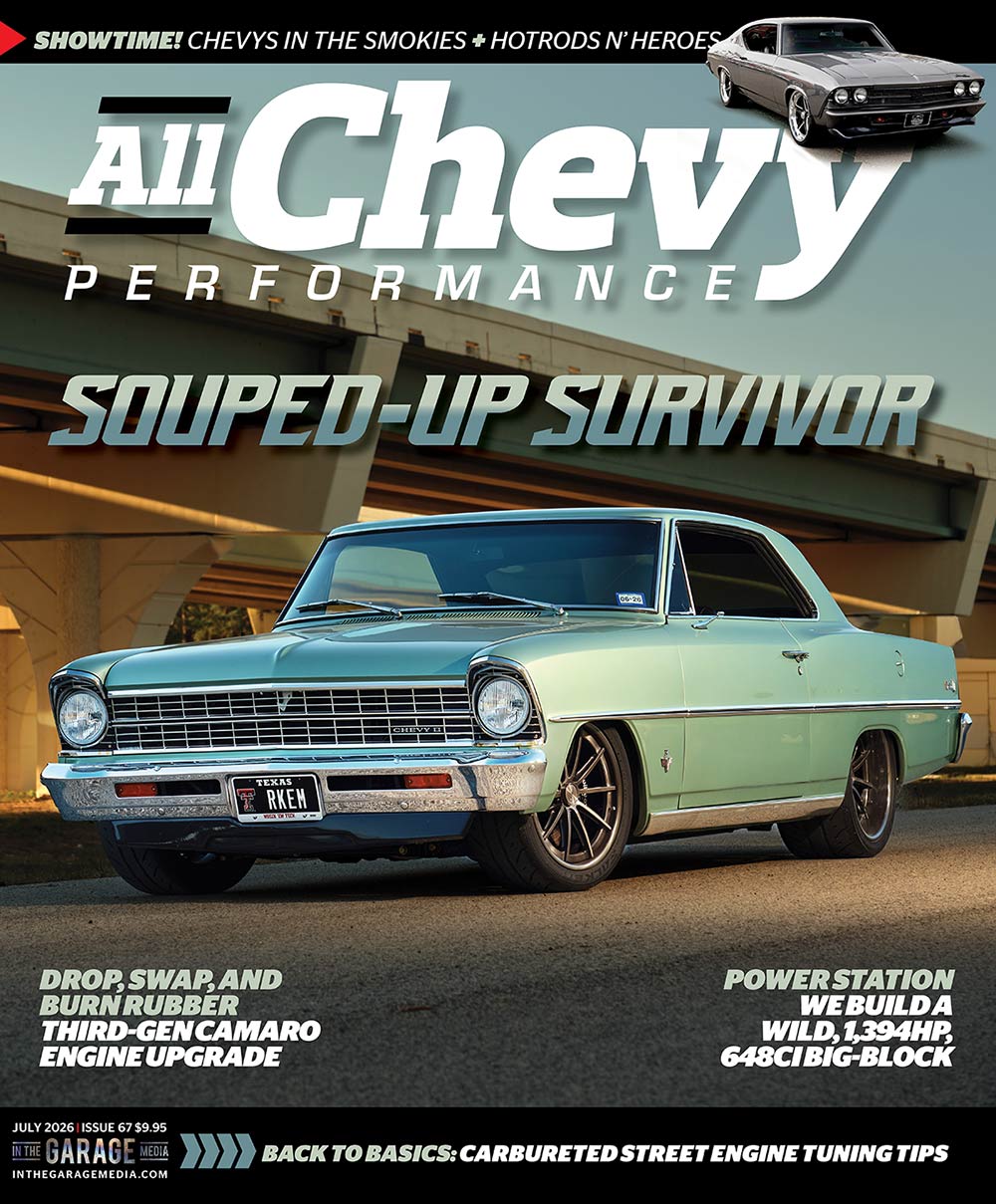
Cover image by NotStock Photography








“Rotten” Rodney Bauman, Jefferson Bryant, Tommy Lee Byrd, Ron Ceridono, Ron Covell, Grant Cox, Fuelish Media, John Gilbert, Tavis Highlander, Jeff Huneycutt, Barry Kluczyk, Scotty Lachenauer, Patrick Lauder, Jason Lubken, John Machaqueiro, Ryan Manson, Jason Matthew, Josh Mishler, NotStock Photography, Todd Ryden, Jason Scudellari, Jeff Smith & Chuck Vranas – Writers and Photographers
Travis Weeks Advertising Sales Manager
Patrick Walsh Sales Representative
ads@inthegaragemedia.com
AllChevyPerformance.com
ClassicTruckPerformance.com
ModernRodding.com
InTheGarageMedia.com
inthegaragemedia.com “Online Store”
For bulk back issues of 10 copies or more, contact store@inthegaragemedia.com
info@inthegaragemedia.com
Editorial contributions are welcomed but editors recommend that contributors query first. Contribution inquiries should first be emailed to info@inthegaragemedia.com. Do not mail via USPS as we assume no responsibility for loss or damage thereto. IN THE GARAGE MEDIA, INC. reserves the right to use material at its discretion, and we reserve the right to edit material to meet our requirements. Upon publication, payment will be made at our current rate, and that said, payment will cover author’s and contributor’s rights of the contribution. Contributors’ act of emailing contribution shall constitute and express warranty that material is original and no infringement on the rights of others.

Copyright (c) 2026 IN THE GARAGE MEDIA, INC.
PRINTED IN U.S.A.


 firing up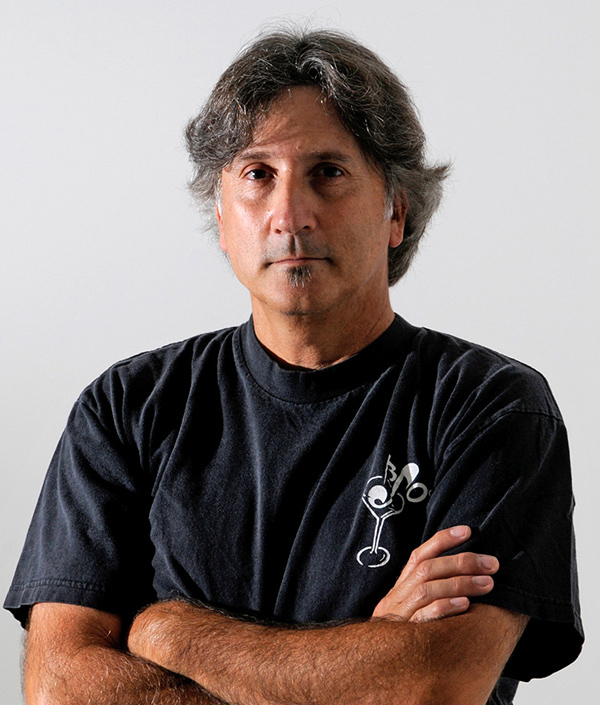
 BY NICK LICATA
or just about every car enthusiast, there’s a special kind of satisfaction in having a project that fires clean, runs strong, and cruises effortlessly down the road. That first pull through the gears of that powerful V-8 is what got most of us hooked in the first place. Small-block, big-block, or LS—the rowdy sound these engines create is infectious.
For many, the dream doesn’t stop in the garage. Seeing your car featured in one of your favorite magazines is the ultimate payoff. After the late nights, the bloody knuckles, and the steady drain on the wallet, there’s nothing like seeing your pride and joy in print.
But getting there isn’t always easy.
There are a few hurdles to clear before a car ever makes it onto those glossy pages. For starters, the build itself has to align with what a magazine is looking for. Editors are selective, and as trends pivot, they’re constantly dialing in the styles that keep their content relevant.

 PARTS BIN




 CHEVY CONCEPTS

 Text & Rendering by Tavis Highlander
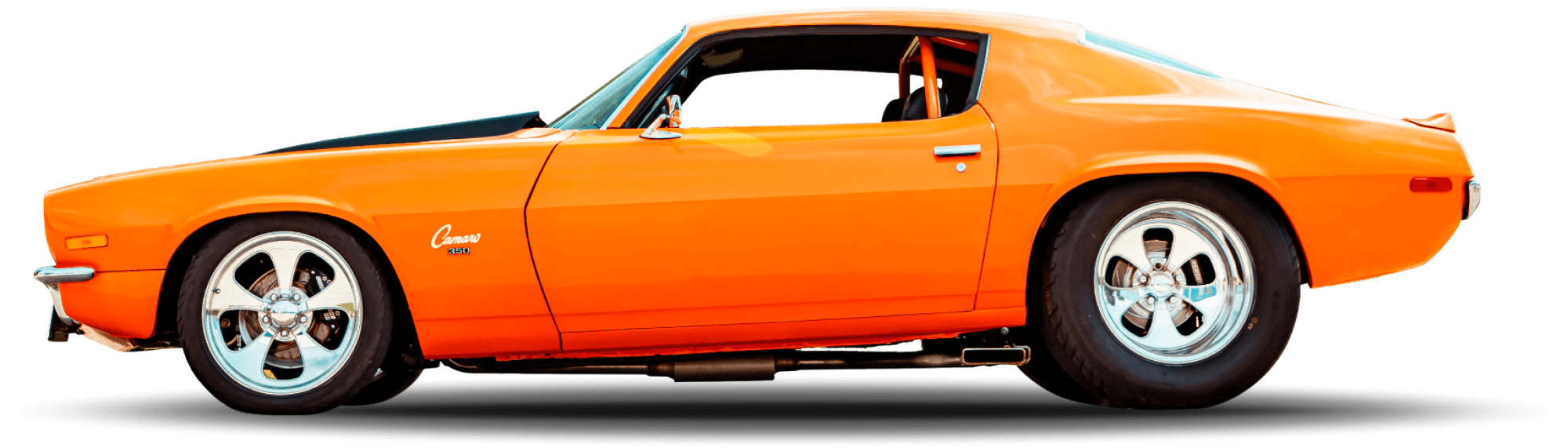
ig meats in the back and skinnies up front are something you just don’t see much of anymore. Nichols Paint & Fab decided to bring back a little bit of that Pro Street look for this Camaro build. Billet Specialties Street Lite wheels look the business and allow the fitment of Coker Pro-Trac S/C 445 tires in the rear. An extensive amount of cage work was completed inside of the interior, which is still comfortable enough to use off the track. Finished in a dark metallic orange with charcoal graphics, this Camaro is sure to get a few people to take a second look.
 FEATURE
 IMAGES BY NOTSTOCK PHOTOGRAPHY
e’ve all dreamed about finding that elusive one-owner 1960’s classic that survived decades of living a quiet life doing family service without ever being wrecked or cut up and turned into a drag car. But these mythical survivors just aren’t around anymore, or are they? Chuck Johnson, owner of Octane and Iron in Magnolia, Texas, thought the same thing until Gabe Wilson of Fredericksburg, Texas, proved otherwise. Gabe had a specific target in mind: a first-generation Chevy II Nova that had not been butchered by time or trends. Something straight he could transform into the driver he wanted without undoing someone else’s questionable decisions.
Six months of digging through Nova enthusiast social media sites, classifieds, and Online forums finally paid off. Sitting quietly in Indiana was a 1967 Nova that had spent its entire life, a charmed one at that, servicing the same family since it rolled out of a Chevrolet showroom.
Aside from a single repaint in 1981 that changed the Nova to its current Mountain Green hue, the car remained almost completely untouched. The sheetmetal was original from nose to tail. Trim, bumpers, panels, and brightwork were all factory pieces. No rust repair, no collision scars. Just decades of careful ownership.

 TECH
TECH IMAGES BY THE AUTHOR
here is certainly a time and place for pulling an iron-block 5.3 out of a pickup truck or a work van and throwing it into your beater along with a low-buck turbo of unknown origin you found on eBay. The bottom-dollar ethos is a cornerstone of hot rodding, and that should never go away.
But sometimes you want to push a few boundaries.
Drag racing is all about exploring the boundaries when it comes to how far you can push engine parts to maximize speed, even if that means occasionally blowing up. But you can’t win championships if you are scattering your connecting rods across the track too often. So, if you are into the science of building rockets that consistently cross the finish line ahead of your opponent, quality and precision become pretty dang important.





 FEATURE IMAGES BY NOTSTOCK PHOTOGRAPHY
t’s a fact, at least in this scenario, that the classic car hobby seamlessly travels from generation to generation. Marty Amoroso’s grandfather, the OG Marty, who the younger Marty was named after, understood that a good car isn’t just transportation, it’s an identity with a heartbeat—a heartbeat that got the young Marty into cars, creating a lifelong passion and appreciation for vintage cars. Although Marty’s grandpa lit the fire, after his death, it was Marty’s grandpa’s best friend, Bill, who took Marty under his hot rodding wing and taught the then 14-year-old the finer aspects of hot rodding—how to drive a stick and how to do proper burnouts—all in this 1955 Chevy Bel Air. The burnout lessons backfired one time when Marty was caught by local law enforcement doing that very exercise on the streets near his home. “I didn’t have a driver’s license yet, so when the cops pulled me over, they gave me a good tongue-lashing and wouldn’t allow me to drive the car back home, which meant Bill had to come pick me up,” Marty laughingly says. “On the way home Bill told me if I don’t stop doing burnouts in his car, he’d get a bad reputation around town. That’s when we decided to name the car Bad Reputation.”
 IMAGES BY NOTSTOCK PHOTOGRAPHY
t’s a fact, at least in this scenario, that the classic car hobby seamlessly travels from generation to generation. Marty Amoroso’s grandfather, the OG Marty, who the younger Marty was named after, understood that a good car isn’t just transportation, it’s an identity with a heartbeat—a heartbeat that got the young Marty into cars, creating a lifelong passion and appreciation for vintage cars. Although Marty’s grandpa lit the fire, after his death, it was Marty’s grandpa’s best friend, Bill, who took Marty under his hot rodding wing and taught the then 14-year-old the finer aspects of hot rodding—how to drive a stick and how to do proper burnouts—all in this 1955 Chevy Bel Air. The burnout lessons backfired one time when Marty was caught by local law enforcement doing that very exercise on the streets near his home. “I didn’t have a driver’s license yet, so when the cops pulled me over, they gave me a good tongue-lashing and wouldn’t allow me to drive the car back home, which meant Bill had to come pick me up,” Marty laughingly says. “On the way home Bill told me if I don’t stop doing burnouts in his car, he’d get a bad reputation around town. That’s when we decided to name the car Bad Reputation.”
 TECH
TECH
 IMAGES BY CHADLY JOHNSON
here are a variety of opinions when it comes to personalizing a car. For some, it often seems the goal is to make a change for change’s sake. The problem with that is change with no purpose is often counterproductive and makes the result less appealing than the original form. The trick to making any car look better is to improve the fit and finish of individual components and simplify them, if possible. That’s exactly what Dayton Eitner of MetalWorks in Eugene, Oregon, did to this second-gen Chevy Nova.
Eitner was tasked with what would seem like a simple chore: clean up the front bumper, make it fit better, and give it a “cleaner” look. The process began simply enough. The first to go were the bumper bolts. The holes were filled and studs were added to the back side, a pretty standard customizer’s trick.
With the boltholes filled, the bumper brackets were modified to bring it closer to the body and also lower it ever so slightly so it would match the accent line in the fenders. Next, Eitner cut the bumper in the center then reshaped it to fit the shape and the peak of the grille precisely, then welded it back together. The ends of the bumper were cut off and reattached to tuck them closer to the body and align their peaks with the peaks in the fenders.


 FEATURE
 IMAGES BY THE AUTHOR
limbing the ladder of performance is a natural progression for most young automotive aficionados. Dan Lutz, of Harleysville, Pennsylvania, is one of those guys who took his preteen love for muscle cars and trucks and slowly moved closer to his ultimate ride through a series of steps—each time climbing higher up the horsepower pyramid and closer to his main objective of owning his dream muscle car.
Dan, like many of us, got his love for classic rides through his immediate family. “As a kid living in a car house, I was always surrounded by hot rods,” Dan says. “One of my first memories was losing control of my bicycle and crashing it directly into the side of my dad’s (Brian) 1969 Nova. At that time, it was a complete basket case, but it was the car that kick-started my passion for the hobby.
From there, it was a series of purchases and sales that drove Dan up the ladder of performance. First was a 1982 El Camino, which was painted and then sold off for a 1989 K2500. Due to a lack of hot rod feel the truck was also quickly sold. Dan then scored a 1967 Chevelle, which was a real Pro Street ride. He painted the Chevy then added a 502ci big-block and a fresh blower up top. “The car was an eye-catcher, but as I got older, and having kids became a possibility, I decided something with a back seat was needed,” Dan says. “That was the moment I decided not to settle and went after the car I always wanted.”
TECH IMAGES BY THE AUTHOR
his story will approach the art of tuning street carburetors and ignition timing from a slightly different angle. Instead of just listing the information in a generic manner, this story will attack this issue from a real-world problem standpoint by offering information that is rarely addressed by Online experts.
A recent small-block Chevy tuner experienced an interesting problem. As he described it, his big-cammed, small-block 383 fitted with a Holley 4150 carburetor was idling with an exhaust smell he said would make his eyes burn. He assumed this was because of a rich air/fuel mixture. But he was perplexed because his newly installed air/fuel ratio meter reported the engine was idling lean with an air/fuel ratio of 17:1.
Right from the start, his description pointed out two important clues. The first is that his engine was equipped with a cam that he described as idling at less than 10 inches of manifold vacuum (10” Hg). The second important piece of evidence was his air/fuel ratio meter reporting a 17:1 air/fuel ratio.


 FEATURE
 IMAGES BY THE AUTHOR
 TECH
TECH
 IMAGES BY RYAN FOSS
urchasing a running/driving vehicle can be a huge step in the right direction when it comes to building or restoring a classic Chevy muscle car, but buyer’s remorse is a real thing and sometimes that sleek street machine turns out to be a bridge too far. Our good buddy and lensman extraordinaire, Ryan Foss, recently decided to dive into the foray that is classic Chevy vehicle ownership, purchasing a well-heeled 1992 Chevy Camaro that has seen plenty of action on the streets and on the track.
Unfortunately, that action reared its ugly head when the Camaro developed a strange noise coupled with vibration emanating from the drivetrain. A cracked or otherwise damaged flywheel was thought to be the initial culprit, but closer inspection from the local transmission shop cleared that hypothesis. Further probing revealed excessive crankshaft endplay, which meant at the very least, the crank thrust bearing surface was toast. A history of hard autocross on throttle/off throttle driving made sense of the singular damage. Postmortem report, the engine would need to be rebuilt or replaced.


 EVENT
EVENT
 IMAGES BY THE AUTHOR & NICK LICATA
ar shows in Southern California always seem to carry their own rhythm, and the gathering on Sunday, March 29, 2026 in Huntington Beach had that familiar pulse from the moment the first Chevys rolled onto the blacktop. Hotrods N’ Heroes, presented by the 42 Foundation in partnership with Qruisin PCH, set the tone early with a show field built around community as much as horsepower. The Foundation’s mission—supporting law enforcement officers, their families, and the broader SoCal community through financial assistance, youth programs, and outreach—gave the event a sense of purpose that resonated across the lot. With first-responder displays lining the perimeter and the Pacific breeze drifting through the aisles, the day unfolded with the kind of energy that defines Southern California car culture.
Chevrolets formed the backbone of the weekend, and the variety was impossible to miss. Nearly an acre of Tri-Fives from the Bel Air Car Club created a vibrant mid-century corridor, each car polished to perfection. Christopher Hernandez’s dual-quad big-block 1955 Gasser, complete with a flip-top front end and a Two-Lane Blacktop attitude, drew steady attention. Full-size fans gravitated toward Scott Toth’s Twilight Blue 1962 Bel Air bubbletop four-speed, “Hek-approved,” and every bit the part of a dual-quad 409 bruiser. Camaros brought their own flavor: Jon Henson’s bright red ’69 in the New Gen Wheels booth, with its Whipple-blown LS, five-speed, and 20-inch steelie-look billet wheels, was a major standout, while ACP Editor Nick Licata found himself drawn to the LSX-powered Butternut Yellow ’67 from Higgins Rod and Custom, a build that blended classic lines with modern punch.


11479 Sixth St., Rancho Cucamonga, CA 91730


 EVENT
EVENT

Rare Chevy Muscle In The
Smoky Mountains
IMAGES BY THE AUTHORpringtime in East Tennessee can be tricky. The month of March may see freezing temperatures and threats of snowfall in the high elevations, or you may break out the swimming gear. Despite the unpredictable weather, the organizers of the Corvette Expo seem to have Mother Nature on their side, at least for the last few years. This event is in its 49th year, starting as a small gathering of like-minded gearheads, and growing into an event that caters to all classic Chevys, with the creation of the Chevys in the Smokies.
The event is held at the LeConte Center in Pigeon Forge, Tennessee. This convention center offers plenty of room for show cars, vendors, and swap meet, but there is a huge outdoor portion of the show with even more cars, vendors, and swap meet vendors. This dual-purpose event offers a cool variety of cars, ranging from NCRS award-winning Corvettes to wild custom creations to fit all tastes. There was a great mixture of stock and modified Corvettes, and the diversity of Corvette generations covered the full scope from the earliest of C1s to the latest and greatest C8s. Our favorites included two incredible custom Corvettes, a ’58 and ’64, that were parked front and center inside the LeConte Center, but we also had our eye on a Hugger Orange ’69 Stingray street machine with slotted mags and 50-series Pro Trac tires in the outdoor area.
For the past few years, the Chevys in the Smokies segment of the event has attracted some of the nation’s coolest Chevrolet muscle cars and this year was no different. Highlights from Chevys in the Smokies included a 1968 COPO Nova, which is one of only three Fred Gibb/Dick Harrell collaborations known to exist, as well as a trio of 1965 Chevelle Malibu SS L79 cars. All three of the L79 cars were owned by the same guy, Brandon Hall, and all were documented heavily.


Advertiser
- AMERICAN AUTOWIRE33
- AMERICAN CAMARO ASSOCIATION87
- ART MORRISON ENTERPRISES43
- AUTO METAL DIRECT9
- AUTOMETER PRODUCTS7
- AUTOMOTIVE RACING PRODUCTS47
- BILLET SPECIALTIES11
- BORGESON UNIVERSAL CO.45
- CLASSIC INDUSTRIES57
- CLASSIC PERFORMANCE PRODUCTS4-5, 87, 92
- CUSTOM AUTOSOUND75
- DAKOTA DIGITAL91
- DOUG’S HEADERS89
- EDDIE MOTORSPORTS79
- FITECH EFI87
- FLAMING RIVER INDUSTRIES27
- GOODGUYS ROD & CUSTOM ASSOCIATION59
- HEMMINGS61
- JEGS HIGH PERFORMANCE23
- LOKAR2
- NATIONAL STREET ROD ASSOCIATION71
- POWERMASTER PERFORMANCE79
- SCHWARTZ PERFORMANCE89
- SCOTT’S HOTRODS83
- SPECIALTY AUTO PARTS USA, INC.89
- SPEEDTECH PERFORMANCE USA75
- STEELE RUBBER PRODUCTS31
- SUMMIT RACING EQUIPMENT13
- TRIPLE CROWN OF RODDING, LLC73
- VINTAGE AIR6
- WILWOOD ENGINEERING29