
 TECH
TECH
 Images by The Author
ou see the quotes all the time on the Internet: someone asks a simple forum question, “Hey, which carburetor would be a good choice for my car?” The responses are filled with personal rebukes about how poorly a certain carburetor performs, like “All those Q-jets are Quadra-bogs” or “Those Edelbrocks are junk” or “Holleys are nothing but a calibrated leak.”
What are rarely mentioned are specific positive and sometimes negative points of these carburetors. Based on this lack of detailed feedback, we thought we’d address this issue by evaluating four completely different carburetors: a Holley 4150, a Rochester Q-jet from the ’70s, an Edelbrock AVS2, and Summit’s four-barrel version. These are all 750-cfm carburetors except for the Edelbrock, which is rated at 800 cfm. We’ll take a close look at each one. We will not choose one over the other but rather let your specific application make the decision. How you intend to use your carburetor may well influence its choice. That’s something that is rarely mentioned.
For the purpose of this story, we will focus on mild small- or big-block Chevy engines that make less than 500 hp. These will be engines used in daily driven or mild performance applications with conservative cam timing numbers where their primary function is street use with throttle response, driveability, and fuel mileage of significant concern.
Before we get into the details of each carburetor, there are some generic points worth covering. Among the most important is something that is almost always overlooked. The comment will be that the carburetor is “too rich for street use.” This common complaint can most often be traced back to the idle circuit where the idle feed restrictor (or idle jet if you prefer) is too large for the application. This is often indicated by the fact that the idle mixture screws are adjusted with less than a full turn out from fully seated. This setting indicates that the idle feed restrictor is too large.
Street carburetors operate mainly at part throttle, often operating on the idle circuit. This extends even to highway use where the throttle is open perhaps less than 15 percent. The idle circuit then dictates the fuel mileage and how rich the engine idles. Mediating this situation is beyond the scope of this story but this situation can be remedied by a carb tuning expert or by using a smaller idle feed restrictor and larger idle air bleed.
Another point worth mentioning is that all of these carburetors are universal application units. Because they are not built with a specific engine in mind, it should be emphasized that each carburetor should be tuned to fit your specific engine to enhance its performance. With small changes such as to the primary side with the idle feed restrictors, jets and/or metering rods, and power valves that it’s possible to improve your engine’s part and full throttle performance.
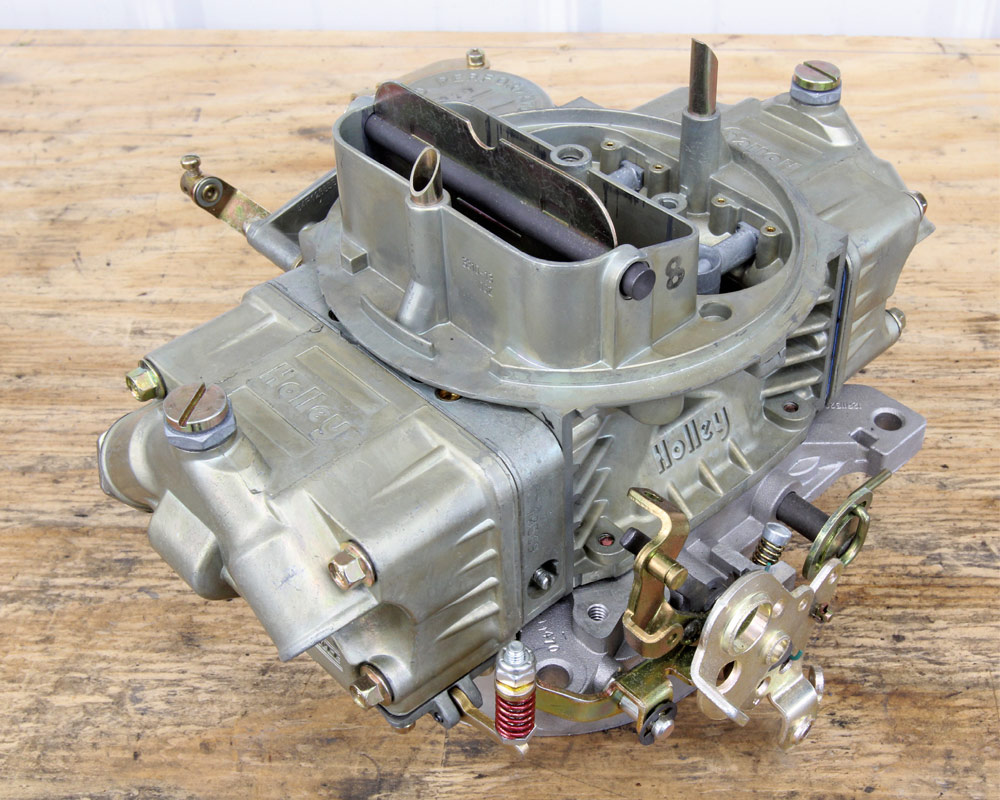
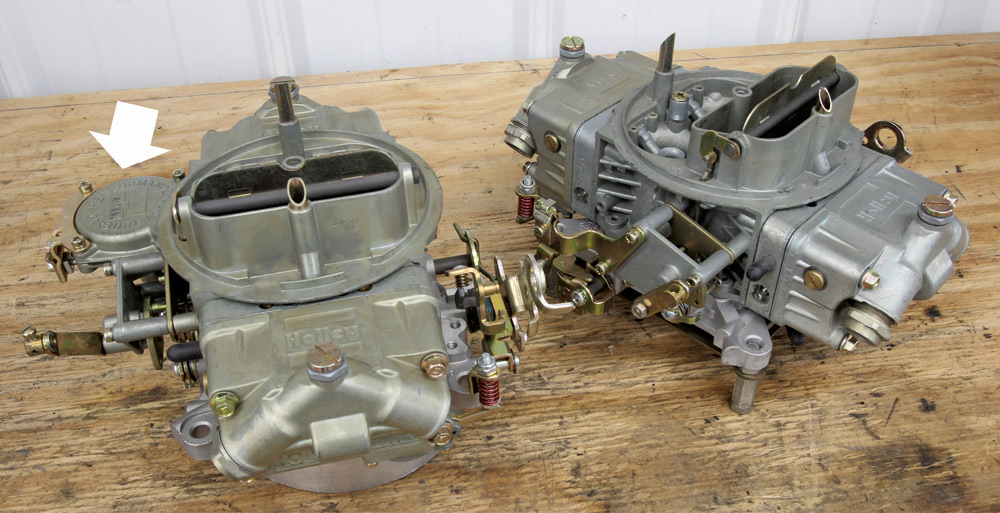
We’ll start this overview with perhaps the most popular carburetor in the modern performance age: the Holley 4150/4160 model four-barrel. We’ll choose a vacuum secondary version of this 750 as the 0-3310, which is a 4160 model. The difference in these model numbers refer to whether the carburetor uses a secondary metering block with replaceable jets or a secondary metering plate where the metering can be changed only by exchanging the entire plate. The 0-3310 is a 4160 carb using the secondary metering plate, which also makes the carb’s overall length shorter. This is important when buying a dedicated fuel line because a dual-feed fuel line for a 4160 model Holley will be shorter than one for a 4150 carb.
The Holley’s advantages are numerous. Because of its universality, parts like jets, power valves, gaskets, accelerator pump nozzles, and rebuild kits are readily available through hundreds of sources. Another advantage is that the primary and secondary metering blocks are easily accessed by removing the fuel bowls to access the idle feed restrictors, jets, and power valve(s). Float level is also externally adjustable, which is a tuning factor only available on Holley and the Summit carburetors. This makes the Holley very easy to work on because of its modular design, although you must drain the fuel from the bowls to access the jets.
Furthermore, there is an enormous amount of information both in print and online on how to tune and modify a Holley carburetor. So even if you are not conversant on carburetor tuning, there is plenty of information on these carburetors to give you a solid base from which to start.
As long as your engine is at least 300 ci or larger and idles with a manifold vacuum level of 11-12 inches of mercury (Hg) or higher, this particular Holley will work very well with some minor tuning changes required. All vacuum secondary Holleys come with a very stiff vacuum diaphragm spring that delays the opening of the secondaries. A good early tuning recommendation would be to buy a vacuum diaphragm spring kit and experiment with a lighter spring to open the secondaries sooner. The purple spring is good choice for most mild street engines.
On the liabilities side of the ledger, the modular design of the Holley places fuel above the gaskets, which can contribute to leaks when the gaskets become old and brittle. Plus, modern fuel has changed radically and chemicals like ethers and benzene can cause the rubber O-rings in the primary and secondary needle and seats to crack (especially if stored for long periods of time), which can cause the float level in the bowl to rise and cause the engine to run excessively rich.
Older Holleys also were susceptible to backfires that can rupture the power valve but all-new Holleys built in the last 10 or 15 years are equipped with an anti-backfire feature that protects the power valve from damage. The abovementioned vacuum diaphragm spring is difficult to change and if you are not careful the thin diaphragm can be easily torn during the conversion. But with practice, you can successfully change spring without damaging the diaphragm.
Overall, the typical Holley four-barrel carburetor is a great performance component that with a little careful and accurate tuning can be a great street carburetor.
Rochester Quadrajet
More than any other carburetor, the Q-jet is perhaps the most universally maligned. This is mainly due to the fact that this carburetor is also the most sophisticated fuel mixer of any four-barrel carburetor. The most important point to emphasize is that each Rochester Q-jet was designed for specific engine applications like a 390hp 427ci Corvette or for a 1979 305ci El Camino.
Nearly all Q-jets are rated at 750 cfm, which is also something that is rarely mentioned, yet this small primary design offers excellent part-throttle response. Because these carburetors are aimed at a fairly narrow range of engine applications, applying a used Q-jet to your specific use might be problematic. PN 34002 is from JET Performance and is aimed at a performance small-block that is specifically tuned for an engine with a mild cam of between 210 and 220 degrees of duration at 0.050-inch tappet lift with headers and a performance dual-plane intake manifold. This Stage 2 carb is specifically tuned for this application and will offer all of the advantages of a Q-jet while still flowing enough fuel to meet the demands of a mild performance small-block. JET also offers carburetors tuned for big-block use.
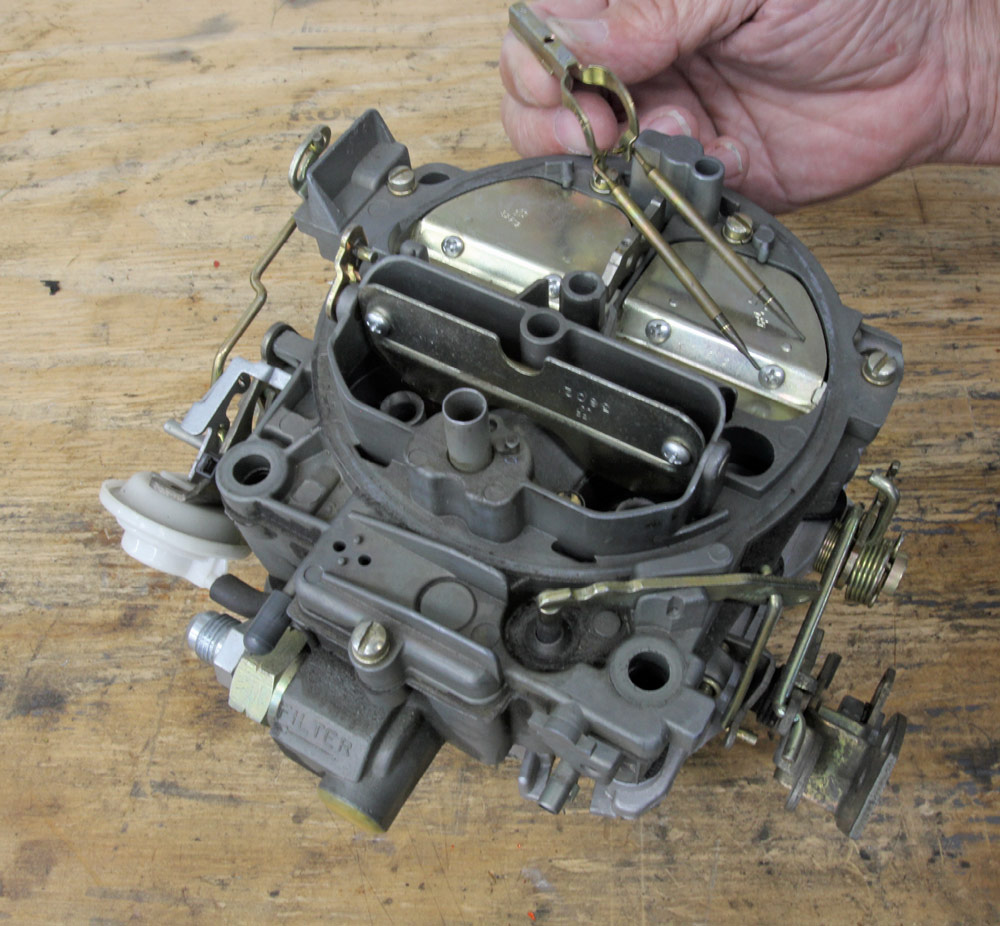
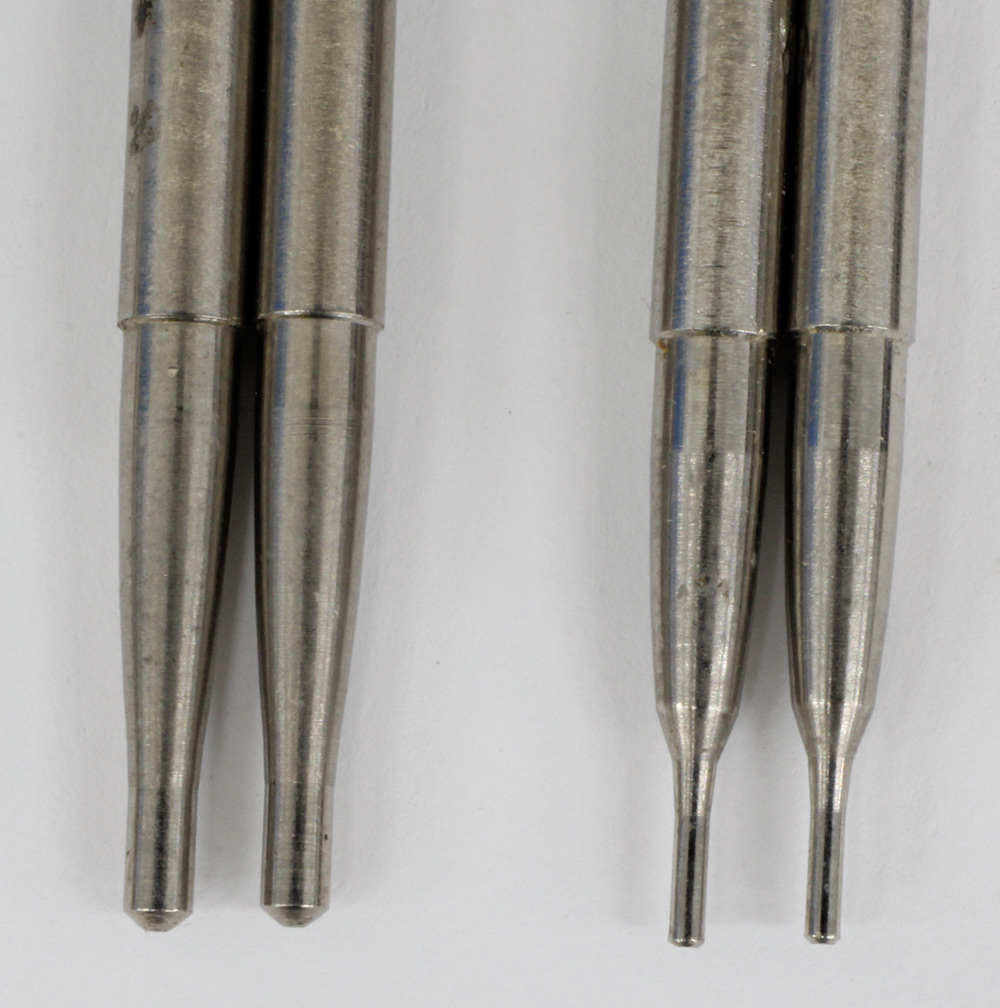
What makes this carburetor sophisticated is its use of both a primary metering jet combined with a tapered metering rod controlled by a tiny piston and coil spring that controls the position of the metering rod in the jet. With high engine vacuum and low load, the spring positions the tapered metering rod deep into the primary jet, reducing fuel flow. As load increases, the metering rod rises out of the jet and the thinner diameter flows more fuel.
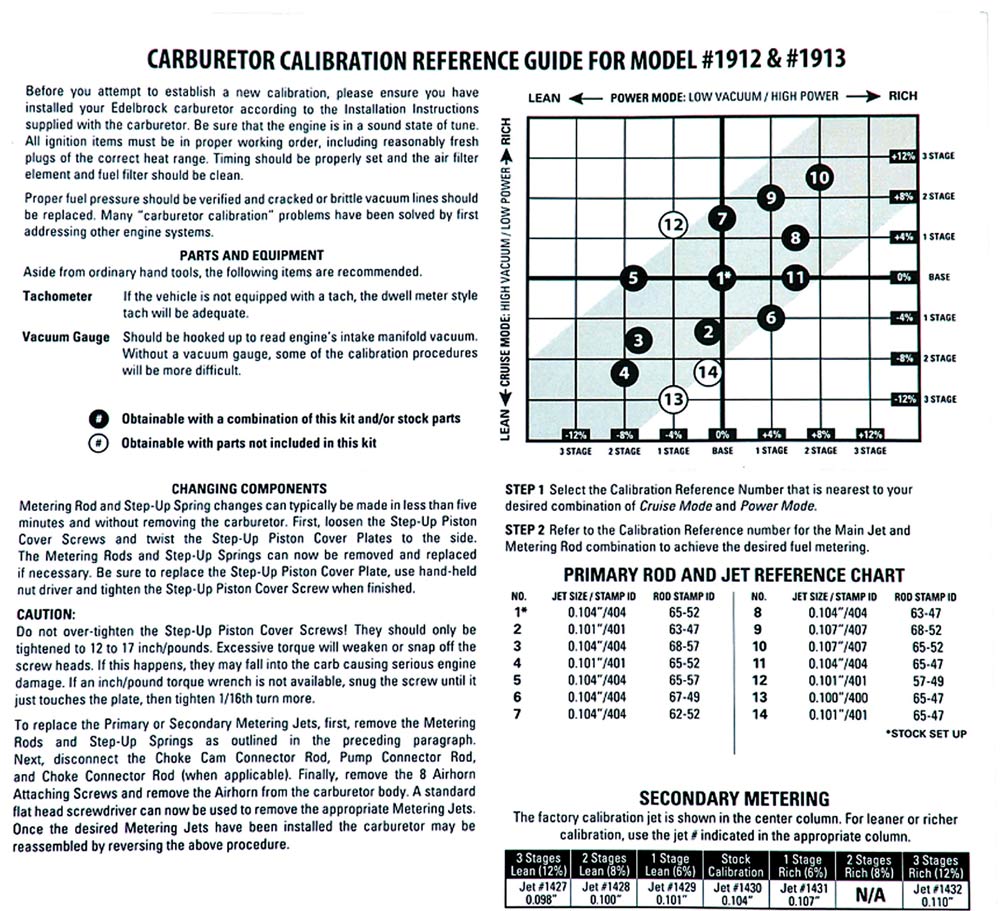
This allows the tuner to very specifically calibrate the amount of fuel delivered during part-throttle operation. Some Q-jets even offer an external adjustment to the primary metering rod position called APT (adjustable part throttle). So, for even just primary metering you have the options of changing the power valvespring, the primary metering rod, or the primary jet. This offers a broad range of part-throttle tuning options.
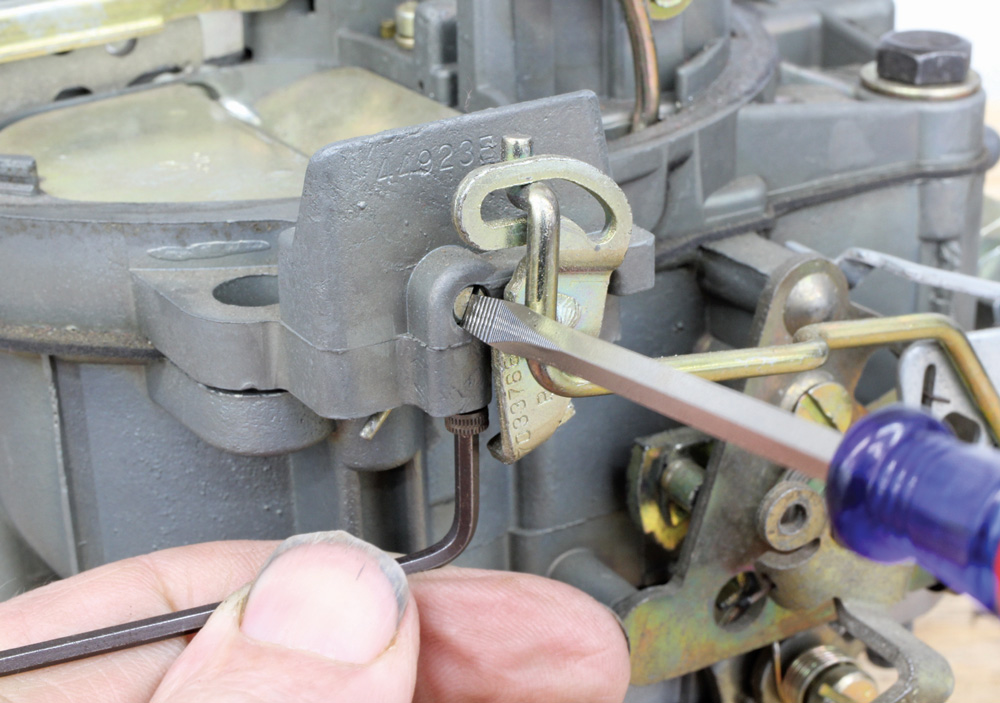
On the secondary side, the metering rods are easily accessed with a single screw that allows removing the hanger to access the two secondary metering rods. The secondary jets are fixed so all secondary metering tuning is accomplished by changing the metering rods and the hanger.
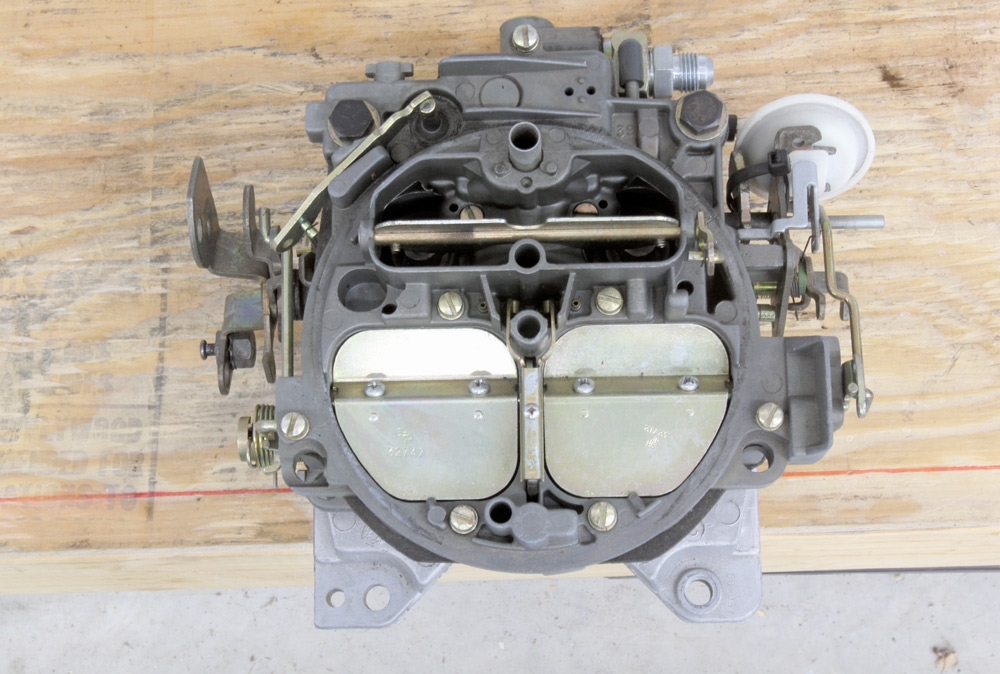
Where the Q-jet gets its bad reputation is from the secondary air valve door operation. Hackers who don’t understand how it works often loosen the adjustment spring to allow the door to open too quickly. Since there is no secondary accelerator pump like on a mechanical secondary Holley for example, adjusting the secondary spring too loosely will create a hesitation or bog. Luckily, this can be easily fixed with a simple adjustment of the secondary air-valve door tension spring.
On the liability side of the Q-jet the biggest issue is that it is a very complex carburetor to work on. To access the primary metering rods the lid must be removed, which requires removing nine small machine screws along with the accelerator pump rod and the two large 5/16-inch bolts that attach it to the manifold. With practice this will become easy but it is still a hassle.
Another downside is that tuning parts like primary and secondary metering rods, power valvesprings, secondary hangers, and the like are difficult to find. JET Performance offers some parts with a wider selection from a company called Quadrajet Power. Older Q-jets also suffer from absorbing fuel into the plastic float that can lead to rich operation due to high float levels. Older Q-jets from the ’70s can also suffer from casting porosity issues that allow the fuel to leak out of the float area into the intake manifold, and the only solution is to replace the main body.
Overall, if you have carburetor tuning skills, the Q-jet can be an excellent choice for an engine making 475 hp or less. This is an arbitrary horsepower number but is driven by the fact that the entire carburetor is fed through a single inlet instead of dual inlets like a Holley. This limits fuel flow on high demand applications, which is why this is a carburetor best aimed at applications of less than 475 hp.
Edelbrock AVS2
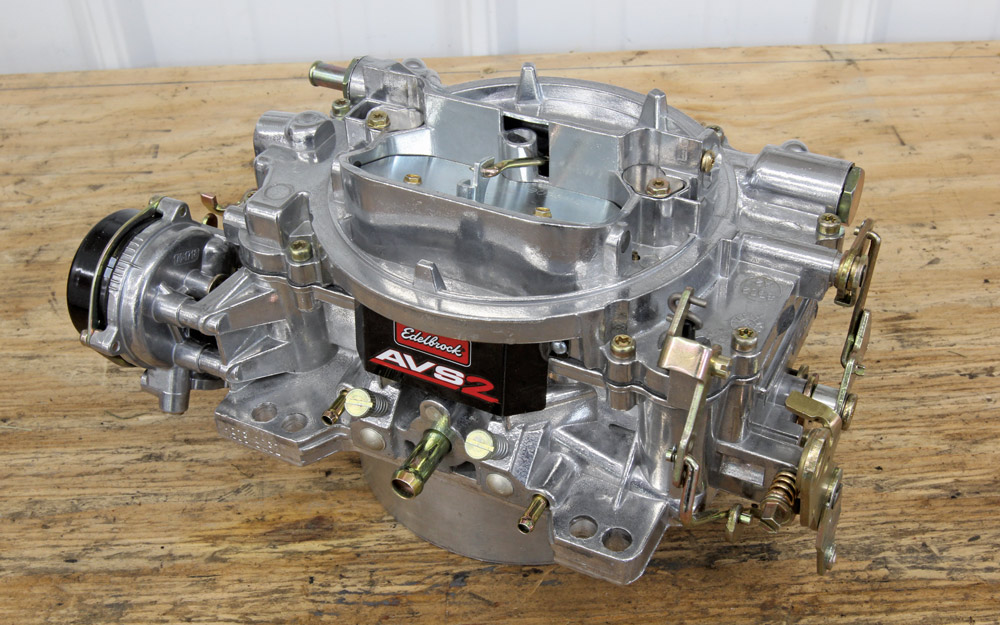
The Edelbrock AVS or air valve secondary carburetor has been around for many years. It is based on the older Carter carburetor design from the ’60s. Recently, Edelbrock improved upon the original design by adding an annular discharge fuel nozzle to the primary side of the carburetor. Without going too deeply into this, an annual discharge nozzle releases fuel into the carburetor from multiple points around the inside of the booster as opposed to discharging fuel from a single hole in the booster. This produces a more even flow of fuel in smaller droplets, especially at lower engine speeds where inlet air velocity is also slower.
The advantage of using an annular discharge booster is that it tends to improve throttle response at low engine speeds. When this carburetor was first introduced, we performed a test where we measure throttle position versus mild acceleration against a 4160-style Holley carb of the same cfm rating. We discovered that the car would accelerate at the same rate (by measuring the time to accelerate to a given speed) with a measurably smaller throttle position using the AVS2 carb.
In practical terms, what this means is that the annular discharge AVS2 offered sharper throttle response than a typical Holley carb of the same cfm. With a more aggressive throttle opening like whacking the throttle to wide-open throttle from a dead start, we experienced no noticeable difference in acceleration. But because street driving is all about light throttle acceleration, the difference offered by the annular discharge boosters was noticeable.
Other features about the AVS2 include its use—like the Q-jet—of a metering rod controlled by a power valvespring that extends into the primary jet. But the AVS2 offers much easier access to these parts without removing the top of the carburetor. Several times we have found that merely changing to a lighter power valvespring can result in improved fuel mileage and even better throttle response for mild engines. This is where the Edelbrock enjoys a slight edge over the Q-jet in terms of ease of tuning.
The Edelbrock carb, like the Q-jet and the Summit carb, employs a design where all the fuel is located below the parting line gasket so external fuel leaks should be nearly non-existent. Also like the Q-jet the AVS2 is a mechanical secondary carburetor with a spring-loaded air-valve door. This makes tuning the air valve very easy compared to the more-complex Holley diaphragm.
The Edelbrock is somewhat limited in fuel flow because it uses only a single fuel inlet. Like the Q-jet, this limits fuel flow through a single needle and seat so even with its 800-cfm airflow capacity this carburetor is limited to roughly 475hp power output. This is fine for small- and somewhat mild big-blocks. When you consider that few daily driven engines honestly make 500 flywheel horsepower, this should not be considered a major limiting factor for most street engines.
Overall, this is a great street carburetor for mild street engines that is easy to tune and will deliver excellent street manners over thousands of miles of street use.
Summit 750
This is Summit’s version of the original Holley 4010 square flange carburetor that was a significant departure from the original modular Holley configuration. There are many ideas incorporated into this design that could be considered improvements over the traditional Holley. Among the most important is the use of annular discharge boosters in all four barrels. As mentioned previously with the Edelbrock AVS2, annular boosters offer a significant improvement over even the more accepted drop leg boosters used in most performance Holleys. While not an aspect that can add horsepower, but for a street carburetor these boosters significantly improve throttle response and driveability.
Other design aspects worth mentioning are that like the AVS2 and Q-jet the fuel level is always below the gasket level, which extends the life of these gaskets. The jets, power valves, vacuum secondary diaphragm, and accelerator pump cams are typical Holley replacement items, so these parts are easy to obtain from a wide range of sources.
The carburetor itself is quite simple with a throttle plate, main body, and a lid as the main components. Another small advantage to this design is that if you desire to change jets, all that’s required is removing the main air cleaner nut, eight lid screws, and unclipping the choke rod from the electric choke housing. This allows removing the lid where you can change jets without having to drain fuel.
In terms of performance, while this carburetor looks very different, it actually executes its fuel mixing duties extremely well. We once compared this Summit 750 to a typical 4150 Holley 0-3310 750 on a mild small-block Chevy engine on the dyno and with slight jetting changes to both carburetors to optimize their performance for the dyno engine, we witnessed peak power within 1 hp of the Holley.
If this carburetor has a weak spot, it might be its aluminum alloy material. While significantly lighter than its zinc and pot metal compatriots, aluminum tends to absorb heat so it could become susceptible to heat soak on very hot days. One way to combat this issue would be to use the spacer gasket supplied with the carburetor between it and the intake manifold, which will help keep the carburetor cool. We have not experienced this issue, but the potential is there with any aluminum alloy carburetor.
The Summit carburetor offers the standard, square flange mounting pattern, is furnished with an electric choke and also with a dedicated dual-feed fuel line as part of the package. When you price compare of all these carburetors, the Summit 750 is only threatened by the AVS2 but still wins the current price comparison with a distinct advantage.
As you can probably tell by now there are no bad choices here in this four-carb evaluation. Yes, the Q-jet is clearly the most complex and difficult to work on, but we can honestly say from personal experience that this carburetor can be made to perform wonderfully with the right tuning expertise. The Holley is likely the best decision if you want to fit in with tradition. However, the AVS2 and Summit carbs both offer the advantages of superior off-idle throttle response with their annular boosters. What we likely have done here is to make the decision more difficult with all this additional information, but that’s far better than going in blindly following only what your brother-in-law recommends. Just ask him if he’s ever had the air cleaner off on his own car!