




Repairing Weather-Damaged
1967 Chevelle Sheetmetal
We Break Down Four
Top 750-cfm Models so
You Don’t Have To
Repairing Weather-Damaged 1967 Chevelle Sheetmetal
We Break Down Four Top 750-cfm Models so You Don’t Have To

Preview Issue





 TOC
TOC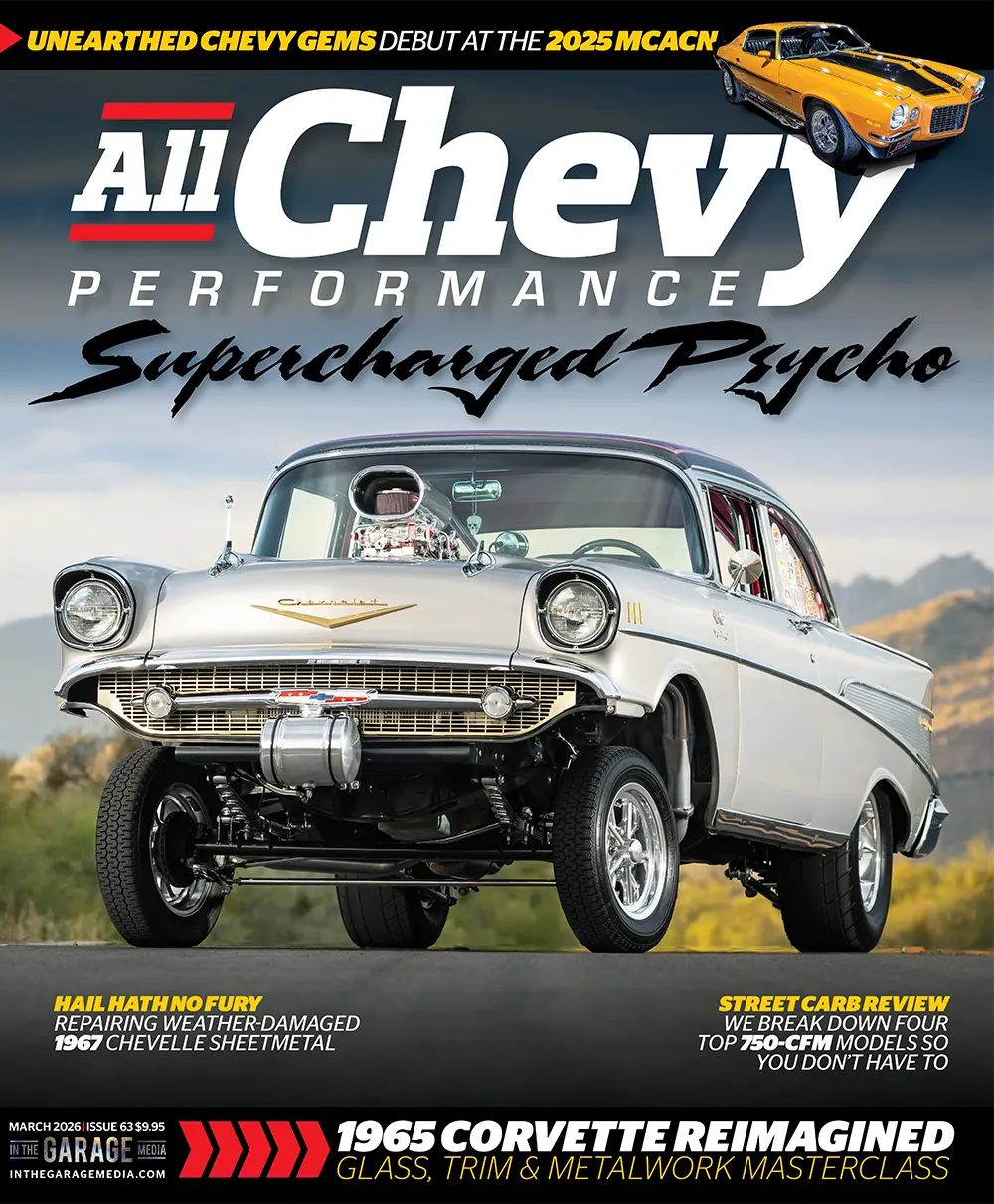
Cover image by Fuelish Media.







“Rotten” Rodney Bauman, Jefferson Bryant, Tommy Lee Byrd, Ron Ceridono, Ron Covell, Grant Cox, Fuelish Media, John Gilbert, Tavis Highlander, Jeff Huneycutt, Barry Kluczyk, Scotty Lachenauer, Patrick Lauder, Jason Lubken, John Machaqueiro, Ryan Manson, Jason Matthew, Josh Mishler, NotStock Photography, Todd Ryden, Jason Scudellari, Jeff Smith & Chuck Vranas – Writers and Photographers
Travis Weeks Advertising Sales Manager
Patrick Walsh Sales Representative
ads@inthegaragemedia.com
AllChevyPerformance.com
ClassicTruckPerformance.com
ModernRodding.com
InTheGarageMedia.com
inthegaragemedia.com “Online Store”
For bulk back issues of 10 copies or more, contact store@inthegaragemedia.com
info@inthegaragemedia.com
Editorial contributions are welcomed but editors recommend that contributors query first. Contribution inquiries should first be emailed to info@inthegaragemedia.com. Do not mail via USPS as we assume no responsibility for loss or damage thereto. IN THE GARAGE MEDIA, INC. reserves the right to use material at its discretion, and we reserve the right to edit material to meet our requirements. Upon publication, payment will be made at our current rate, and that said, payment will cover author’s and contributor’s rights of the contribution. Contributors’ act of emailing contribution shall constitute and express warranty that material is original and no infringement on the rights of others.

Copyright (c) 2026 IN THE GARAGE MEDIA, INC.
PRINTED IN U.S.A.


 firing up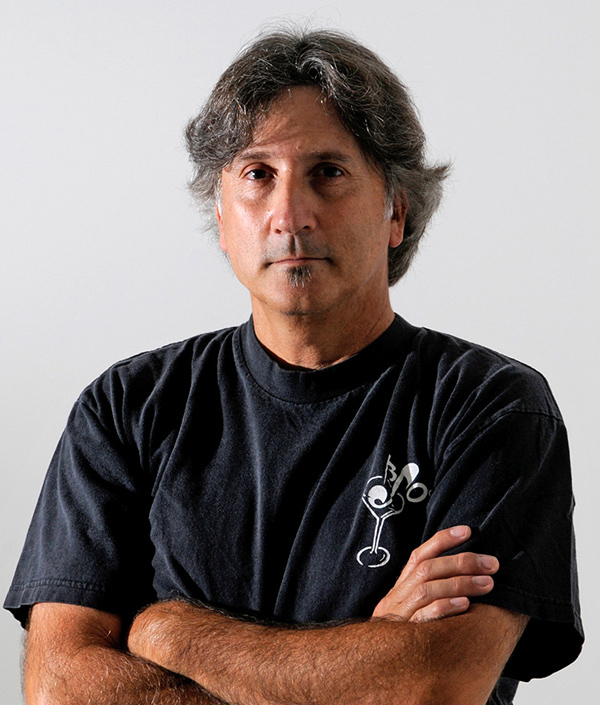
 BY NICK LICATA
very year thousands of automotive enthusiasts make the pilgrimage to Las Vegas for the annual SEMA show to catch up on the latest happenings in the automotive aftermarket world. There is never a shortage of companies debuting new products geared toward making your car run faster and look cooler—you know, stuff we probably don’t need. Skip that … it’s stuff we absolutely need!
Amid the flood of new products at the Las Vegas Convention Center, many companies showcase top-tier muscle car and hot rod builds from some of the country’s best builders, using these standout vehicles to draw potential buyers into their booths. It’s a brilliant tactic that does exactly what it’s supposed to do. But, most of these cars are not just attractive emptiness—far from it—these vehicles are projects that builders have spent years working on to show off their incredible car building talents at the most high-profile automotive spectacle in the world.
What would be considered more coincidence than by design, every SEMA show has a heavy presence of a particular brand and model of muscle car. I remember previous SEMA shows where Mopars dominated the show, while there have been a number of years where you couldn’t turn a corner without the possibility of scratching a first-gen Camaro with your backpack. This year’s SEMA show revealed an unusually high volume of C1 to C3 Corvettes—all incredible cars built in Pro Touring, Day Two, and restomod styles—many featuring the most amazing one-off fabrication parts developed with surgical precision and glistening paintjobs that didn’t just seek but demanded your attention. It was an unforgettable gathering of the most innovative Corvettes I’ve ever seen at SEMA, and I truly believe this one will be hard to beat.

 PARTS BIN




 CHEVY CONCEPTS
InTheGarageMedia.com
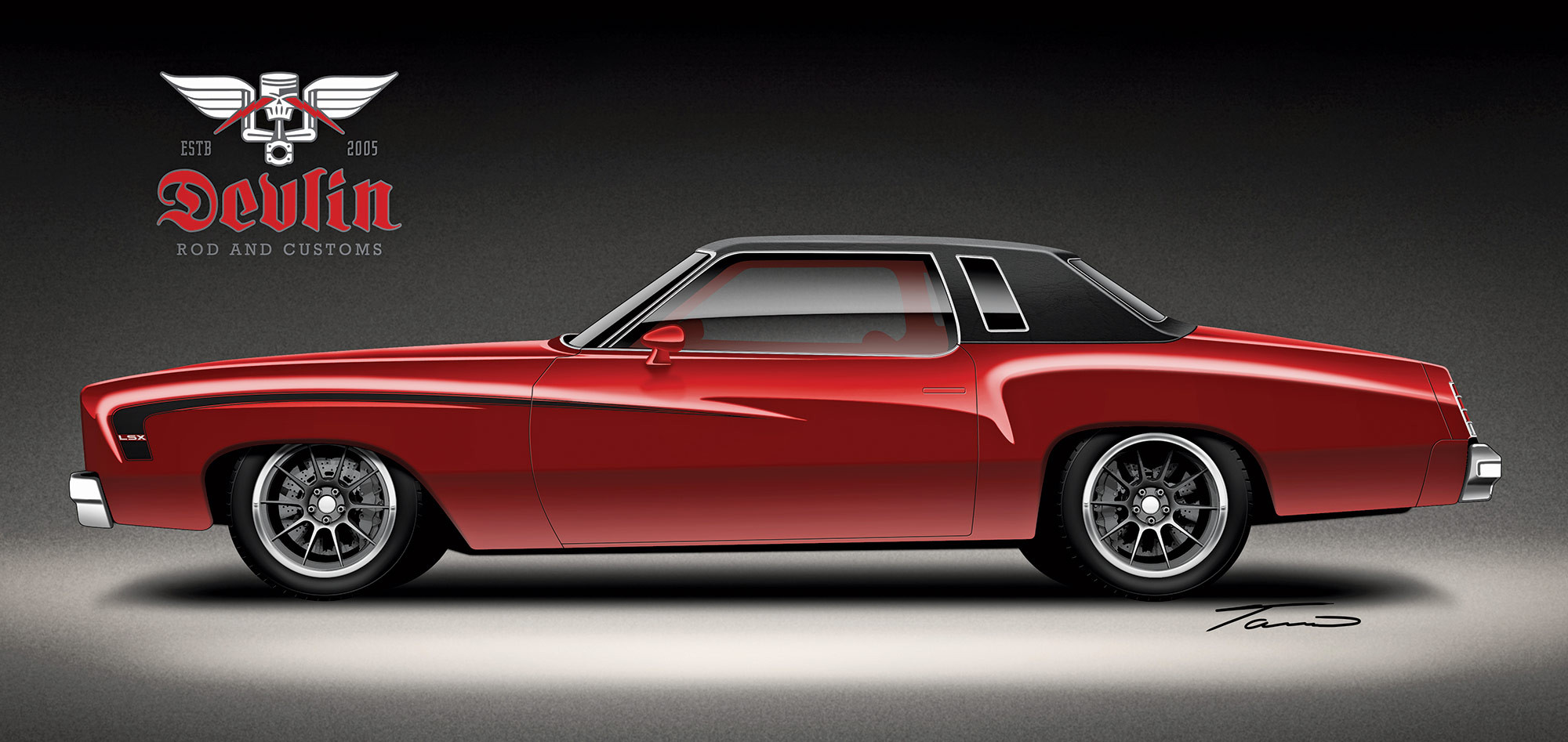


 Text & Rendering by Tavis Highlander
hese big grilled monsters don’t get much attention from hot rodders. The guys at Devlin Rod and Customs were able to work their magic on it, though. First up was the powertrain. There’s no two-barrel 305 under the hood of this Monte. Instead, Devlin installed a 625hp 7.0L LSX with a 4L80E to back it up. Detroit Speed suspension, Wilwood disc brakes, and a 9-inch rearend get this thing going, stopping, and turning.
Seventeen- and 18-inch Billet Specialties wheels get the exterior headed in a better direction. Cut-down and tucked bumpers clean up the look further. A simple touch to the outside was to add some sort of graphic to break up the sides of the Monte. On the front fenders a simple hockey stripe was designed to accent the stock body lines.
 FEATURE
 Images by THE AUTHOR
ike many of us, Steve English of Vail, Arizona, has been a car guy since he was very young (8 years old in Steve’s case). When he grew out of playing with Hot Wheels, he made the leap into buying a 1978 Firebird Formula in 1981. A year later he joined the U.S. Air Force, first stationed in Jackson, Arkansas, and then overseas. That car followed him for both trips and when Steve got back home in 1988, he made more plans for the Firebird. He decided on selling it off to buy a 1985 Monte Carlo SS that he held onto until 2015. By this time, Steve had retired from the service and had owned that Monte Carlo for over two decades. He decided it was time for something new, and luckily his partner in crime, his wife, Margot, was thrilled to be along for the ride.

 TECH
TECH
 Images by The Author
ou see the quotes all the time on the Internet: someone asks a simple forum question, “Hey, which carburetor would be a good choice for my car?” The responses are filled with personal rebukes about how poorly a certain carburetor performs, like “All those Q-jets are Quadra-bogs” or “Those Edelbrocks are junk” or “Holleys are nothing but a calibrated leak.”
What are rarely mentioned are specific positive and sometimes negative points of these carburetors. Based on this lack of detailed feedback, we thought we’d address this issue by evaluating four completely different carburetors: a Holley 4150, a Rochester Q-jet from the ’70s, an Edelbrock AVS2, and Summit’s four-barrel version. These are all 750-cfm carburetors except for the Edelbrock, which is rated at 800 cfm. We’ll take a close look at each one. We will not choose one over the other but rather let your specific application make the decision. How you intend to use your carburetor may well influence its choice. That’s something that is rarely mentioned.
For the purpose of this story, we will focus on mild small- or big-block Chevy engines that make less than 500 hp. These will be engines used in daily driven or mild performance applications with conservative cam timing numbers where their primary function is street use with throttle response, driveability, and fuel mileage of significant concern.




 FEATURE
 Images by The Author
Scott Mayo’s 1968 Camaro
e are, in many ways, shaped by our environment and the people we spend time with, as well as the interests they pursue—intentionally or not. The passions we develop, the skills we acquire, and even the paths we choose often reflect those influences. Growing up, Scott Mayo’s automotive tastes were shaped early by the car guys he hung out with. “I had been hanging around with some guys who had ’67 Camaros,” he recalls, “roughly two years before I bought my first Camaro at 16.” That was in 1973 when he dove in with a slightly abused ’68 Z/28. “The original engine was gone, and it had a 396 big-block when I bought it. I tracked down the original owner—his car had been stolen three times, and the insurance company sold it after the third theft.” Over time, Scott’s collection grew to include a 1990 1LE IROC, a 1970 Z28 RS, a 1997 Z28, a road-race-prepped 1968, a 2002 35th Anniversary Edition sent to GMMG for a Phase 2 conversion, and an all-original black-on-black 1969 Z/28 RS with factory JL8 four-wheel disc brakes. Though these cars were exceptional, Scott sought something more personal: a Camaro that reflected his tastes, one he could enjoy without worrying about devaluing a rare numbers-matching drivetrain or scuffing original paint.
TECH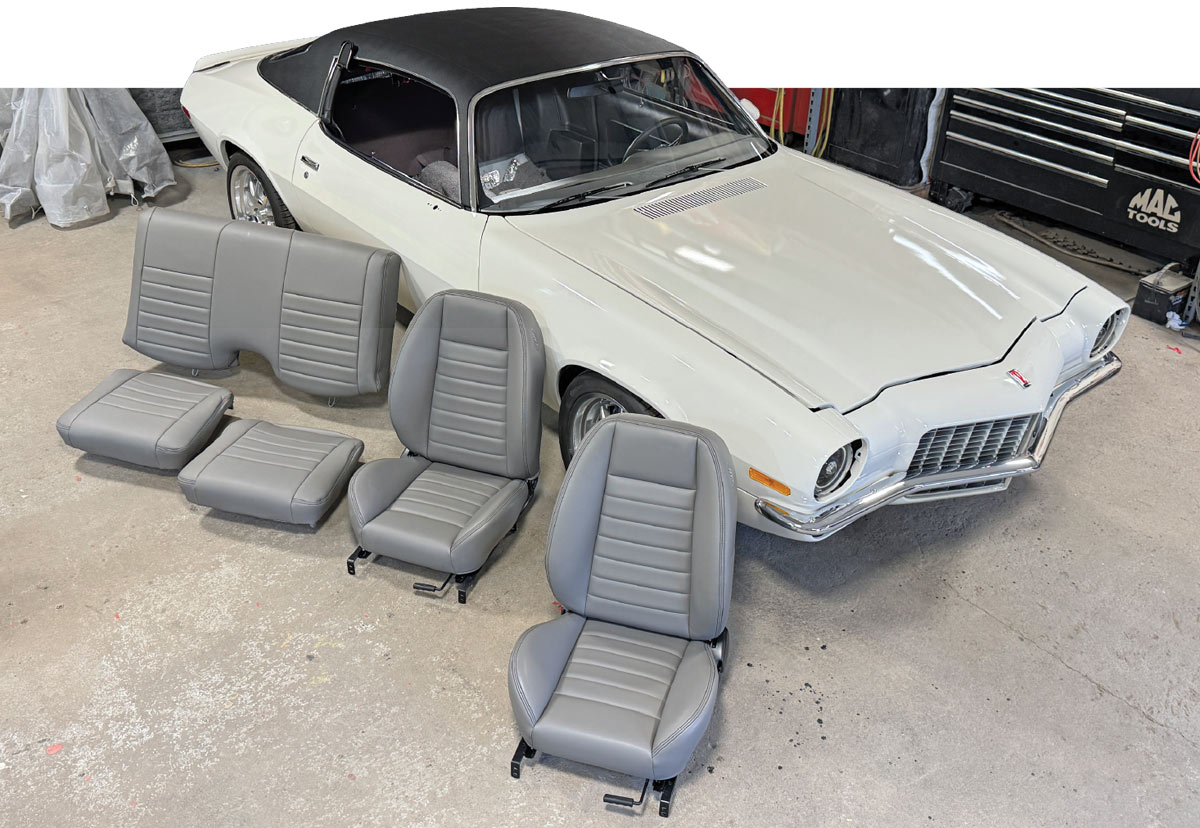 Images by The Author
egardless of whether you’re working on a fresh build or making provisions to improve your existing ride, one of the most important decisions you can make is how to address the interior seating. Picture your Chevy with its buckets or bench removed and study the real estate left within the cabin. This gives you the opportunity to examine the area and make decisions with regard to the vast options available through the aftermarket to give it a timeless new look. Choosing between a custom look, OEM-style, or something in-between offers an endless stream of possibilities regarding colors, textures, and materials available to set the vibe.
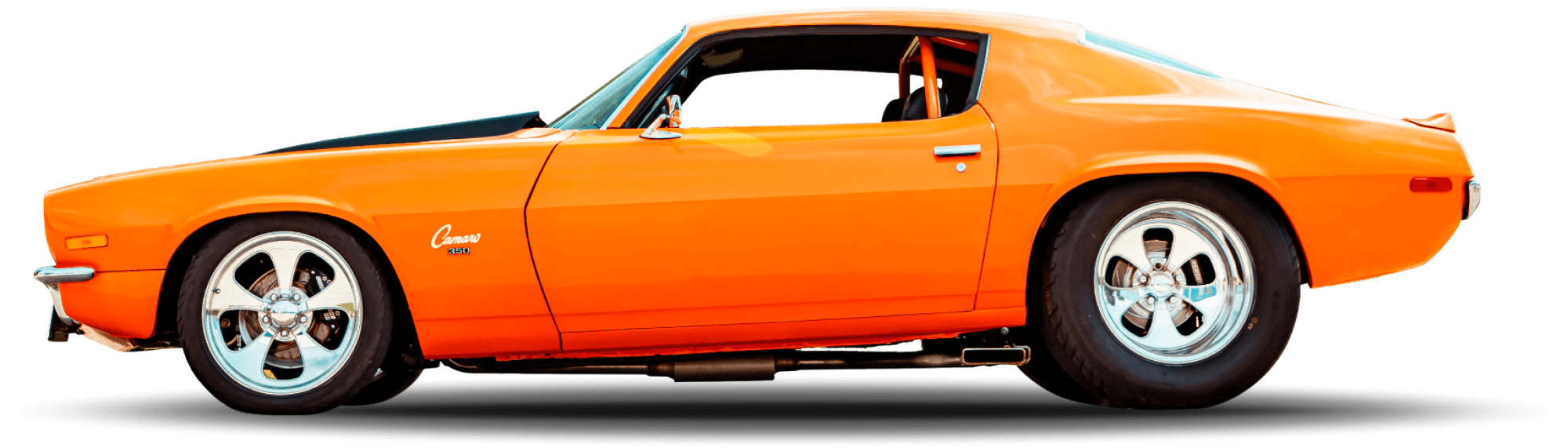
Familiar to many of our regular readers, we’ve covered the buildup of this 1971 Camaro over the past few years in All Chevy Performance magazine. Commencing with a bare shell, it’s taken us on a journey through all aspects of the build, including suspension and brakes, LS engine, cooling, exhaust, sheetmetal, wiring, and insulation, just to name a few. Featuring a scorching 5.3L LC9 linked to a T-56 six-speed manual transmission, it’s a perfect power combination for hitting the streets. This time we’re completing the business office with new material and seating to make driving a dream.


 FEATURE
 Images by NotStock Photography
t’s a familiar story: the one about someone chasing the car that shaped their high school imagination. The only variable is the years they strolled those sacred halls. For Mike Nation, the formative metal came by way of Mötley Crüe and the third-gen Camaro—more specifically, the 1987 IROC-Z. “I’ve always wanted one since they first came out,” Mike says. “I couldn’t afford one back then, but I was finally in a position to set my sights on a clean, original IROC-Z when I found this gem with just 28K on the clock.”
There was just one catch. The seller insisted the car remain original before turning over the Bowtie key chain and attached Camaro keys. “I did not tell him my plans for the car,” Mike says with a sheepish grin. “But in my defense, I did attempt to keep the car as original-looking as possible. One example is that we kept the stock radio and had it converted to Bluetooth, so it looks factory. If he saw the car today, I really think he’d approve.”
 TECH
TECH
 Images by the Author AND Tracy Paskey
ain on your proverbial parade is one thing. Hail on your pride-and-joy 1967 Chevelle is something else. In this particular instance, it’s an interruptive setback to happy motoring.
Around these parts of northwestern Montana, we hear our hail described as “baseball size” and even “softball size” on occasion. When the Big Sky hurls big hail, what’s caught outdoors will surely take a beating.
When we asked Andy Winters (our subject Chevelle’s owner) about his damages, he likened the offending hail size to that of Bing cherries. Although it could’ve been worse, Winters’ insurer might consider his car a total loss—at least according to the first appraiser to come and have a look.


11479 Sixth St., Rancho Cucamonga, CA 91730



 FEATURE
 Images by NotStock Photography
t’s no secret that California is a gold mine for classic car hunters who know where to look. The dry climate has long been a protector of Detroit sheetmetal, offering up sunbaked survivors instead of rusted-out basket cases. For the right buyer, that means finding a solid starting point for a project car that won’t require half your budget in quarter-panels and floorpans.
Larry Fannin of Lewis Center, Ohio, knew exactly where to dig. Back in 2005, after a lengthy Internet search that led him to eBay, he found his dream machine–a 1969 Chevelle sitting in Ontario, California, commonly known to the locals as “The IE” or “Inland Empire.” Larry tells us the car originated from a lady who bought it new and drove it daily for decades. The car took a less predictable turn and spent time in the hands of a local drug dealer who wound up in prison. The car languished in storage until a police officer rescued it and held onto it for years before finally listing it for sale Online.
“The officer had his price and I had mine,” Larry recalls. “After a month of sitting on my offer, the cop finally called and said, ‘You’ve got yourself a deal.’ I jumped on a plane to check it out in person, made it official, and arranged for a hauler to ship the car back to Ohio. I didn’t know the car’s running condition, so I chose not to risk driving it across the country.”
TECH
 IMAGES Courtesy of Roadster Shop
n the first installment of our coverage on this remarkable Corvette—a full-scale reimagining being crafted by the talented team at Roadster Shop—we explored some of the work that went into reshaping the firewall, floor, and interior panels. This time, we’re taking a closer look at a different side of the build: what it takes to fit the glass and trim to a level that goes far beyond factory standards.
Beneath the hood, the inner wheel panels were smoothed and carefully reshaped to nestle cleanly around the new front suspension. New flanged fiberglass panels were fabricated and bonded into place, adding strength and giving the lower edges a finished, coachbuilt look.
The Corvette’s signature side vents also received a complete rethink. New pieces were machined from billet aluminum, and 3-D–printed polymer prototypes were created along the way to perfect the recesses before committing to metal. On the inside, hand-fabricated aluminum panels were added to properly duct air through the functional vents—blending design and engineering in equal measure.

 FEATURE Images by Marc Gewertz
oing things with your father, for your father, or in memory of your father is one of life’s great pleasures. And so it was that Jeff Pont reworked this 1969 Camaro in memory of his father, Duane.
“Duane was a lifelong muscle car enthusiast and for as long as I can remember,” Jeff says, “he dreamed of owning a 1969 Camaro. Years ago, I was blessed to spend a weekend with him at Barrett-Jackson where he fell in love with one particular ’69. I’ll never forget the moment it came across the auction block—I placed a bid, won it, and looked over to see his face filled with pure joy and disbelief.
 EVENT
EVENT
 Images by THE AUTHOR
ard to believe, but we’ve completed another lap around the sun and November has rolled in once again right on schedule. For most holiday-minded folks, the highlight is Thanksgiving. But if you’re the type who prefers a full plate of muscle cars, the Muscle Car and Corvette Nationals (MCACN) at the Donald E. Stephens Convention Center in Rosemont, Illinois, remains the perfect warmup to Turkey Day. Think of the MCACN show as a feast—a variety of irresistible dishes served in one place. No matter which automotive brand you favor, you can count on seeing something new each year thanks to the ever-changing themed displays. It has arguably become the most influential indoor muscle car event in the world.
The 16th edition once again delivered plenty of Bowtie eye candy. In the lobby, attendees were greeted by Bill “Grumpy” Jenkins’ 1972 Pro Stock Vega. A few steps into the main hall brought another iconic racer: Fred Gibb’s first race car, a freshly restored 1967 Camaro Z/28 unveiled on Saturday to help raise the excitement level. Further inside, the Class of 1965 Invitational showcased several L79-equipped Chevelles, including a sub display that featured an entire row of ultrarare 1965 396 Z16-optioned cars. The Fine 09’s Invitational added more Chevrolet flavor, bringing together numerous 409-powered models spanning several years. The Camaro Legends Invitational was a return display once again due to its popularity.
Official unveilings have become a hallmark of MCACN, with restoration shops timing their projects specifically for the show. On Saturday, Peter Brock revealed his latest reinterpretation of the 1963 Corvette from the Peter Brock Studio. The newly restored 1967 Fred Gibb Camaro Z/28, a 1969 Yenko 427 Nova, and a 1969 Baldwin-Motion Phase III Camaro—both the latter owned by Phil Mitchell—also had their covers pulled for their public debut.



Advertiser
- American Autowire31
- American Camaro Association87
- Art Morrison Enterprises13
- Auto Metal Direct9
- Automotive Racing Products7
- Boese Engineering89
- Borgeson Universal Co.33
- Classic Industries29
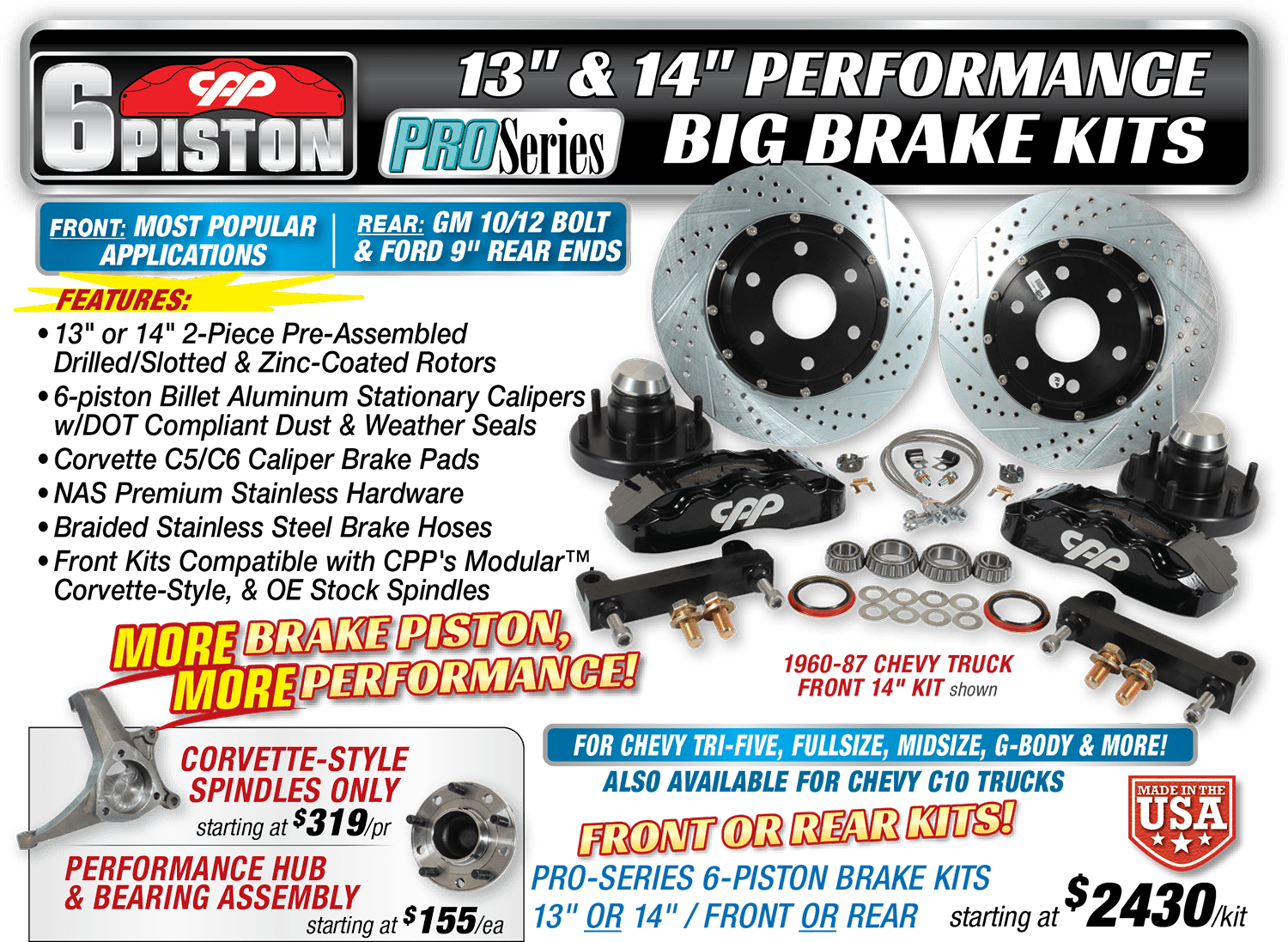
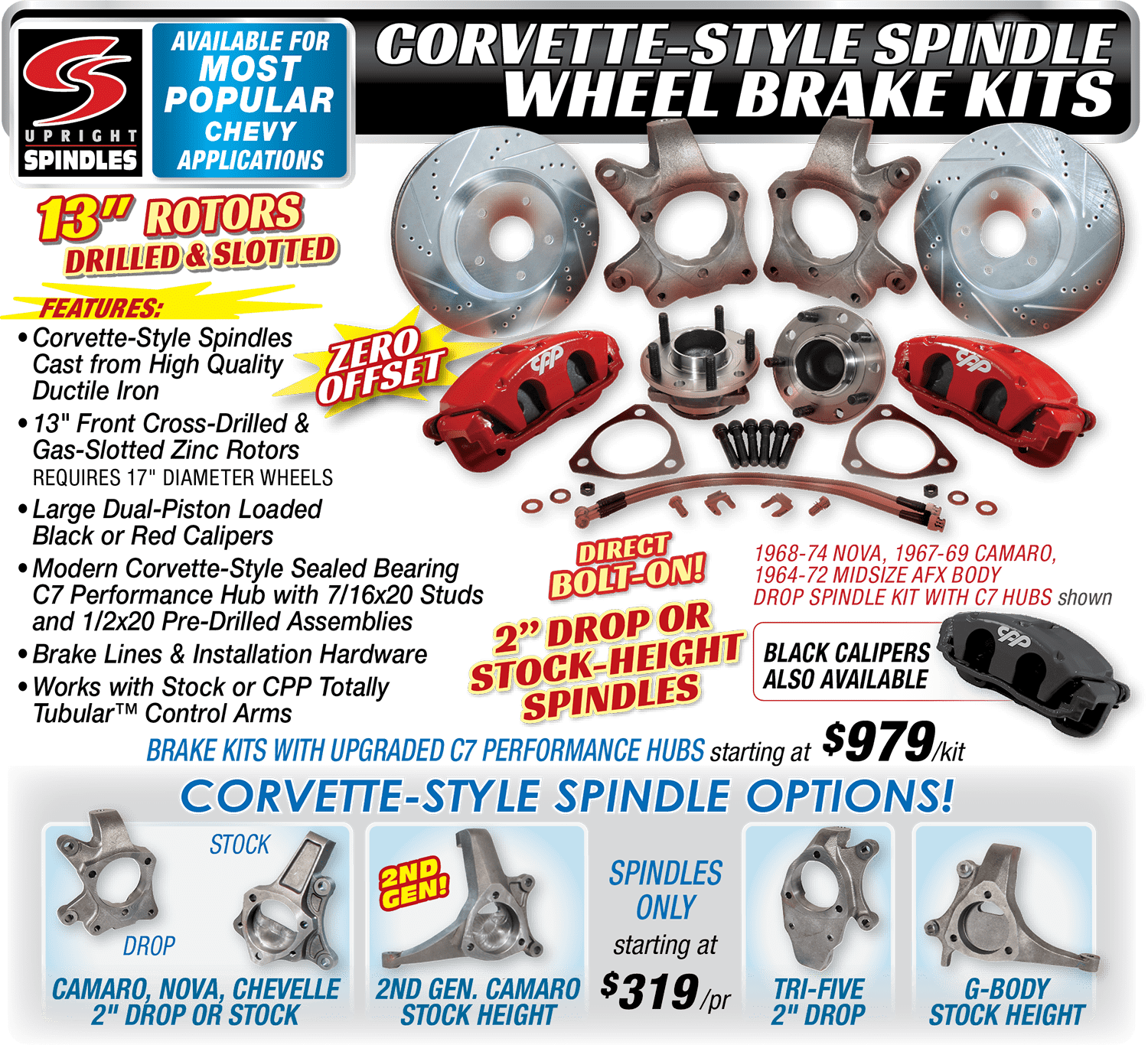
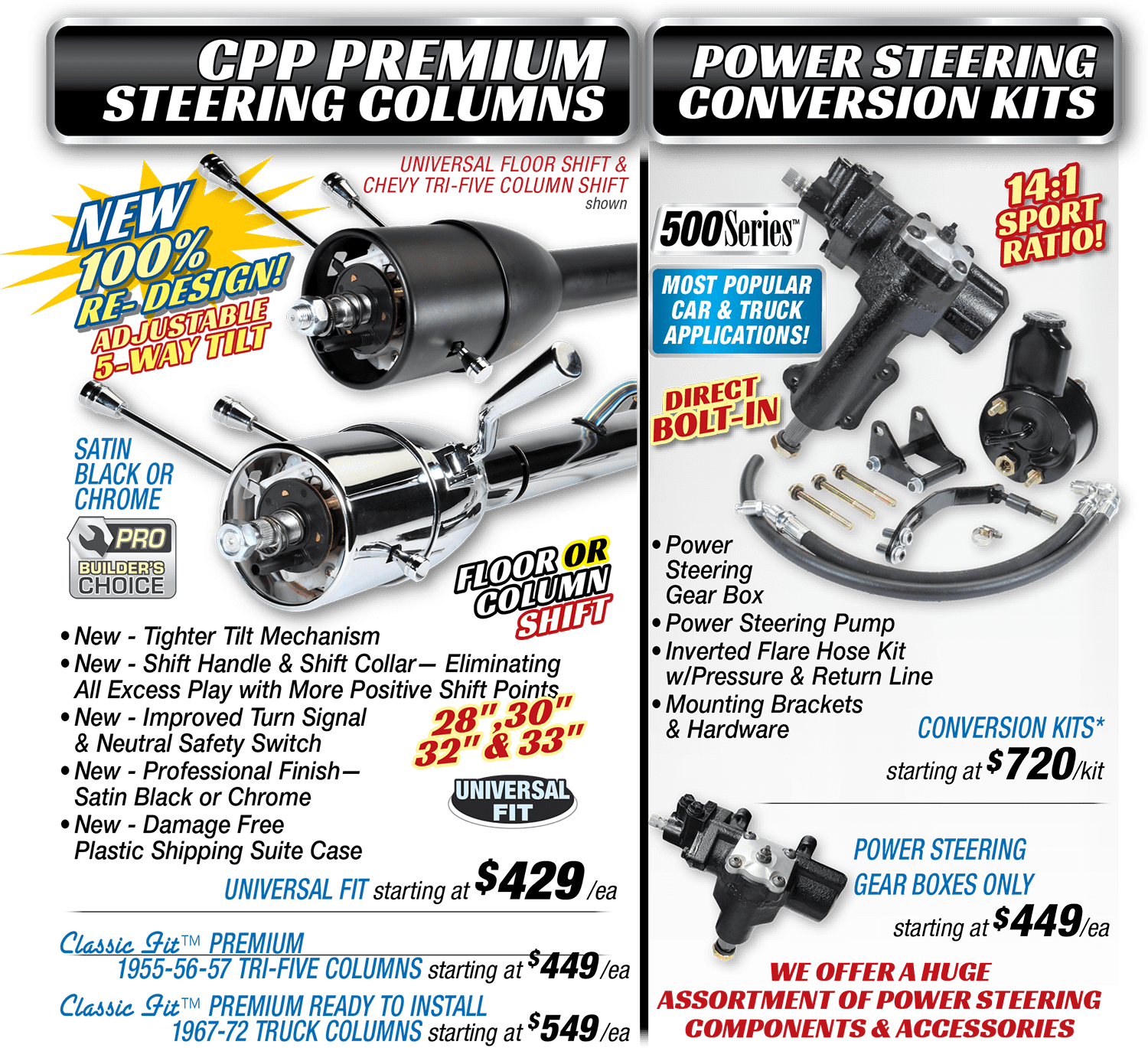
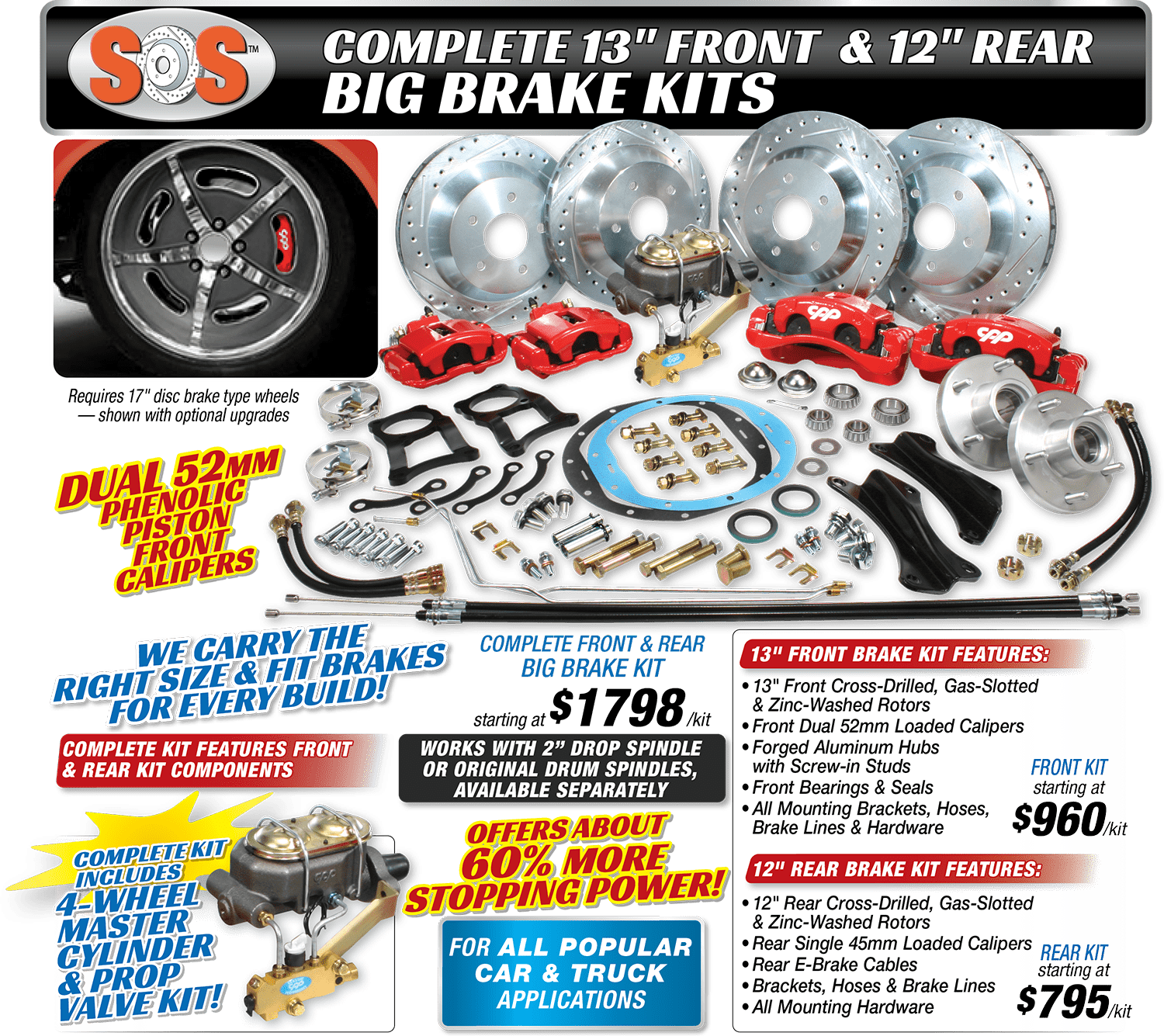
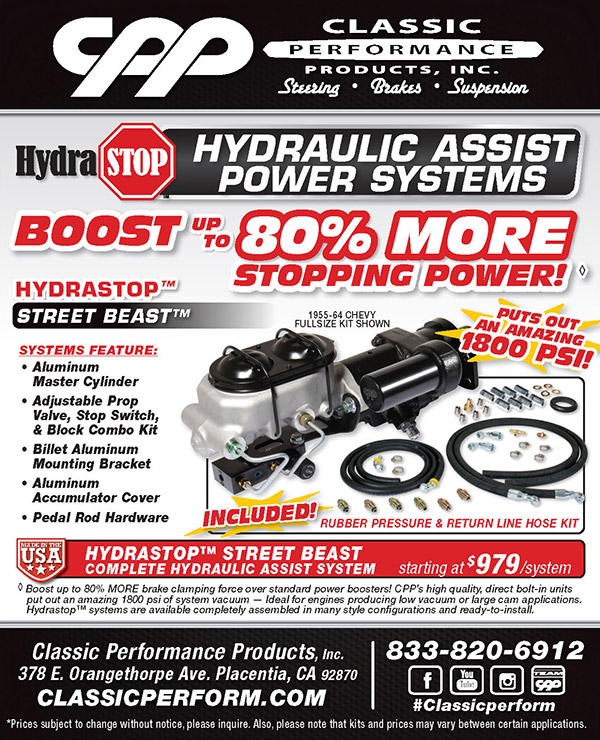
- Classic Performance Products4-5, 87, 92
- Custom Autosound61
- Dakota Digital91
- Detroit Speed45
- Eddie Motorsports59
- FiTech EFI73
- Flaming River Industries27
- Forgeline Motorsports73
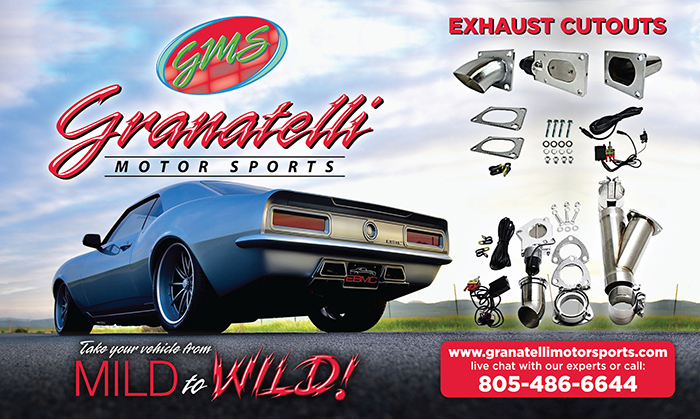
- Granatelli Motor Sports, Inc.85
- Heidts Suspension Systems85
- Holley Performance Products23
- Lokar2
- National Street Rod Association57
- New Port Engineering87
- Powermaster Performance61
- Scott’s Hotrods59
- Specialty Auto Parts USA, Inc.87
- Summit Racing Equipment11
- Triple Crown of Rodding, LLC47
- Wilwood Engineering43