





Workshop
1967 Chevy II
Dash, Cowl, and
Firewall Cleanup
Reinforcement
1965 Corvette
Inner Structure
Strengthening
Preview Issue





 TOC
TOC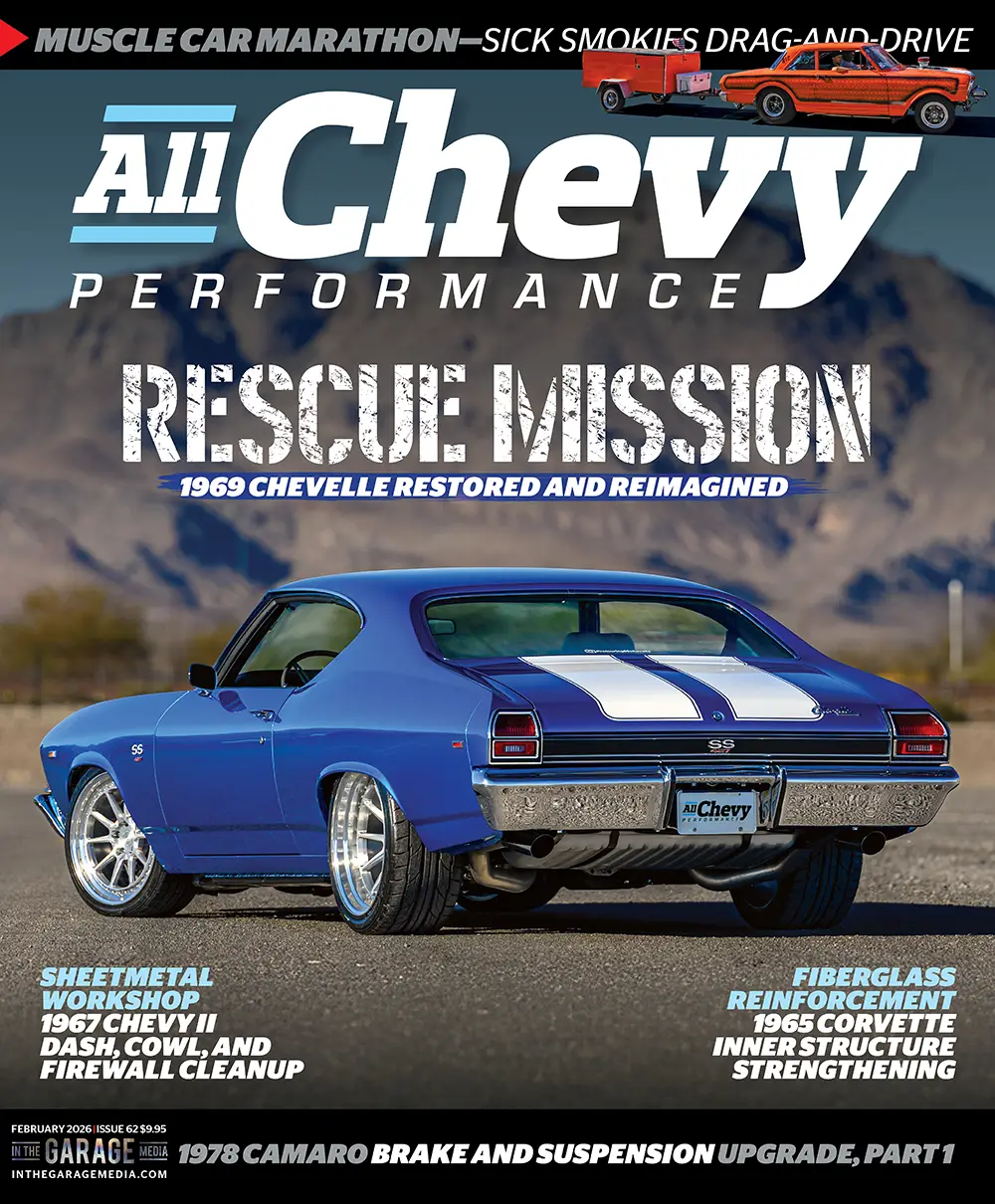
Cover image by Shawn Brereton.








“Rotten” Rodney Bauman, Jefferson Bryant, Tommy Lee Byrd, Ron Ceridono, Ron Covell, Grant Cox, Fuelish Media, John Gilbert, Tavis Highlander, Jeff Huneycutt, Barry Kluczyk, Scotty Lachenauer, Patrick Lauder, Jason Lubken, John Machaqueiro, Ryan Manson, Jason Matthew, Josh Mishler, NotStock Photography, Todd Ryden, Jason Scudellari, Jeff Smith & Chuck Vranas – Writers and Photographers
Travis Weeks Advertising Sales Manager
Patrick Walsh Sales Representative
ads@inthegaragemedia.com
AllChevyPerformance.com
ClassicTruckPerformance.com
ModernRodding.com
InTheGarageMedia.com
inthegaragemedia.com “Online Store”
For bulk back issues of 10 copies or more, contact store@inthegaragemedia.com
info@inthegaragemedia.com
Editorial contributions are welcomed but editors recommend that contributors query first. Contribution inquiries should first be emailed to info@inthegaragemedia.com. Do not mail via USPS as we assume no responsibility for loss or damage thereto. IN THE GARAGE MEDIA, INC. reserves the right to use material at its discretion, and we reserve the right to edit material to meet our requirements. Upon publication, payment will be made at our current rate, and that said, payment will cover author’s and contributor’s rights of the contribution. Contributors’ act of emailing contribution shall constitute and express warranty that material is original and no infringement on the rights of others.

Copyright (c) 2026 IN THE GARAGE MEDIA, INC.
PRINTED IN U.S.A.

 firing up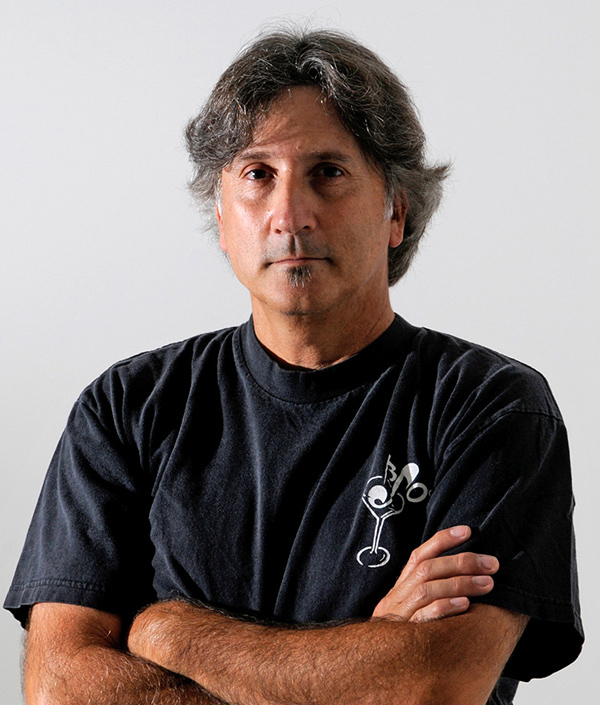
 BY NICK LICATA
uring a recent weekly In The Garage Media editorial meeting with fellow editors, Rob Fortier (Classic Truck Performance) and Brian Brennan (Modern Rodding), the subject came up of how the hot rod, vintage muscle car, and classic truck industry is pricing out new and younger hot rodders. There’s no denying it—most muscle car enthusiasts today are north of 40, and the numbers don’t lie. Younger gearheads typically don’t have the funds to take part in the vintage scene and with classic car values skyrocketing, it’s more difficult for a new generation to get behind the wheel of an old-school ride. With that said, it’s important us veterans do what we can to bring a new blood into the vintage muscle car, hot rod, and classic truck culture.
But, there’s still plenty that can be done. One effective way is to introduce the younger folks to local clubs and cruises. Unfortunately, the majority of today’s high schools lack the auto shop programs that were common 30 years ago. But there are other avenues. Automotive trade schools are another way to introduce younger enthusiasts to restoration, engine building, and fabrication skills, giving them hands-on experience turning wrenches working with sheetmetal. Hearing the sound of a V-8 engine fire up for the first time can create a lifelong passion.
But once again it comes down to cost. Getting into a vintage Camaro, Nova, Tri-Five, or Chevelle can be a costly endeavor even when the restoration process is done in a home garage. With that said, 1980’s G-body cars can be an excellent alternative. Those cars are also climbing in price, but they are still somewhat affordable and are a great platform for an LS swap, opening the door to the hobby without completely breaking the bank.

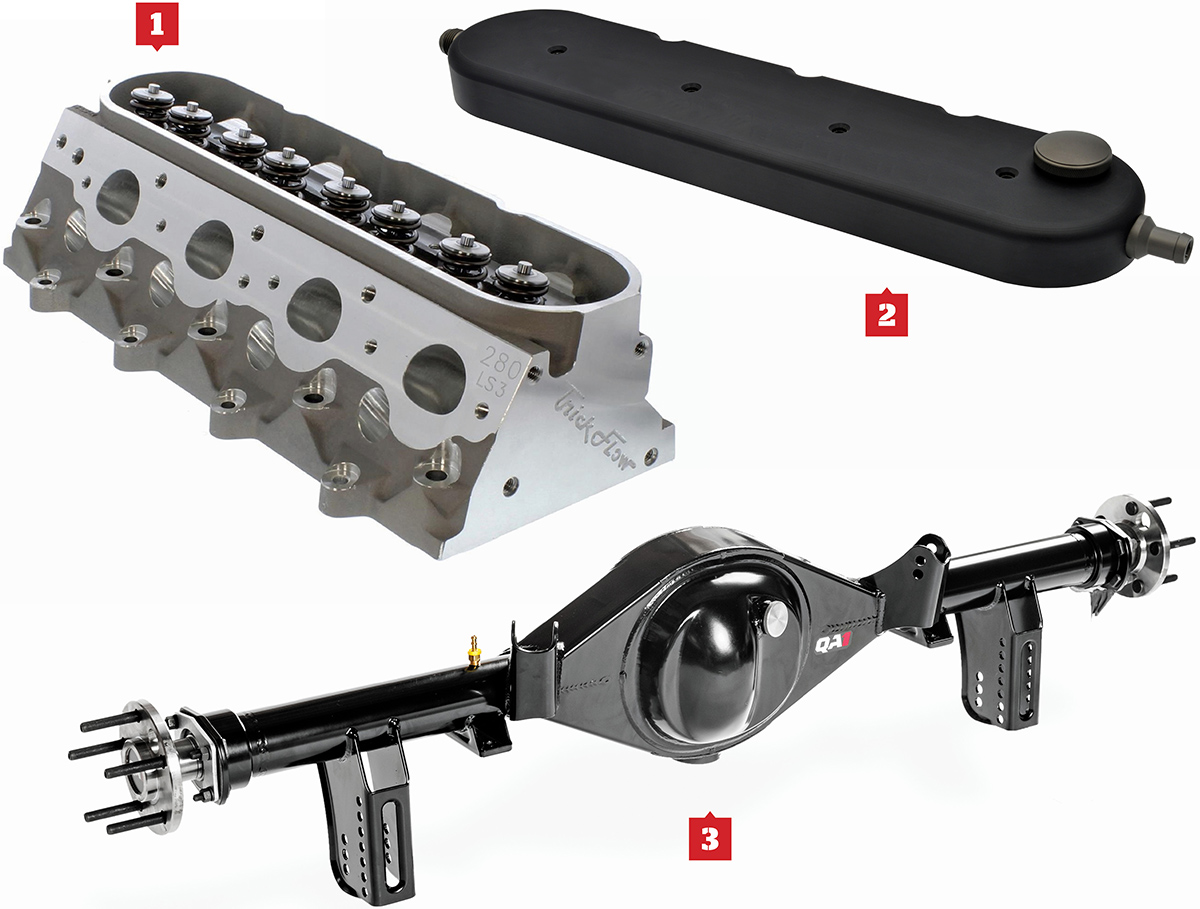
 PARTS BIN



 CHEVY CONCEPTS
InTheGarageMedia.com


 Text & Rendering by Tavis Highlander
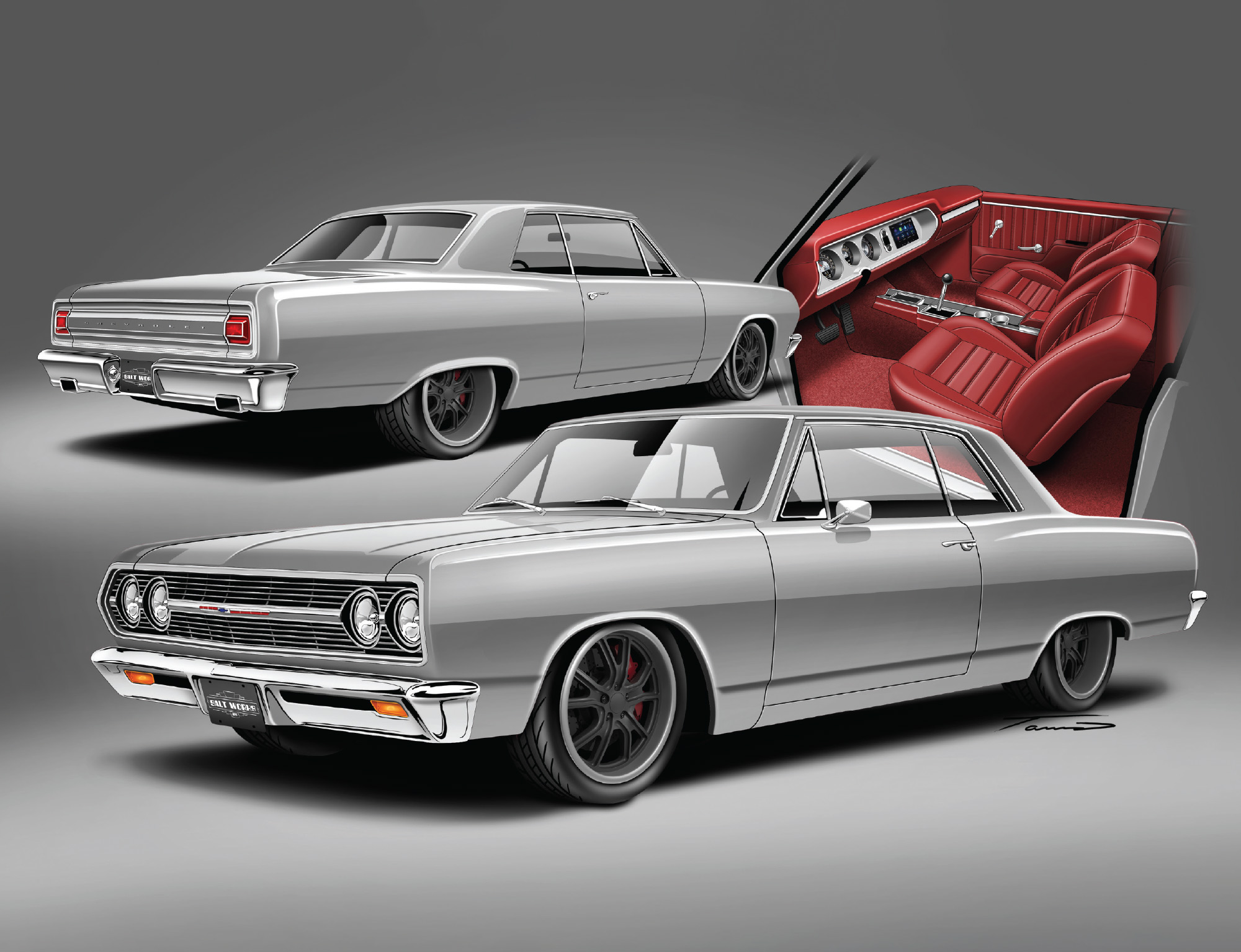
rom the outside, this Chevelle is very subtle with minimal body mods. Inside is where some of the fun is taking place. A few big items, like the seats and door panels, will be easily handled with TMI components. The time savings from those parts will be put right back into a custom dash and also a pretty trick console. Overall, the dash insert will look almost stock, but it will be a custom-machined piece with provisions for Vintage Air climate controls and a double-din screen.
The console will use the factory four-speed styling, but it will also be a combination of 3-D–printed and machined parts. Functionality will be added with a wireless charging pad, cupholders, and an armrest/cubby area.
 FEATURE
 Images by Shawn Brereton
here are addictions that destroy lives and then there are the ones that merely rearrange the furniture in your garage. Michael Cooper’s brand of obsession falls squarely into the latter. He’s not chasing a high that comes from a needle or a bottle; his fix comes wrapped in steel, lacquered in Axalta Marina Blue, and armed with enough horsepower to stir the soul.
“I’ll admit it,” Michael laughs. “I might have an addiction to Chevelles. Any year from the ’60s through the early ’70s works for me. I just finished this ’69, and now I’m into a ’70 El Camino 454. I guess that’s a Chevelle pickup, right? On top of that, I’ve got five more waiting their turn in line for restoration.”
That’s not exactly the statement of a man seeking recovery, but there’s no need for an intervention here. The worst side effect of Michael’s habit is a tendency to grin uncontrollably when the LS7 clears its throat.

 TECH
TECH
 Images by The Author
here’s no doubt that when it comes to the second-gen Camaro, the early years are by far the hottest. It’s been that way for a long time. But as time has gone by, the later years have certainly grown in popularity.
Normally, second-gen Camaros are divided between the debut models from 1970-74 and the mild, mid-gen refresh that came in the 1975 models with the wraparound rear glass, catalytic converters, and other changes that lasted until the end of the generation in 1981. The good news is that while there are some changes under the skin so that everything on the suspension isn’t interchangeable, the differences are minor enough that it’s relatively easy to make performance components and kits that work well across the entire range from 1970 all the way to 1982.
Our project car is a lowly base model 1978. It has a single-stage flat-black paintjob that was a quick and cheap way to cover the mixture of dead silver paint and primer that covered the car when it came into our possession. A while back we built a supercharged 427ci small-block in the pages of the All Chevy Performance Sept. ’23 issue that we plan to put in the car, but with 643 lb-ft of torque and 688 hp, it was way too much for the worn-out Camaro.



 FEATURE
 Images by Jason Lubken
t’s good to have friends—and if one of those friends happens to have a 1967 Corvette project that’s been sitting stagnant for years, well, that’s even better. That’s how this C2 Corvette ended up in the hands of current owner Dan Gernstein, a fiberglass manufacturer from Omaha, Nebraska. His buddy had lost interest in restoring the car and offered it up to Dan, who had ideas of his own for the neglected project.
“When I bought the car, it was basically just a body and frame,” Dan says. “It took me a while to get motivated, knowing it was going to be a fairly big job and I needed to put together a solid plan with an idea on the build style to go with.”
That “while” turned out to be about 15 years. During that time, the Corvette collected a little dust and a lot of potential. Eventually, Dan’s vision started to take shape: keep the body as original-looking as possible but subtly stretch those classic lines to fit some serious modern muscle underneath. The rear quarter-panels were widened 2 1/2 inches to accommodate meaty tires, and that single modification hinted at the direction the entire build would take—classic form with unapologetic function.
 Tech Images by Roadster Shop
oadster Shop has developed a reputation for building street machines at the highest level, and in the next few issues we’ll be taking a close look at a stunning 1965 Corvette they are building for Brad Whitt.
Since Corvettes are made with fiberglass bodies, the construction techniques on this project differ from what you’d see on metal-bodied cars. Even though the material is different, the fit and finish will be held to the same exacting standards as all Roadster Shop builds.
As with many projects of this caliber, a rendering was commissioned to set the direction from the start. Chris Gray, Roadster Shop’s lead designer, produced the rendering, and although the body modifications are subtle, extraordinary care will be taken to perfect the fit and finish of every panel and component.


 FEATURE Images by Chris Shelton
hen it comes to muscle cars, some enthusiasts exercise brand loyalty while others claim to stand behind no specific team. Frank Wolf is a self-proclaimed “Ford guy” but even he admits his loyalty begins to blur whenever a Chevelle rolls by. “I was turned onto Chevelles by my buddy Mike in high school,” Frank recalls. “He was an avid car guy who had a couple of them. He had a blown big-block ’69 that I helped him work on back in the day, and that was the beginning of my love for Chevelles.”

 TECH
TECH Photography by Chadly Johnson
alk around any car show or cruise-in and you’ll likely find examples of two distinctly different approaches to construction. Some builders focus on adding eye-catching elements to their cars that are impossible to miss. Others opt for more subtle modifications, coupled with scrupulous attention to detail; those are the cars that always get a second or third look and make gearheads smile. Those are the kind of modifications MetalWorks Classic Auto Restoration in Eugene, Oregon, is known for and will be making to the 1967 Chevy II shown here.
When the first-generation (1962-65) Chevy II was introduced it was intended as a reasonably priced, no-nonsense economy car. For the first two years of production, Chevy II engine choices were modest, as economical operation was the goal. Buyers had their choice of two inline engines: a 153ci four-cylinder and a 194ci six-cylinder. But in 1964 Chevrolet saw an opportunity to provide performance enthusiasts a mini muscle car and introduced the 283ci V-8 as an available option. In 1965, both the 250- and 300hp 327 became available, then Chevrolet completely redesigned the second-generation Chevy II for 1966. There were minor trim changes for 1967 and the 350hp 327ci V-8 became available, but those efforts were overshadowed by the introduction of the Camaro that same year. Nonetheless, the first- and second-generation Chevy IIs were popular then and are highly sought-after today.
 FEATURE
 Images by THE AUTHOR
ome guys just know how to build a performance-packed Chevy from the ground up. Many of them have been featured here in All Chevy Performance magazine, and rightfully so. However, some guys just keep poppin’ up on our radar, so we oblige by checking out their latest builds.
When this stunning Tri-Five started struttin’ its stuff at some of the major shows, we had to investigate and see what all the fuss was about. What we found out was that the owner was no stranger to our pages, as a few years back his magnificent 1972 Chevelle was featured in the Aug. ’21 issue. Turns out it was Matt Cirocco behind the wheel of this beast, and the Massapequa, New York, resident was more than happy to fill us in on his new, power-packed street machine.
TECH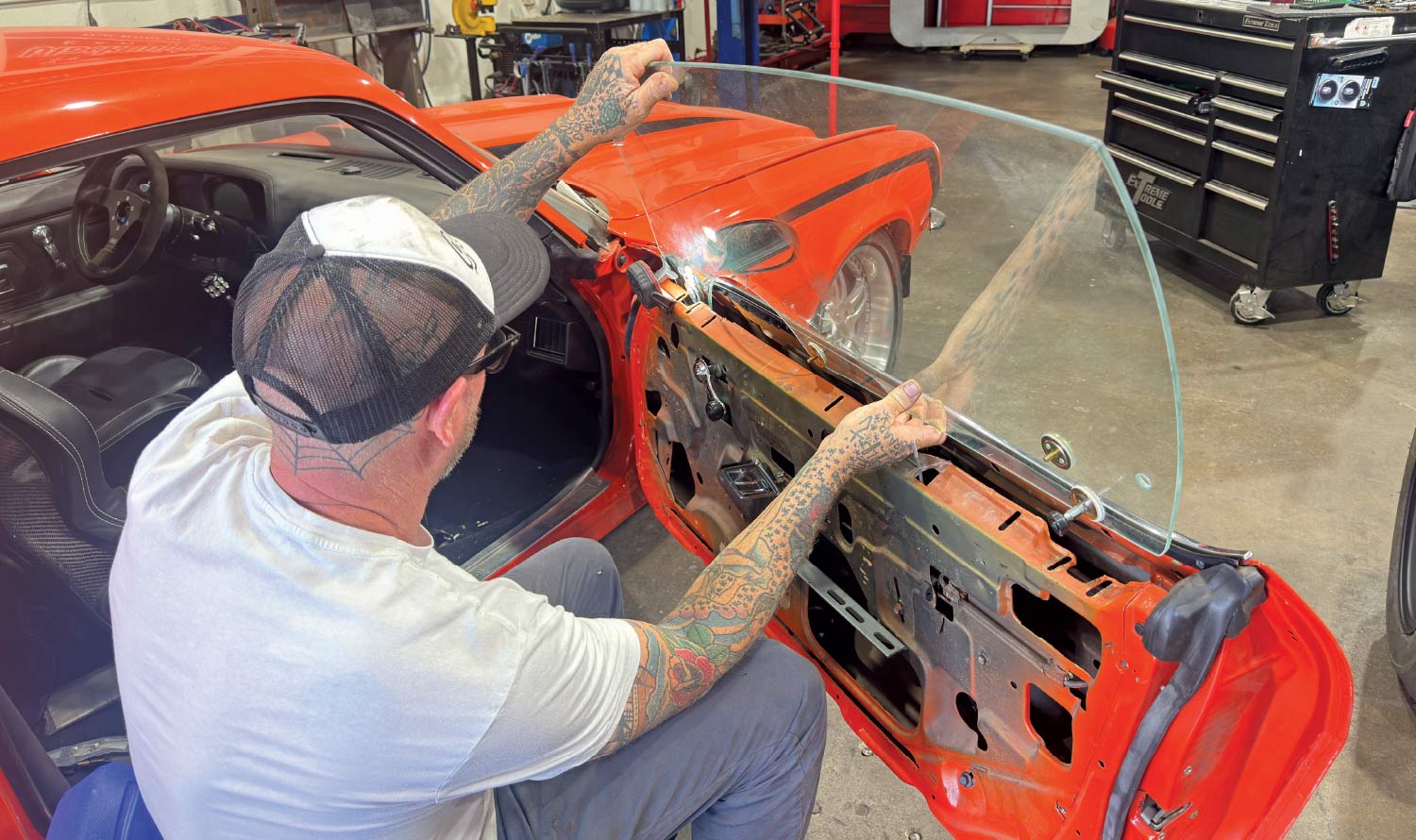
 Images BY THE AUTHOR
eing the 1971 Camaro is now well over 50 years old as of this writing, it would be asking quite a bit for the factory parts to maintain their original strength and dignity. That also goes for internal parts that never see the light of day, which includes side window hardware. Years of repetitive motion, combined with summer heat and freezing cold winters are certain to put a strain on those parts that at some point will begin to fail, as was the case here.
Years ago, “Orange Krate,” our 1971 Camaro, went through a full restoration, and new side glass was part of that process, but the hardware and many of the internal mechanical parts such as the window regulator, window tracks, and adjustment hardware are all original. At the time, those parts fell under the if-it-ain’t-broke-don’t-fix-it rule, so they were retained as part of the restoration.
 FEATURE
 Images by THE AUTHOR
ohn Jackson fell in love with Camaros while in college and owned a lot of them over the years, ranging from numerous first-gens to a 2010 SS and 2014 RS. “I have enjoyed them because they were easy to build and didn’t cost a bunch,” he tells us. “I always owned small-blocks and was fearful of big-blocks because they were expensive and harder to maintain, but one day at a show I heard one start up, and wow! I had to have one. It took 40 years before that dream came true.”
John’s big-block odyssey began in 2013, when he got wind of a derelict ’69 SS396 coupe in Northern New York. “It was a rust bucket,” he recalls, “a big project that was going to take years to reconstruct, but it was a real SS396, so I bought it.”
John left the 396 engine with Camaro Specialties to be rebuilt and went full steam ahead on the body himself. He removed the subframe and had it sandblasted and powdercoated by Action Powder Coating in Huntington, New York. Both rusty fenders were replaced with originals from a donor car. John cut out the rusty floor and quarter-panels and welded new ones in. The trunk floor extensions were replaced but, surprisingly, the trunk was solid enough to save. After replacing all the rusty steel, fitting the doors and front end, and massaging the body surfaces to perfection, John primed and painted his ’69 the original Rallye Green hue.

 EVENT
EVENT Images by THE AUTHOR
he drag-and-drive scene is more than just a fad. The concept of drag racing your car and driving it to the next track on repeat is growing in popularity, and there are many events all over the country that give gearheads a special experience. Tom Bailey hosts a series of events under his Sick Week branding. Along with his annual event that occurs in Florida and Georgia during the winter, he hosts one-off events in other parts of the country. One such example is the Edelbrock Sick Smokies event, a special race that travels through the hills of Alabama, Tennessee, North Carolina, and Georgia, stopping at old-school, eighth-mile dragstrips along the way.


Advertiser
- American Autowire7
- Art Morrison Enterprises15
- Auto Metal Direct27
- Automotive Racing Products11
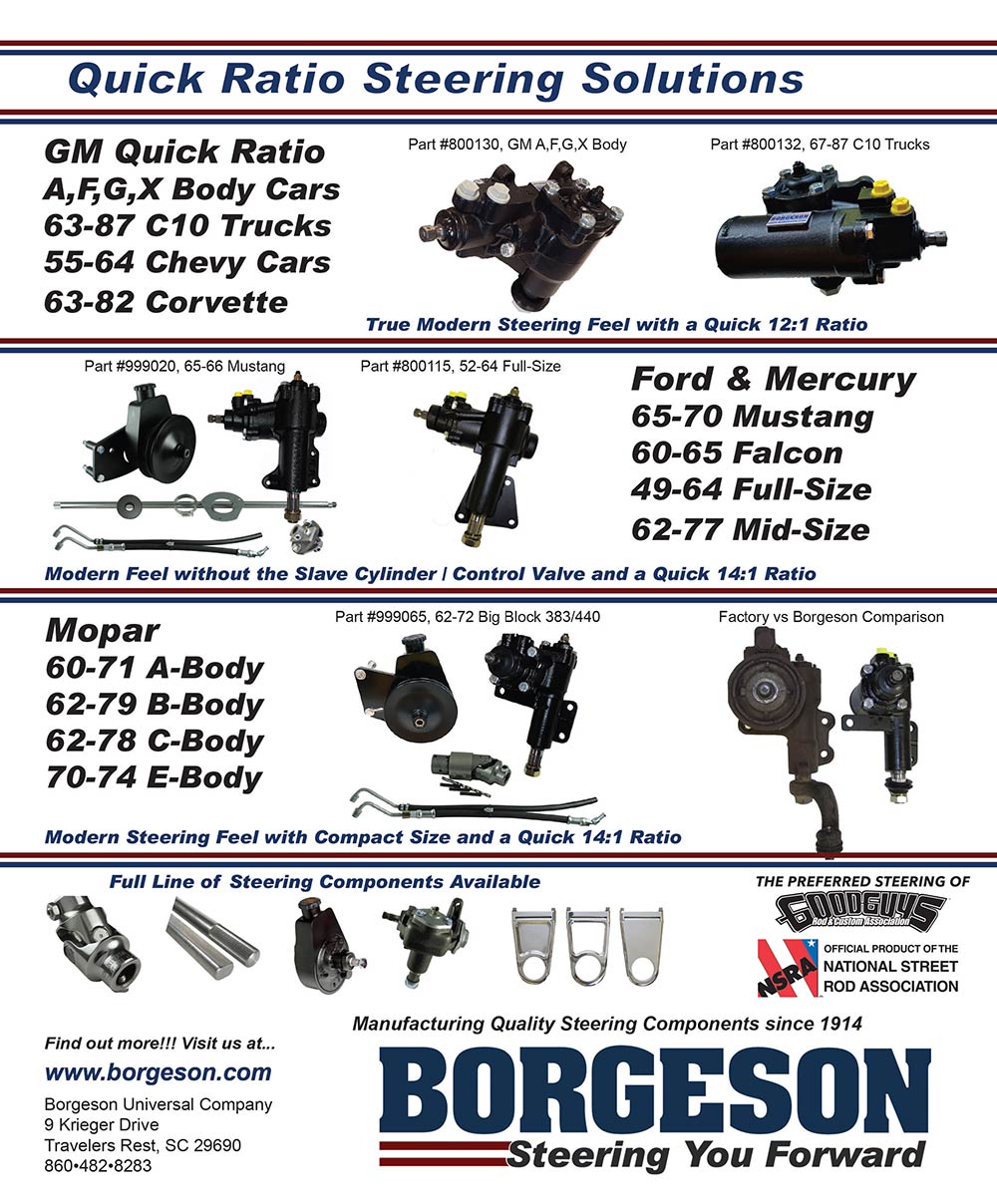
- Borgeson Universal Co.29
- Classic Industries23
- Classic Performance Products4-5, 89, 92
- Dakota Digital91
- FiTech EFI75
- Forgeline Motorsports57
- Golden Star Classic Auto Parts6
- Goodguys Rod & Custom Association31
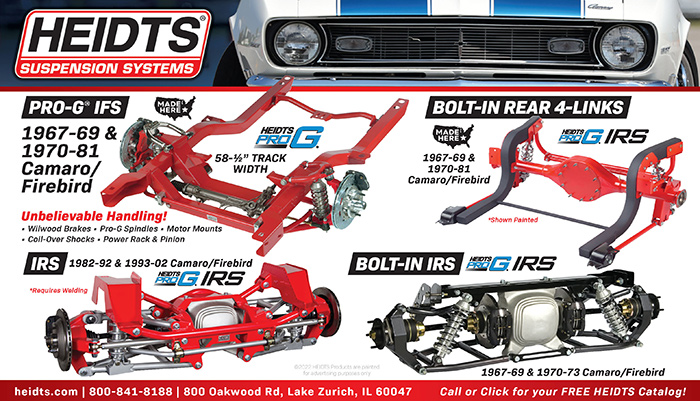
- Heidts Suspension Systems57
- Holley Performance Products9
- Lokar2
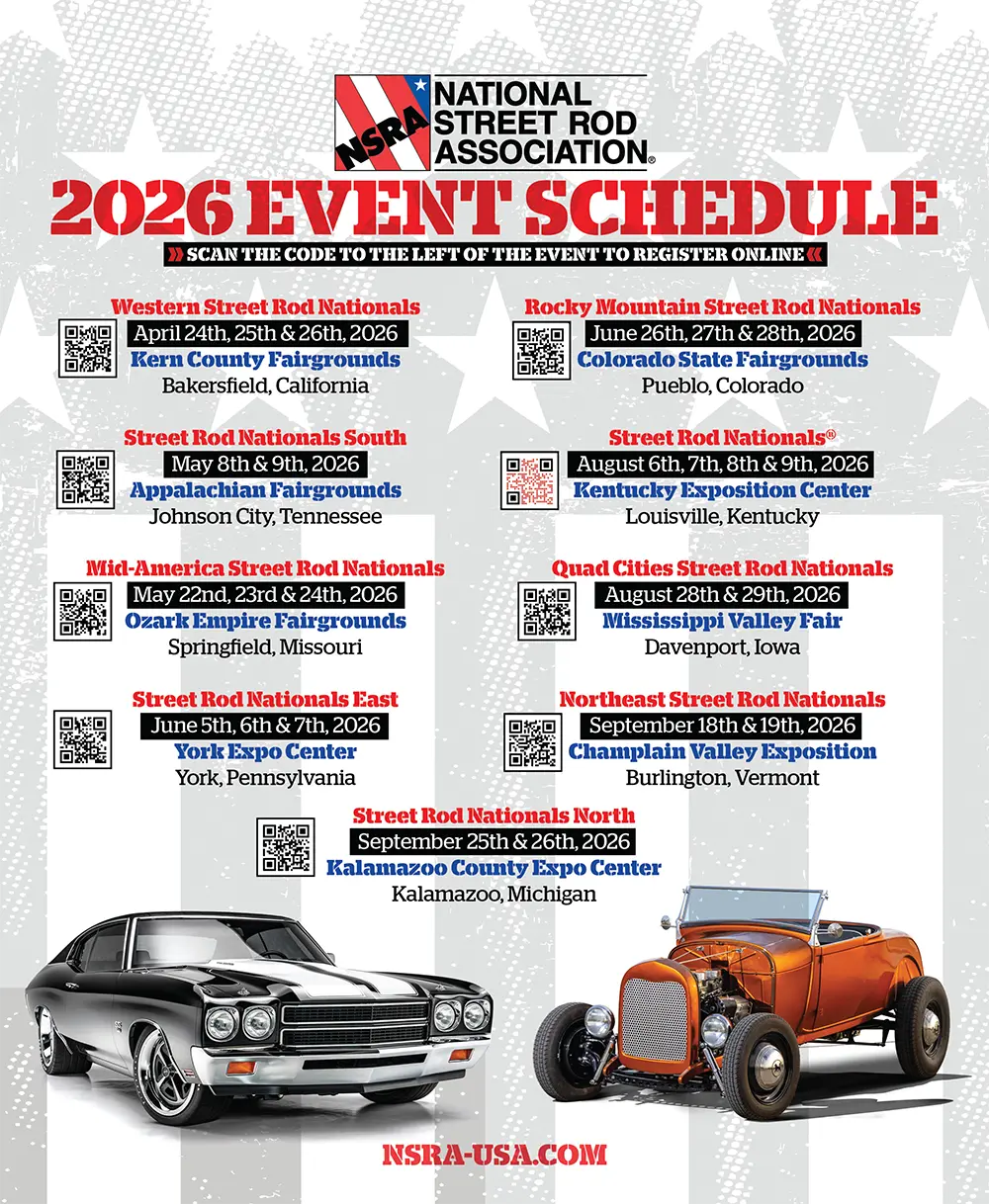
- National Street Rod Association45
- Powermaster Performance87
- Rod Shows33
- Scott’s Hotrods89
- Specialty Auto Parts USA, Inc.87
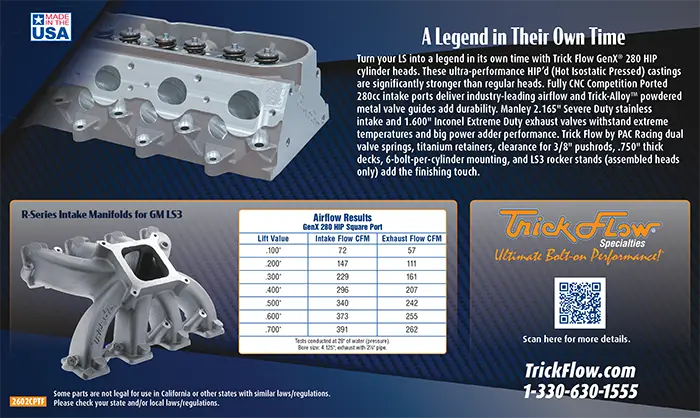
- Trick Flow Specialties47
- Triple Crown of Rodding, LLC41
- Tuff Stuff Performance Accessories (Hurst Auto)47
- Wilwood Engineering13