

 TECH

 IMAGES BY THE AUTHOR
n the old days, racers and street enthusiasts muscled that steering wheel without assist, using just a slight leverage advantage from an old manual steering box. Only luxury cars were fitted with power steering. But today with steamroller front tires, plenty of positive caster in the alignment, and the need to negotiate corners with quicker steering box ratios, power steering is now considered a necessity.
There are advantages to both designs and a few pitfalls to avoid, so let’s get started.
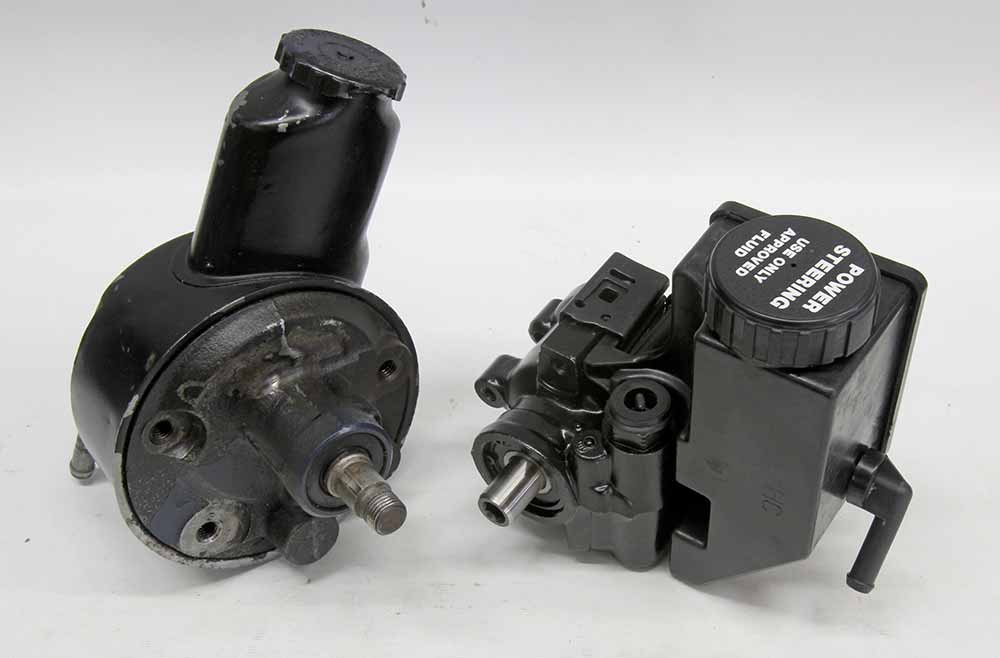
The original P-style pump dates its first appearance in Chevrolet with the early ’60s. The hydraulic pump generates significant flow and pressure, which is both good and a bit of a detriment. This pump’s advantage is that it is inexpensive and easily found when it comes time for replacement.
The P-pump can generate up to 20 gallons-per-minute (gpm) at a pump shaft speed of 5,000 rpm. This shaft speed is created by the combination of engine speed, crank pulley diameter, and the diameter of the power steering (PS) pulley. As an example, if the crank pulley is 8 inches in diameter and the engine is spinning 6,000 rpm with a PS pulley of 6.7 inches, the PS pump shaft speed is over 7,000 rpm. The formula is (Crank Diameter x Engine Speed) / PS Pulley Diameter.
Generally, this is an excessive speed that can cause the pump to cavitate and damage the fluid. Most pump companies recommend keeping the pump shaft speed below 7,000 rpm. P-style pumps move so much fluid that most of it is internally bypassed, which can lead to elevated fluid temperatures. This is why you will see OEM applications equipped with power steering coolers.
Also related to power steering is the notion that pump pressure is the main factor affecting the feel through the steering wheel. This is not true. Initial effort is more in line with the torsion bar inside the steering box. Companies like Turn One or Lee Power Steering can rebuild your box and install a larger torsion bar inside the box that will improve initial effort to turn the wheel. If the effort feels too easy—like one-finger motion—changing pressure will not affect this.
As an example, Chevelles can benefit from quicker steering by swapping to a different OEM steering box like the 1988 Monte Carlos SS box. This box employs a larger torsion bar to establish a higher initial effort into the steering wheel along with a quicker ratio.
While most enthusiasts rarely consider power steering fluid temperatures, if you are an autocross or track day enthusiast, it’s a good idea to monitor the temperature and keep it preferably around 180 degrees F and certainly below 250 degrees F. If your fluid hits this higher number, you should immediately drain and replace the fluid.
The advantage of the more-compact Type II pumps is that they typically move less fluid versus the older P-pumps. The guys at Turn One tell us that a typical Type II pump will move around 15 gpm at the same shaft speed but do so demanding slightly less power. A P-pump can draw over 12 hp to deliver maximum pressure and volume while a Type II pump requires 8 to 10 hp. Turn One claims their pumps are even more efficient. As a more efficient pump, the Type II pumps also generate lower fluid temperature.
When considering a Type II pump, be aware these pumps come in two different shaft diameters. The more common pumps found in the front-wheel-drive J-cars and many other GM passenger cars use a larger shaft diameter of 0.748 inch that is supported by a bushing. Corvette Type II pumps appear similar but use a smaller 0.644-inch shaft diameter that is backed with a ball bearing. This is important because the pulley must be the pump shaft diameter. Tuff Stuff offers Type II pumps in both shaft diameters.
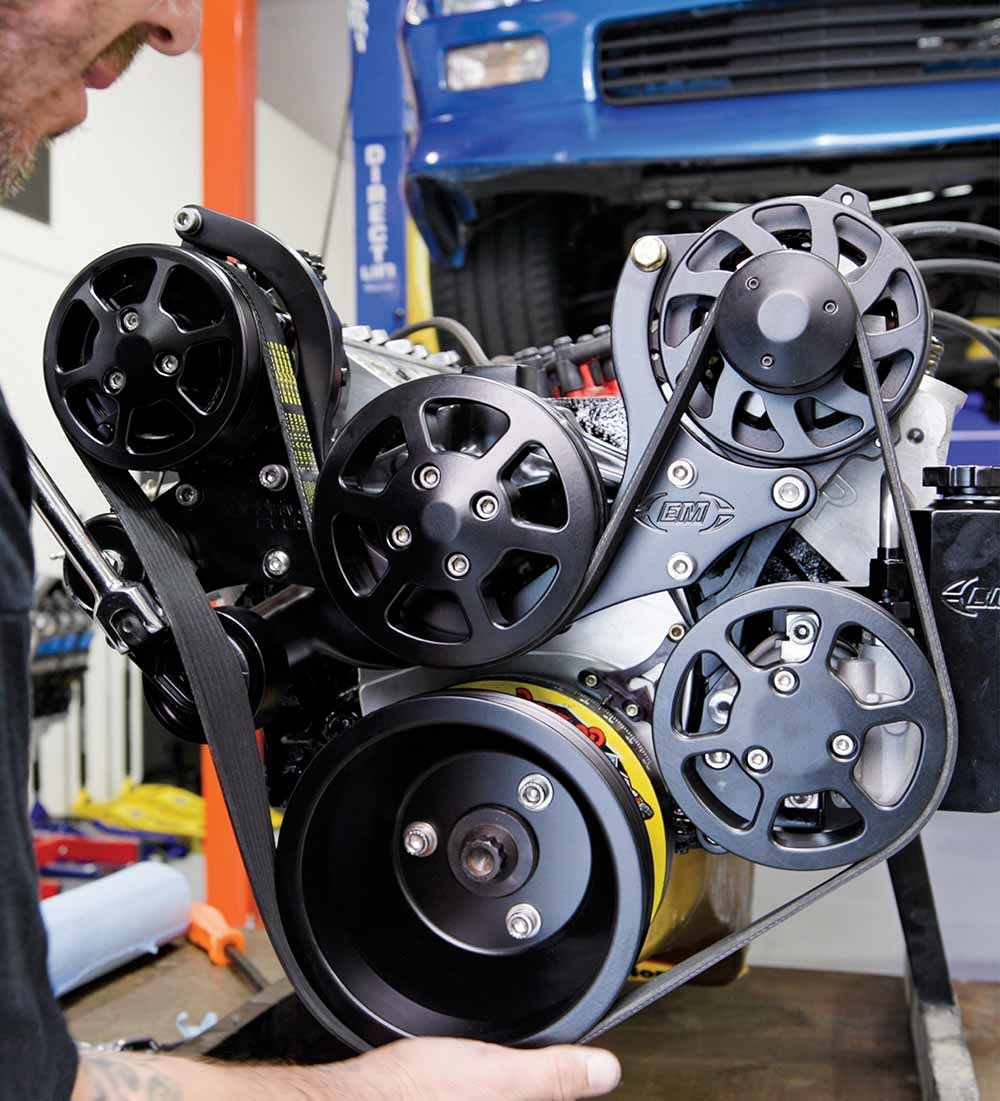
Many aftermarket accessory drives employ the smaller and more compact Type II pumps. You can find these pumps through various sources like Borgeson, Tuff Stuff, Kwik Performance, Summit Racing, Turn One, and others. These pumps can be fitted with separate or remote reservoirs. This can also be accomplished with the older P-pumps as evidenced by factory big-block Chevy power steering applications. The remote reservoir applications will require additional plumbing and fittings.
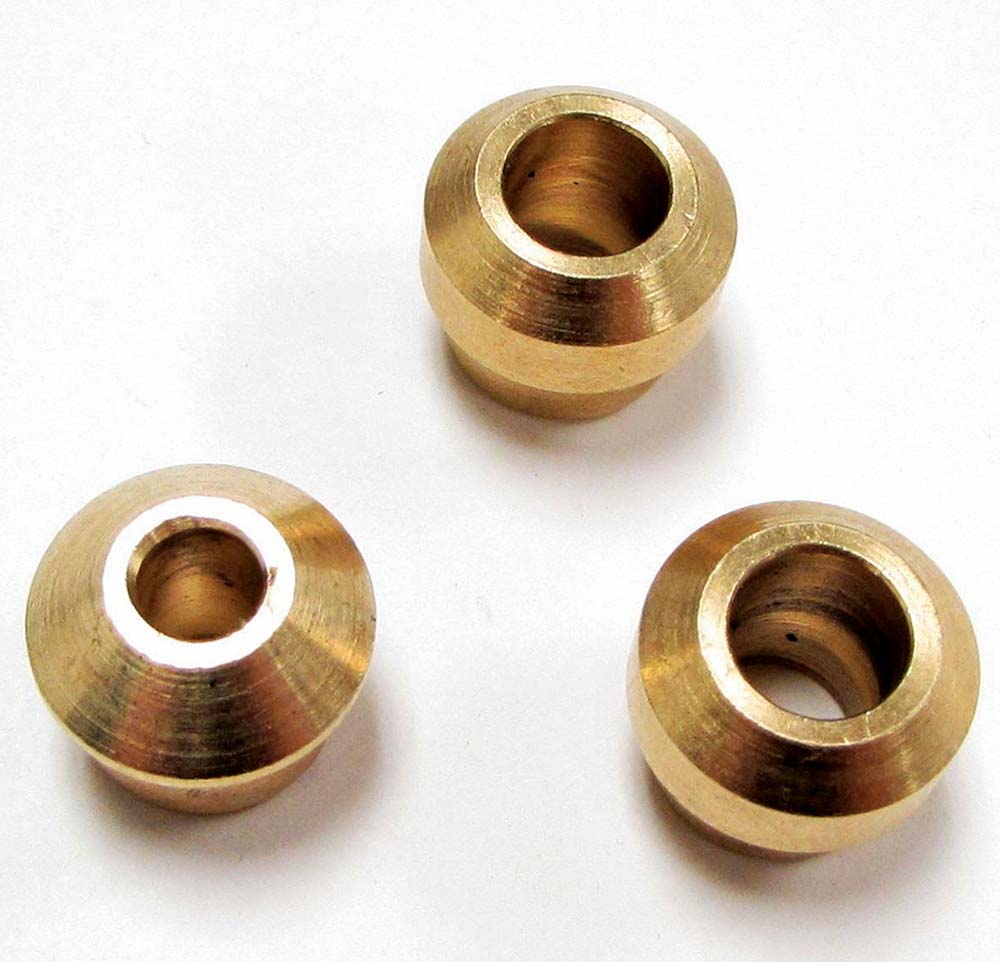
Early PS systems (before 1979) used common inverted flare fittings for both the pump and steering box hose connections. Beginning in 1979, GM converted to what is called a Saginaw or O-ring fitting. If you choose a later model steering box that uses Saginaw fittings but you have a pump using the inverted flare–style connection, there is a solution. Borgeson offers inverted flare inserts (PN 925122) that you can find through Summit that will convert the box (and the pump, if necessary) to use the inverted flare–style hoses.
Another option is to replace the standard high-pressure hoses with AN versions. If you choose this route, it’s best to use dedicated power steering hose for the high-pressure side. Earl’s offers a 6-foot length of -6 hose under PN 150606ERL. This requires steel -6 hose ends with 159106ERL for the 90-degree fitting and 154606 for a 45-degree fitting. Steel inverted flare adapters to -6 male are available through Summit under PN SUM-G3170 or from Classic Performance Products (CPP) with PN 605ANF-IF.
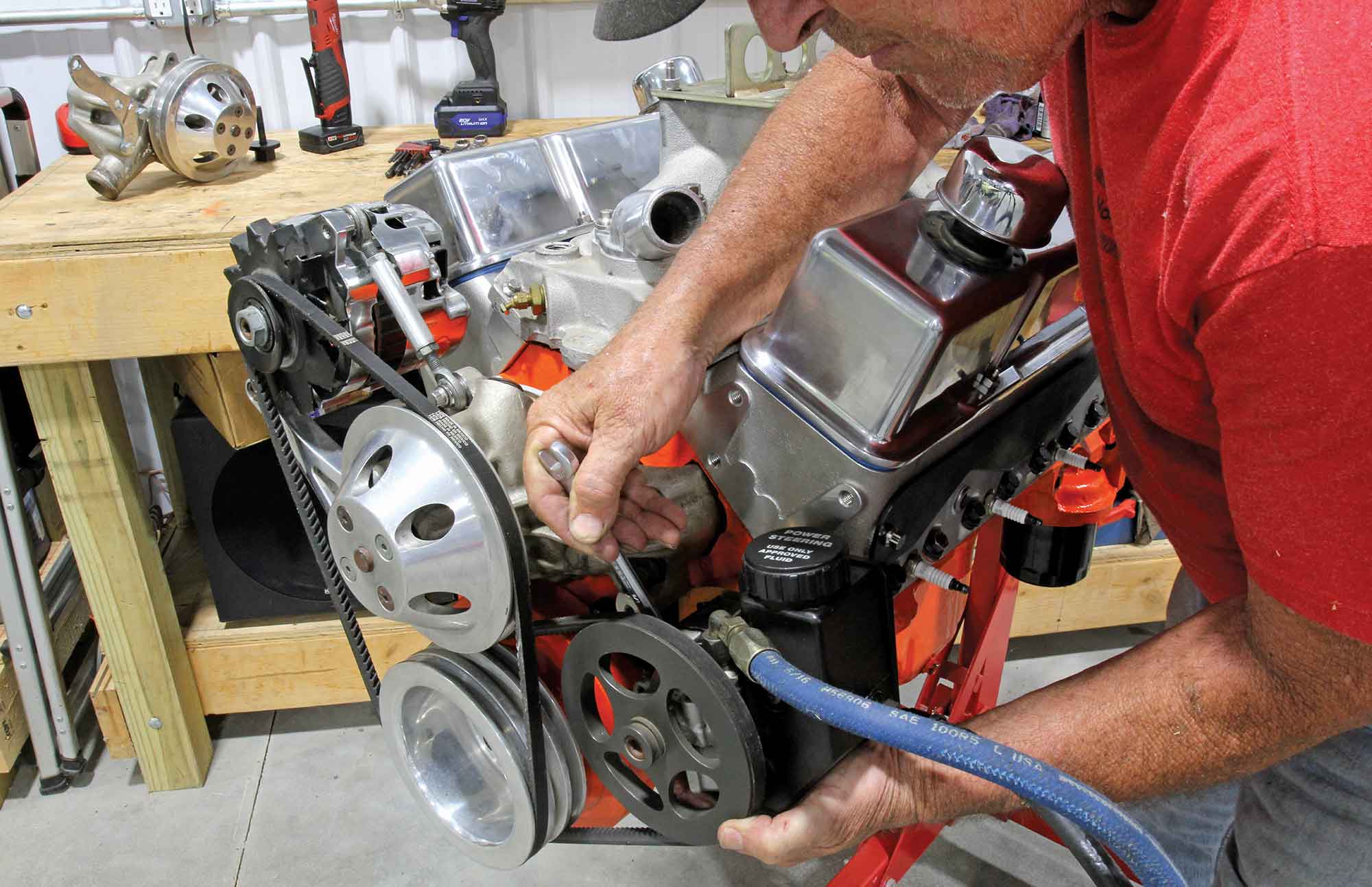
One issue that we’ve run into several times when servicing P-style power steering pumps is that the solid pulley must be removed to access the pump mounting bolts. Unlike the early ’60s pulleys that bolted in place, all modern pulleys press onto the pump shaft. This step requires a specific power steering pump puller and installer tool. If you need one of these tools, we like the newer design Lisle tool, PN 3900.
One way to avoid having to remove the pulley to access the pump is to find a pulley with windows that allow you to remove the pump without removing the pulley. There are way too many combinations to list here but a little research may uncover a pulley that will work for your application.
If you are facing a situation where you need to replace either the power steering pump or the box, this will require bleeding the air out of the system. Because power steering systems operate by making hydraulic pressure, this means all the air in the circuit must be removed. We will run through the actual process, which isn’t difficult but requires a few specific steps.
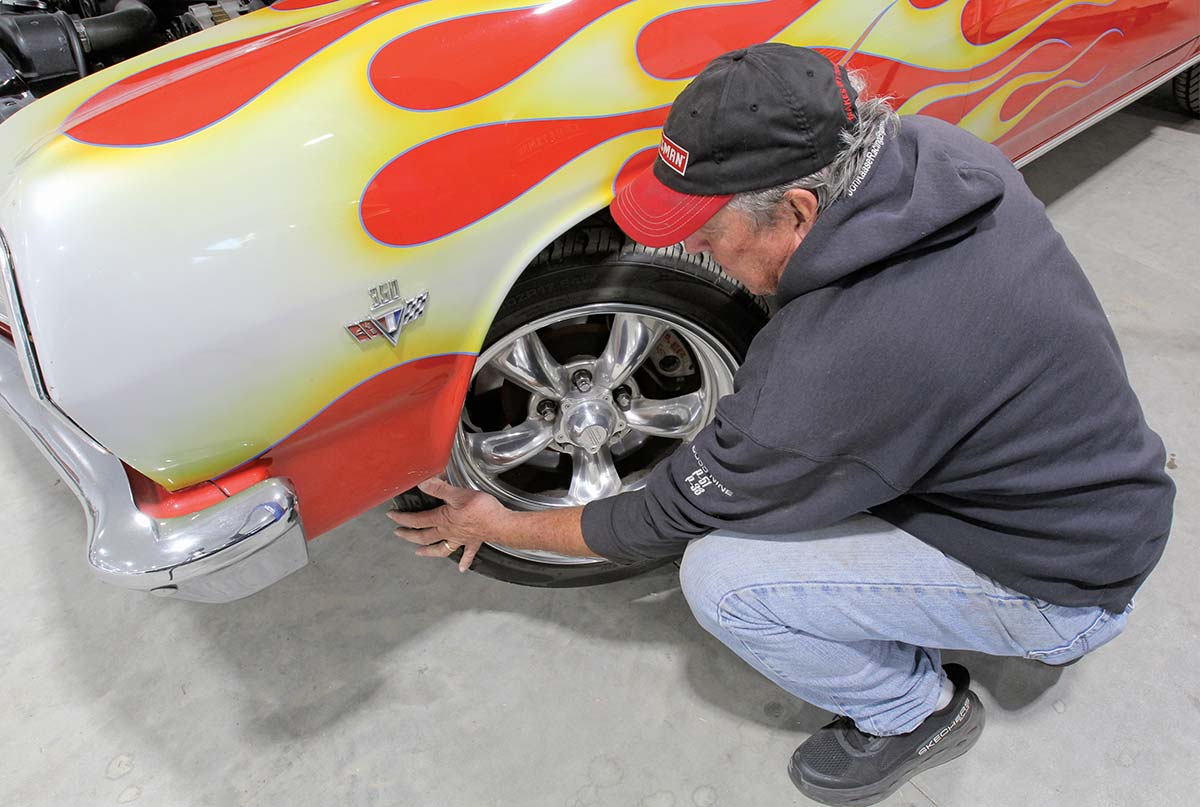
Once all the components are in place and all the hydraulic pressure and return lines are connected and tight, you can fill the pump reservoir with power steering fluid. Next, jack the car up so the front tires clear the floor. Do not start the engine. Instead, grasp the driver side front tire and move the wheel and tire through multiple full turns to move the input shaft on the steering box. This may take 20 to 40 repetitions. This movement will draw fluid into the box and displace air. Monitor the fluid level in the pump reservoir closely and refill as necessary.
Continue to rotate the steering back and forth through full lock in both directions until no more bubbles appear in the fluid and the level stabilizes. At this point you can start the engine and run it for a few moments and then turn the engine off. This may lower the fluid level again in the reservoir so refill the fluid as necessary. At this point, you can lower the car on the ground and start the engine and verify that the power steering works properly while checking for leaks. The fluid should be clear of bubbles or foam, and the power steering system should make no growling noise.
Speaking of fluid, most power steering companies will advise not to use automatic transmission fluid (ATF) as a power steering fluid. ATF contains friction modifiers and other additives that are not compatible with the rapid recirculation action that occurs with power steering. Synthetic fluids are available but Lee Power Steering, for example, recommends its own traditional fluid that contains wear additives designed for iron power steering pump and boxes.
Another important consideration is fluid contamination. Power steering boxes maintain very tight tolerances and even the slightest contamination can cause problems. Tuff Stuff, Lee Power Steering, Turn One, and others offer in-line power steering filters that are installed on the return side to help remove this contamination. Another good plan is to install new hoses when replacing a steering box or at least drain all the old fluid to minimize contamination of the new box.
We’ve only touched on a few of the multiple aspects of maintaining a solid-performing power steering system. There are other aspects like tuning the “feel” of the steering or how to improve the performance by adding a quick ratio box. We’ll save those for a later story if there is sufficient reader interest. For now, perhaps this story has planted a seed for some changes to your steering system.
Your biceps will thank you.






borgeson.com

classicperform.com

summitracing.com

tuffstuffperformance.com