


ACP department heading TECH
InTheGarageMedia.com
Factory 502 Ram Jet port fuel injection intake on a big-block engine.
1. When Jeff Pont purchased the Camaro for his father, Duane, it was powered by this GM crate 502 Ram Jet Port Fuel Injection (PFI) intake that produced 502 hp and 568 lb-ft of torque.
I'd Rather Be Stacked
Swapping A Ram Jet Intake With A Borla 8-Stack V-8 Injection Kit
BY TONY THACKER IMAGES BY THE AUTHOR
L

ess is always more, and that adage applies to performance cars as much as anything. Sure, blowers and stacks, even turbos, look good sticking up through the hood Gasser style, but isn’t it just sneakier to hide stack injection under the hood and not let everybody know the power you are hiding?

Take for example Jeff Pont’s 1969 Camaro. It’s definitely an understated animal but beneath the hood lurks a beast producing in excess of 500 hp.

The Camaro was first owned by Jeff’s late father Duane and was one of his fondest joys. Unfortunately, Duane was diagnosed with lung cancer and died; nevertheless, Jeff vowed to honor his father with a build for dad to be proud of. Originally, Duane’s Camaro was powered by a GM 502ci Ram Jet big-block Chevy with a TREMEC five-speed. With the factory 502 Ram Jet port fuel injection (PFI) intake, it produced 502 hp and 568 lb-ft of torque. At some point, valve covers machined with the words “PREPARED EXCLUSIVELY FOR DUANE PONT” were installed.

Duane found the manual box awkward so the car went to Steve Sbelgio’s Eclipse Engineering that used to be in Whittier, California, where Sbelgio removed the TREMEC and replaced it with a 4L80E. Sbelgio also removed the existing GM MEFI engine controller used on all Ram Jet engines and replaced it with a Holley Dominator ECM for both the engine and the trans.

Ultimately, however, the car was sent to Mick’s Paint, in Pomona, California, for extensive bodywork, and it was decided to replace the factory Ram Jet intake with a Borla 8-stack Chevrolet V-8 injection kit with 50mm IDA throttle bodies for oval-port heads. According to Sbelgio, “This is a fairly simple swap, however, new fuel lines and throttle linkage using a Lokar pedal and cable were required. We retained the factory Ram Jet distributor but used a Holley engine management system to control idle speed and ignition timing. The most time-consuming operation was the balancing and synchronization of the injectors before developing the calibration.”

Once the componentry had been determined, all the parts were sent to Mick’s paint department to be detailed in black with orange anodized accents to match the exterior graphics and wheels.

As street drivers go, Jeff’s “Black Ops” Camaro is the perfect sleeper with subtle design cues and a not-so-subtle performance.
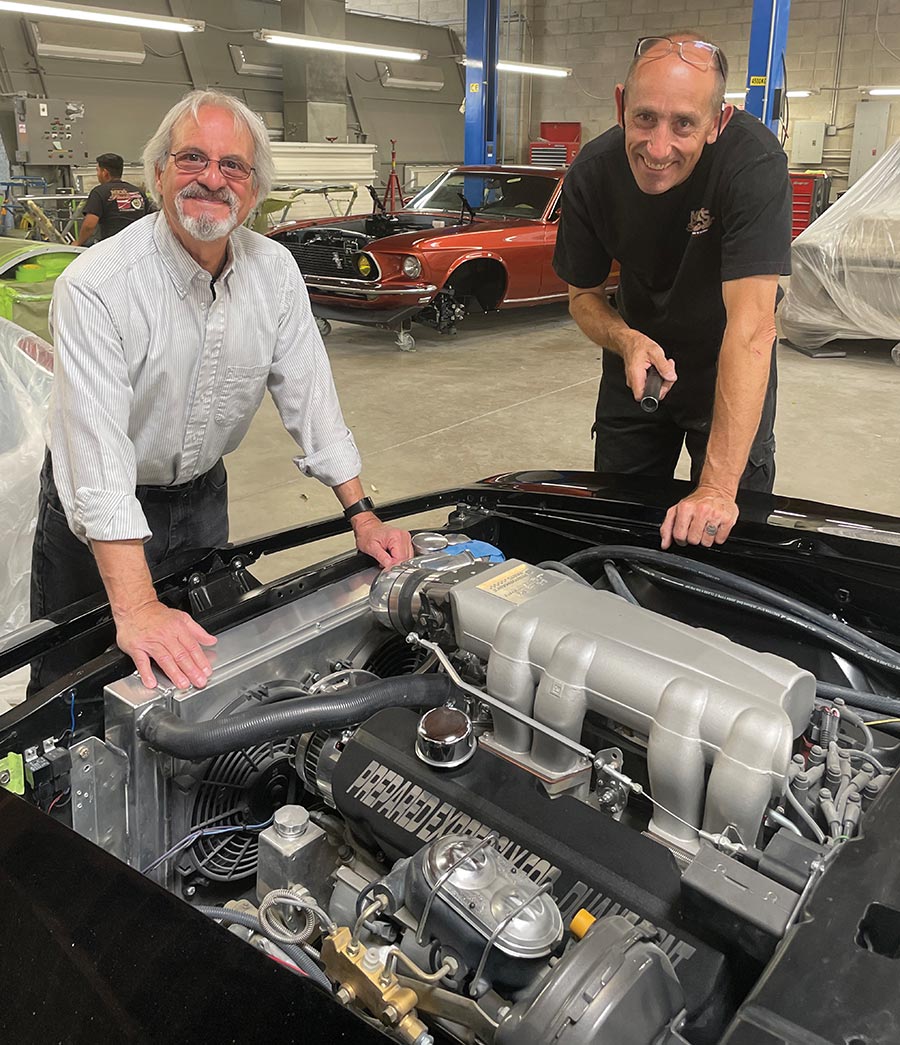
Steve Sbelgio and Marco Piehl discussing the engine conversion project.
2. Before the conversion from factory PFI to a Borla stack injection, Steve Sbelgio (left) of Eclipse Engineering discusses the project with Marco Piehl of Mick’s Paint where the car was built.
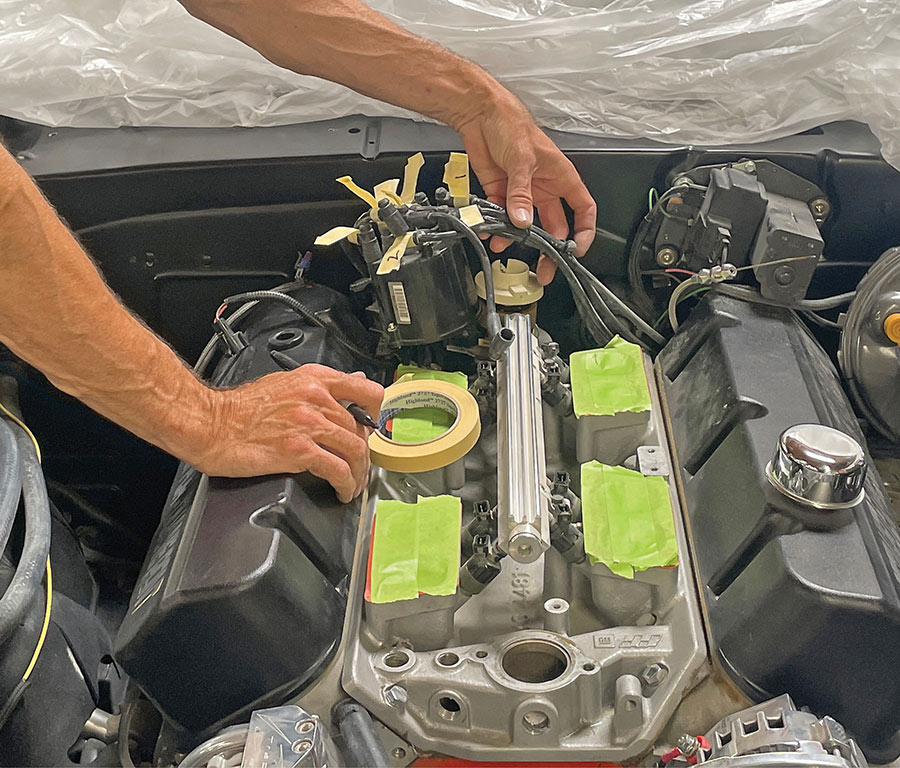
Close-up of distributor with marked ignition wires for identification.
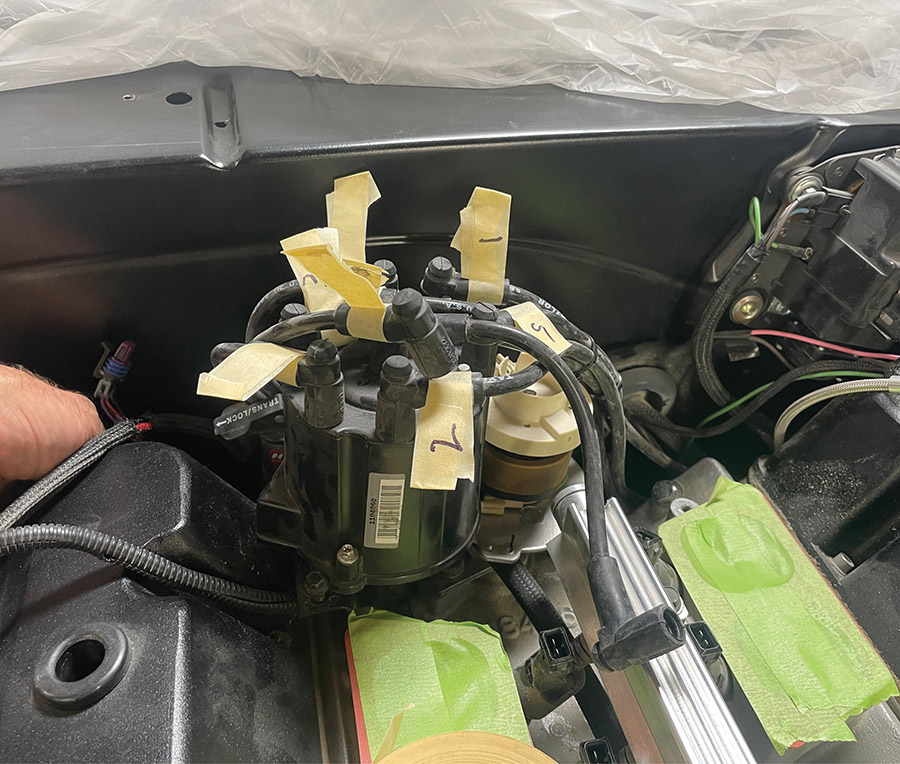
3. After removing the PFI plenum, Piehl marked all the ignition wires as he and Sbelgio planned to retain the stock GM small HEI distributor.
Detail of ignition wires tagged with masking tape and marker.
4. A close-up of the distributor shows how Piehl just used masking tape and a permanent marker to identify the various ignition wires. Something you can easily do at home.
Lifting the distributor shaft out of the engine block.
5. With the distributor cap and numbered wires removed, along with the distributor hold-down, Piehl carefully lifted the distributor shaft out of the engine block.
Lifting the intake manifold clear of the engine.
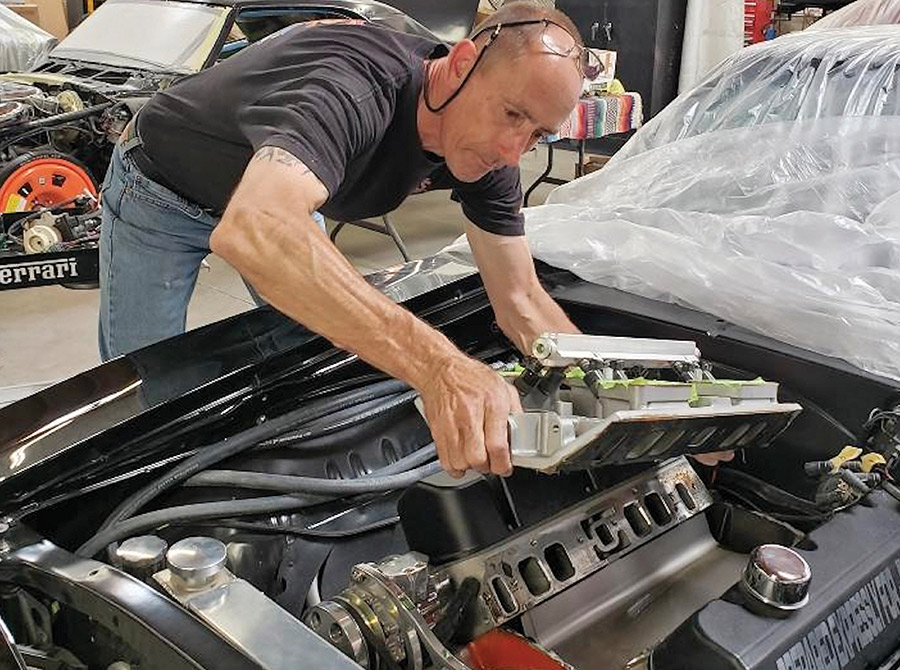
6. Once the 10 bolts securing the lower intake manifold had been removed, Piehl was able to lift the manifold clear of the engine.
Borla stack injection kit components including throttle bodies and hardware.
7. Out of the box, the Borla stack injection V-8 system with 50mm IDA throttle bodies for oval-port heads. The whole caboodle starts at around $7,000, complete plus various finish options.
Hand-sanding a valve cover for custom paint preparation.
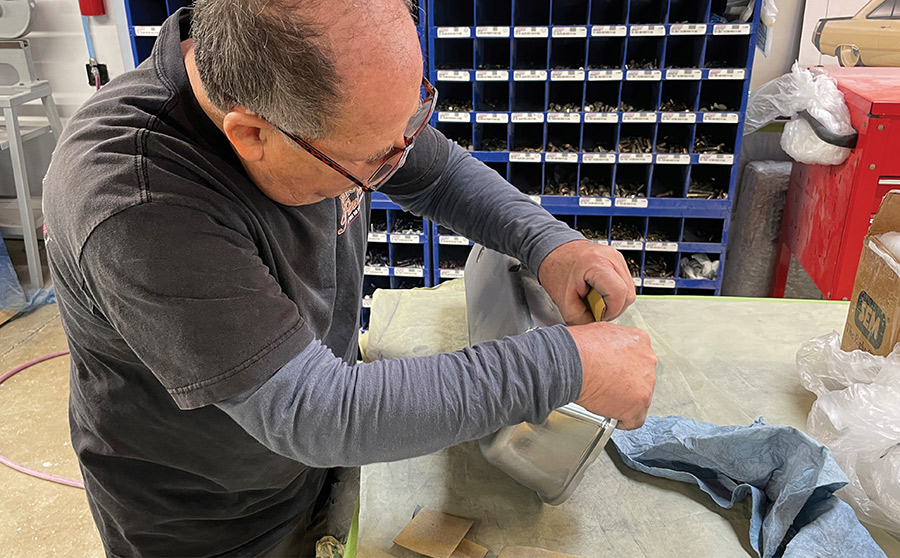
8. Meanwhile, over in Mick’s paint department, Juan Carillo got busy hand-sanding the valve covers that would be painted gloss black to match the Camaro’s exterior.
A pair of valve covers prepped with primer and sealer.
9. The valve covers were prepped and readied for paint, beginning with PPG DP90 epoxy primer/sealer, then four coats of PPG basecoat, and five to six coats of clear.
Hand-polishing a painted black valve cover for gloss finish.
10. After the painting process was complete, Carillo hand-polished the valve covers for a super durable gloss finish that emulates the exterior finish.
Adjusting the throttle butterflies for synchronized operation.
11. Adjusting the butterflies is an exacting task that entails carefully following the instructions to ensure all eight butterflies open and close together cleanly and without jamming.
Using dowel gauges to ensure equal opening of throttle butterflies.
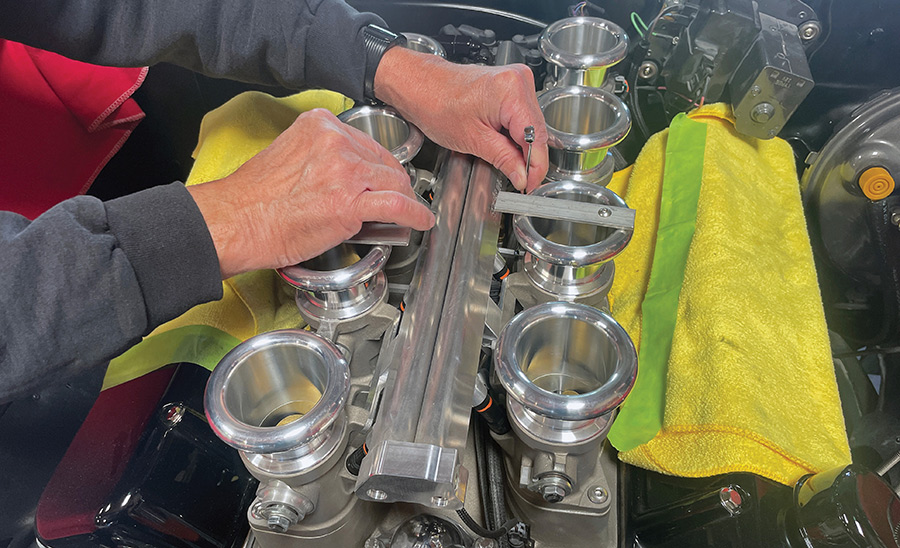
12. Using the dowel gauges inserted in the center of a butterfly on each bank, adjust the hex link to make sure that each bank of butterflies opens the same amount.
Adjusting the hex link between the two throttle shafts.
13. A close-up of Sbelgio adjusting the hex link that connects the two throttle shafts. This hex link adjustment is used to make sure both banks open at the same rate.
Installing the Lokar center-pull throttle cable over the valve covers.
14. With the valve covers on and protected from dropped tools, Carillo easily installed the Lokar center-pull throttle cable.
Airflow meter positioned on a throttle body intake.
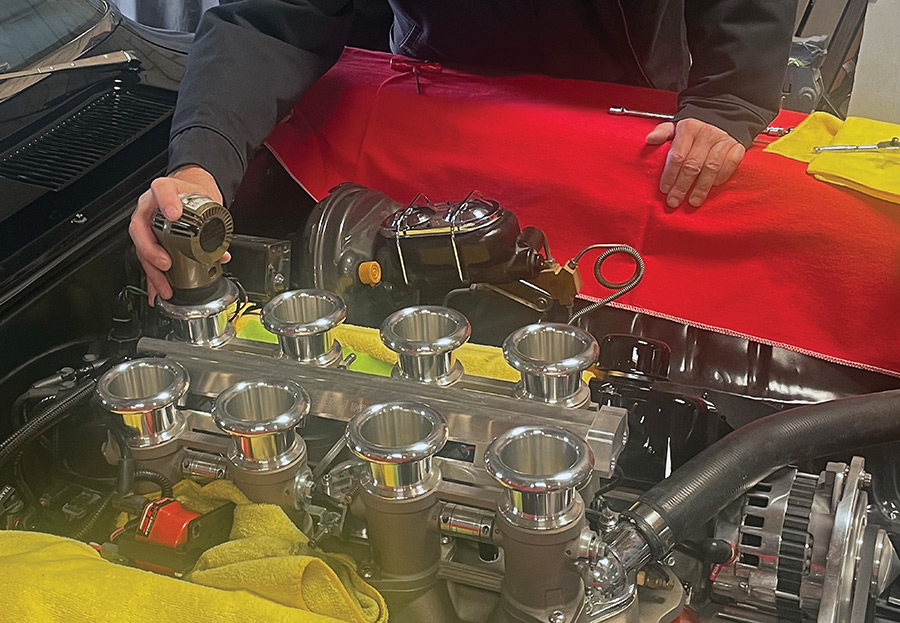
15. A carburetor airflow meter/synchronizer designed to measure the airflow directly on the air intake of the carburetor/injector can be used at low rpm on down-draft and side-draft induction.
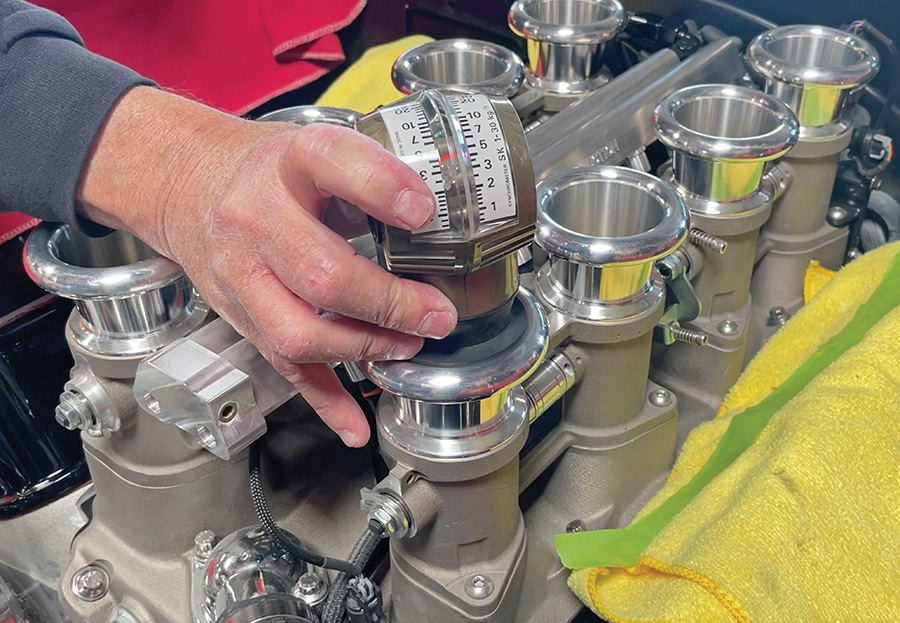
Measuring airflow volume through a throttle body with a synchrometer.
16. Synchrometer Air Flow meters cost around $50 and measure the volume of air passing through each throttle body. It allows Sbelgio to synchronize them for equal airflow.
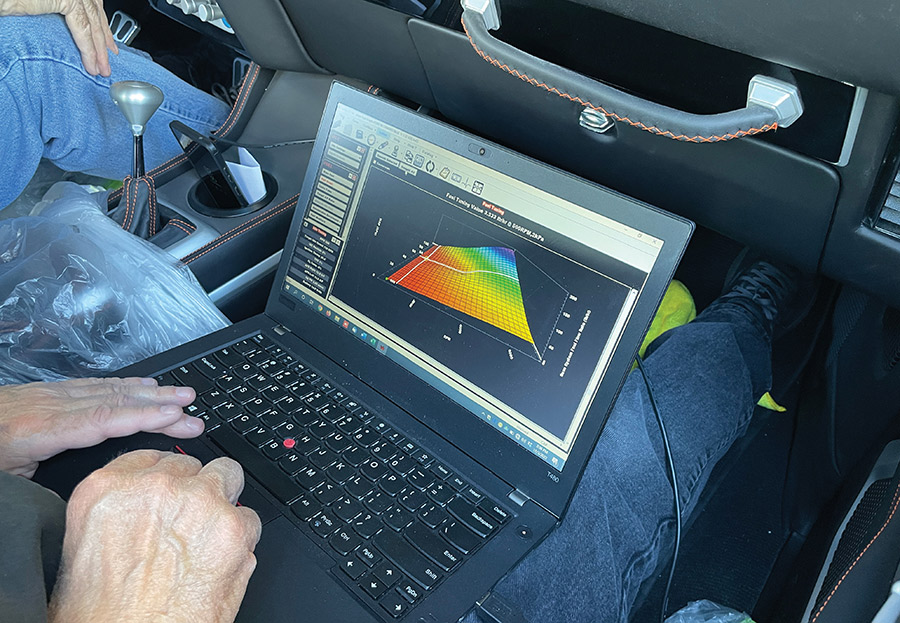
Laptop screen displaying a 3D fuel map tuning graph.
17. Over the years, and after many hundreds of similar tune-ups Sbelgio has developed his own fuel map, which is basically a graph showing the air/fuel ratio.
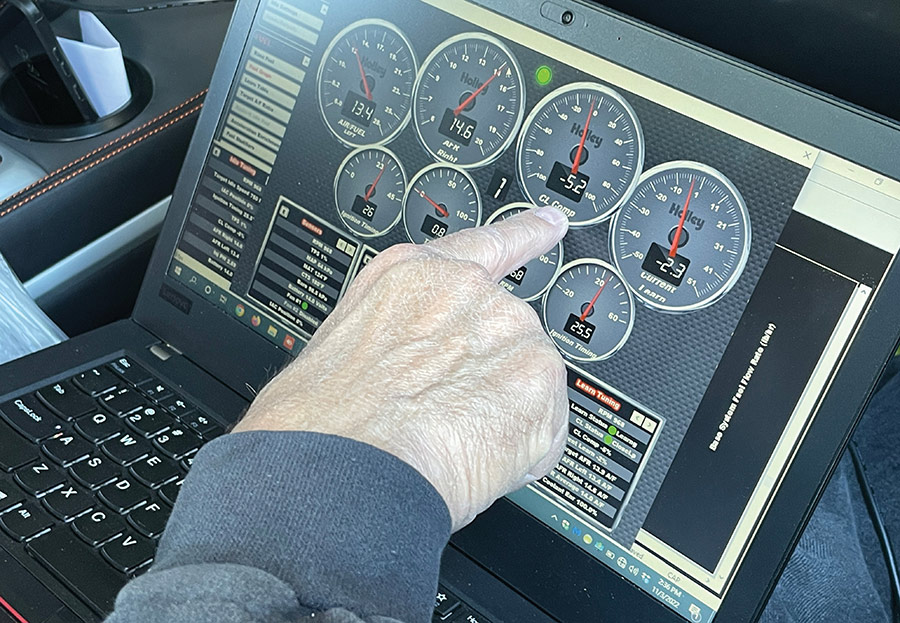
Steve Sbelgio correcting air/fuel ratio using digital gauges on a laptop.
18. Here, Sbelgio was working on correcting the air/fuel ratio. The top left gauge indicates the target, the next indicates the actual, and the gauge he is indicating shows the correction required.
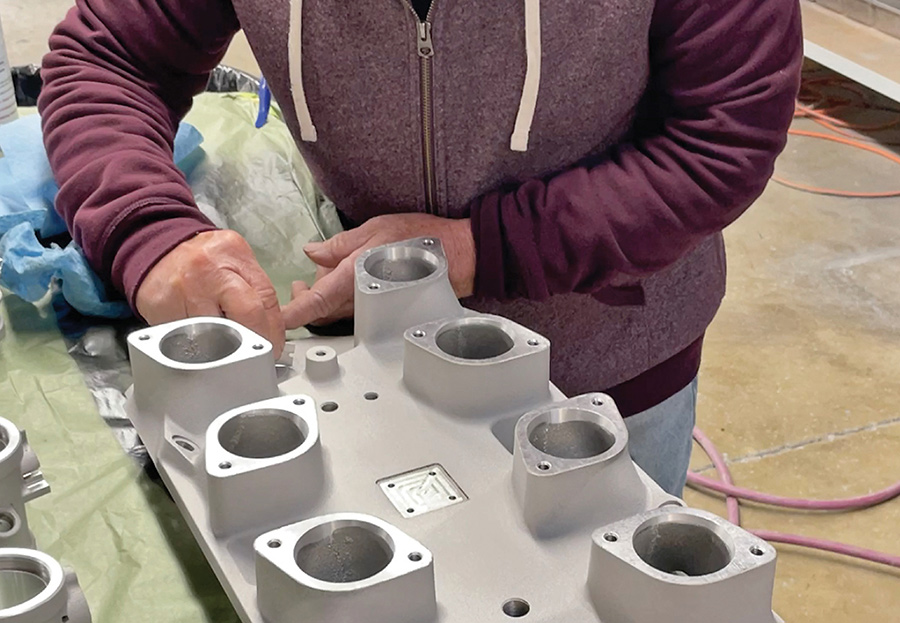
Prepping the intake manifold for paint by removing rough casting edges.
19. Carillo prepped the intake manifold for paint. He removed any rough edges of the casting prior to priming using PPG DP90 epoxy primer/sealer.
Radiusing sharp edges on the intake-to-throttle body flange.
20. Carillo used a razor blade to remove any sharp edges of the intake-to-throttle body flange. Paint doesn’t like sharp edges—either inny or outy—so they are best radiused.
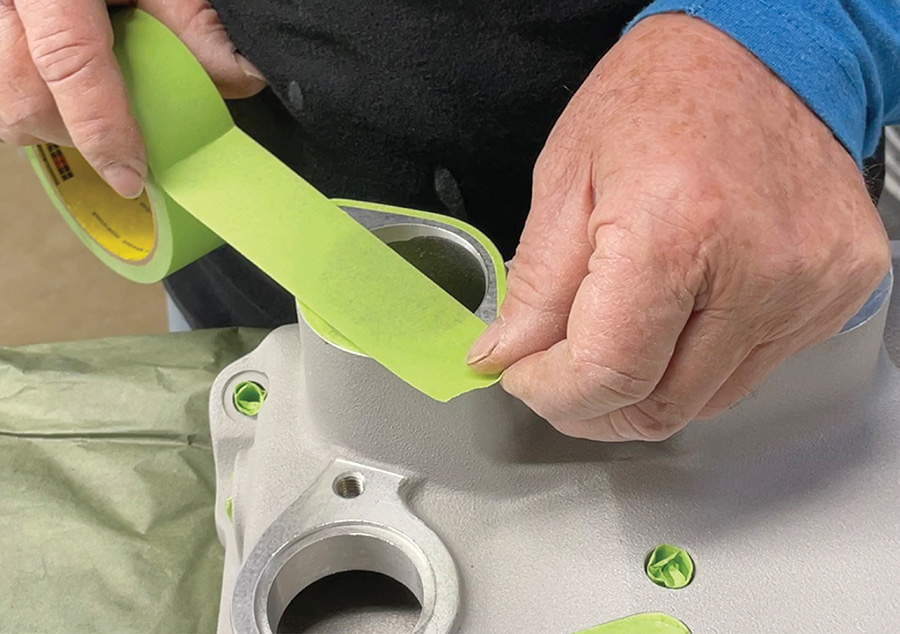
Masking manifold surfaces prior to painting.
21. Once the intake manifold had been prepped, Carillo carefully masked all the surfaces that didn’t require paint, including the intake-to-throttle-body flanges, and the bolt and stud holes.
Careful assembly of the painted and anodized intake components.
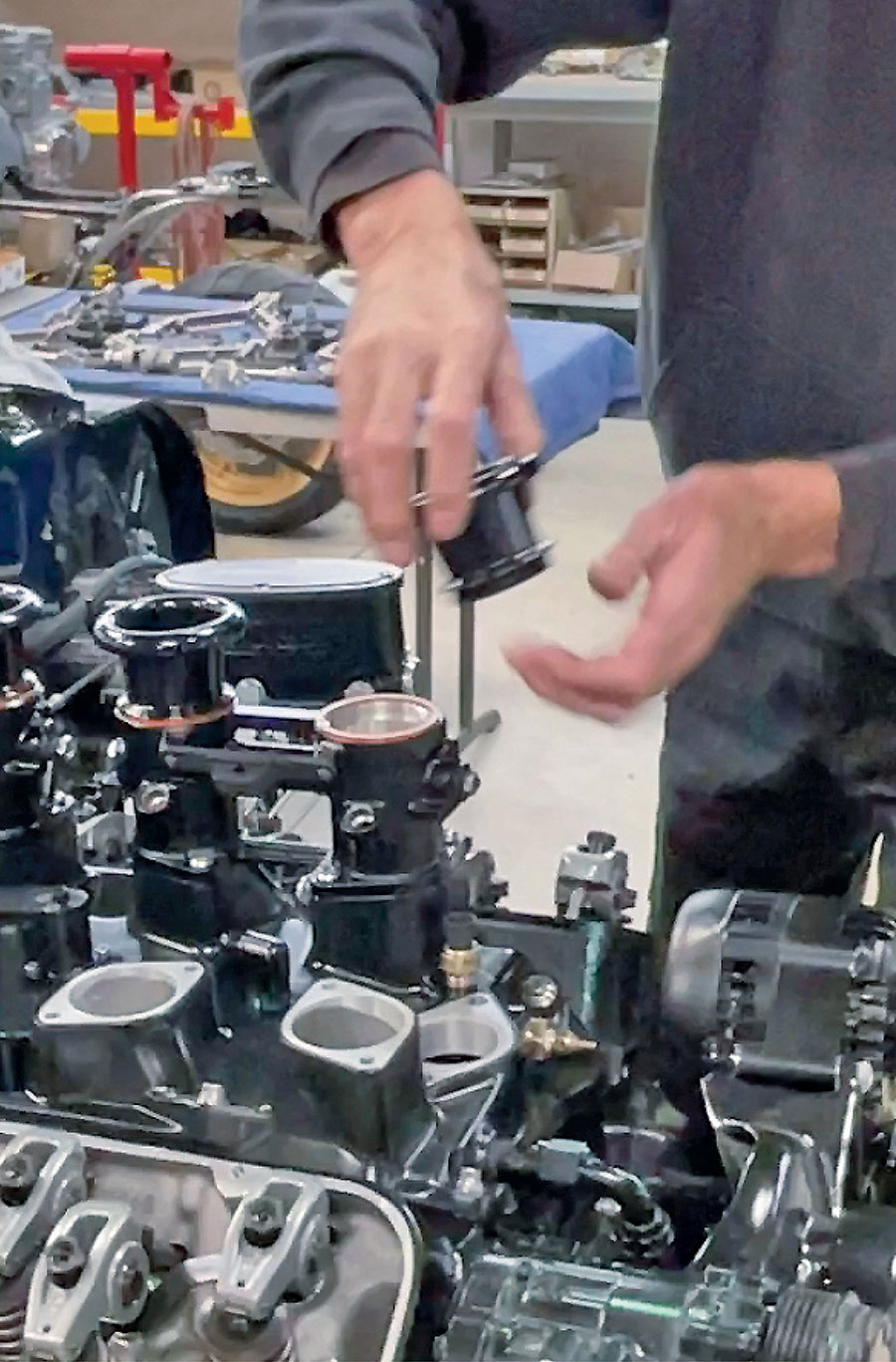
22. After all the painted and anodized parts were ready, Piehl began the assembly process being very careful not to scratch any of the finished parts.
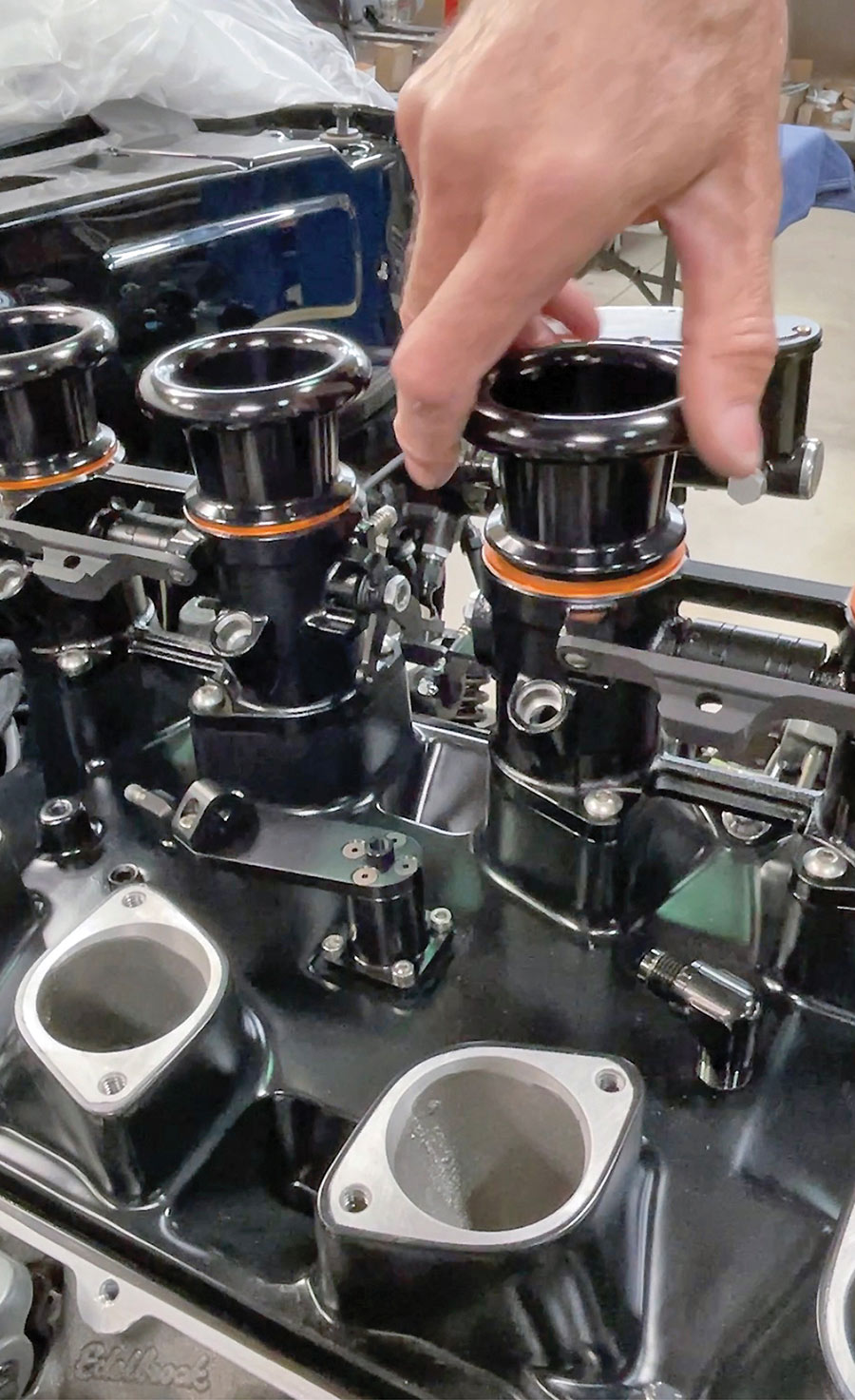
Orange anodized spacer rings installed beneath the airhorns.
23. Notice that the spacer rings underneath the airhorns that had been finished in black, had been anodized orange to match the wheel rings and the paint highlights.
Checking engine ignition timing with a light during tuning.
24. Sbelgio’s proprietary tuning program incorporates a timing curve that works but he likes to check using a light for 20 degrees at idle and 34 degrees total.
Completed black stack-injected engine in the 1969 Camaro.
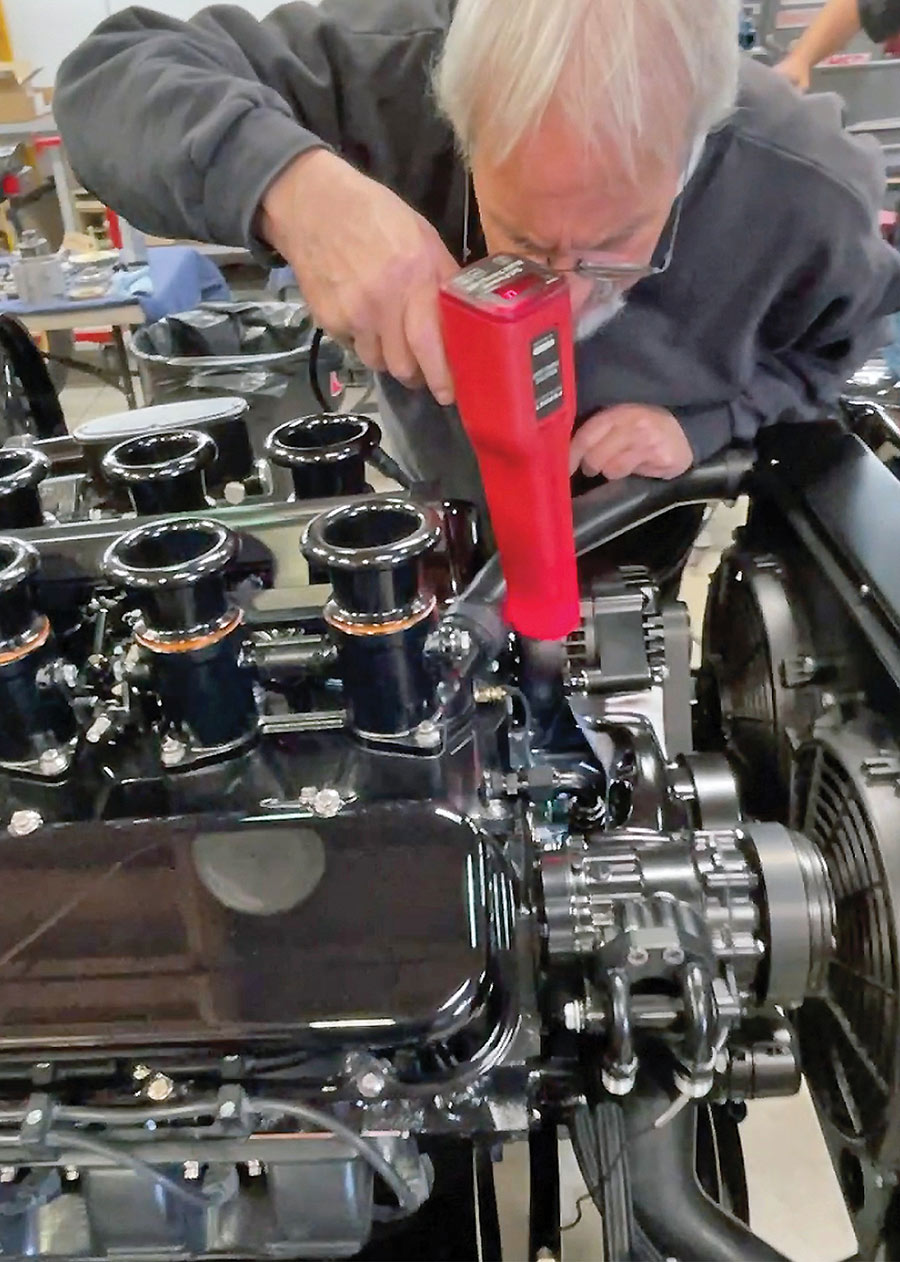
25. Black on black with a hint of orange, Jeff Pont’s stack-injected 502 not only looks the part but performs like a total badass!
In The Garage Media
Lokar Inc. logo

(877) 469-7440
lokar.com
Mick’s Paint