
 FEATURE
 IMAGES BY THE AUTHOR
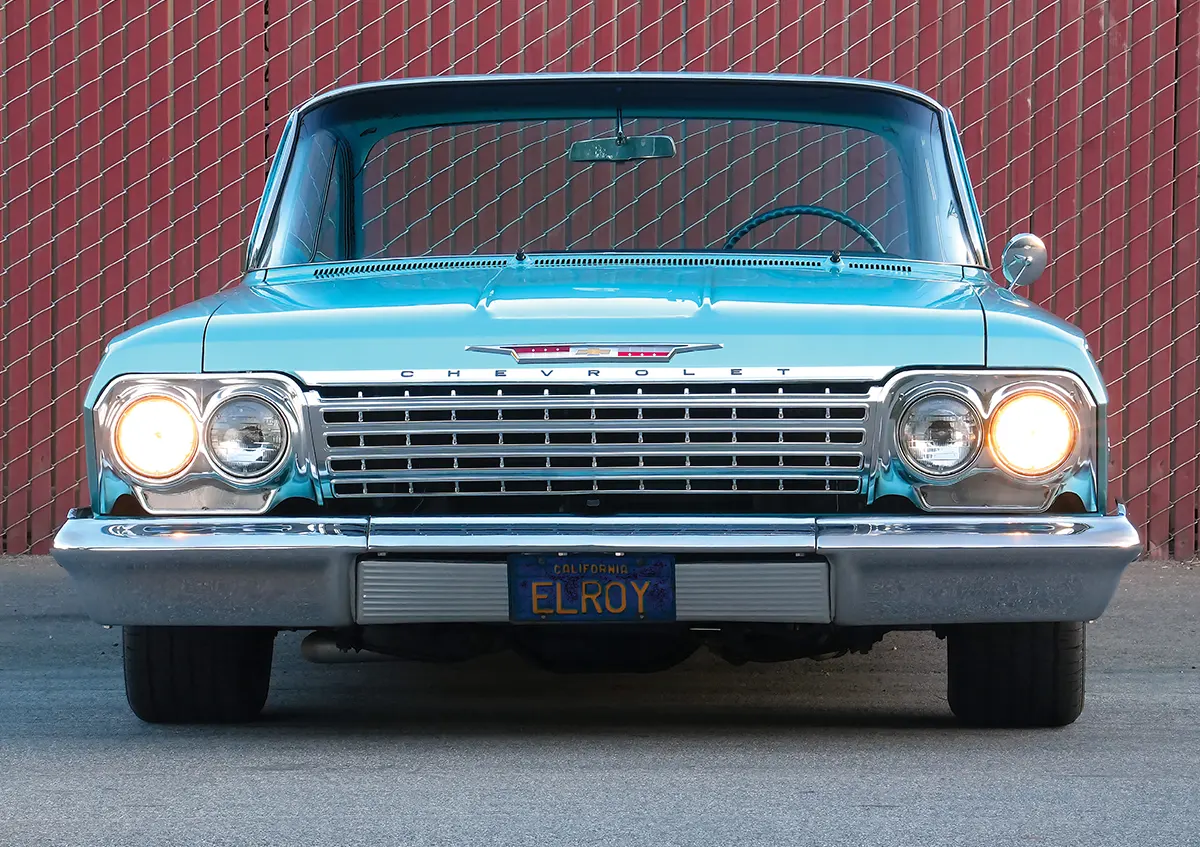
hen a lot of people moved out of California, Scott Toth moved in. We guess you could say he’s a California boy at heart who was born in the wrong place. At least he got here as soon as he could, and oh boy, did he buy into the SoCal lifestyle. The 55-year-old teenager runs a pool service and repair business (a Cali business if there ever was one) in Huntington Beach, California, and when he’s not hanging around swimming pools or hanging ten over the Pacific from one of his many surfboards, he can be found working on his 1962 Chevy bubbletop or cruising along PCH with it.
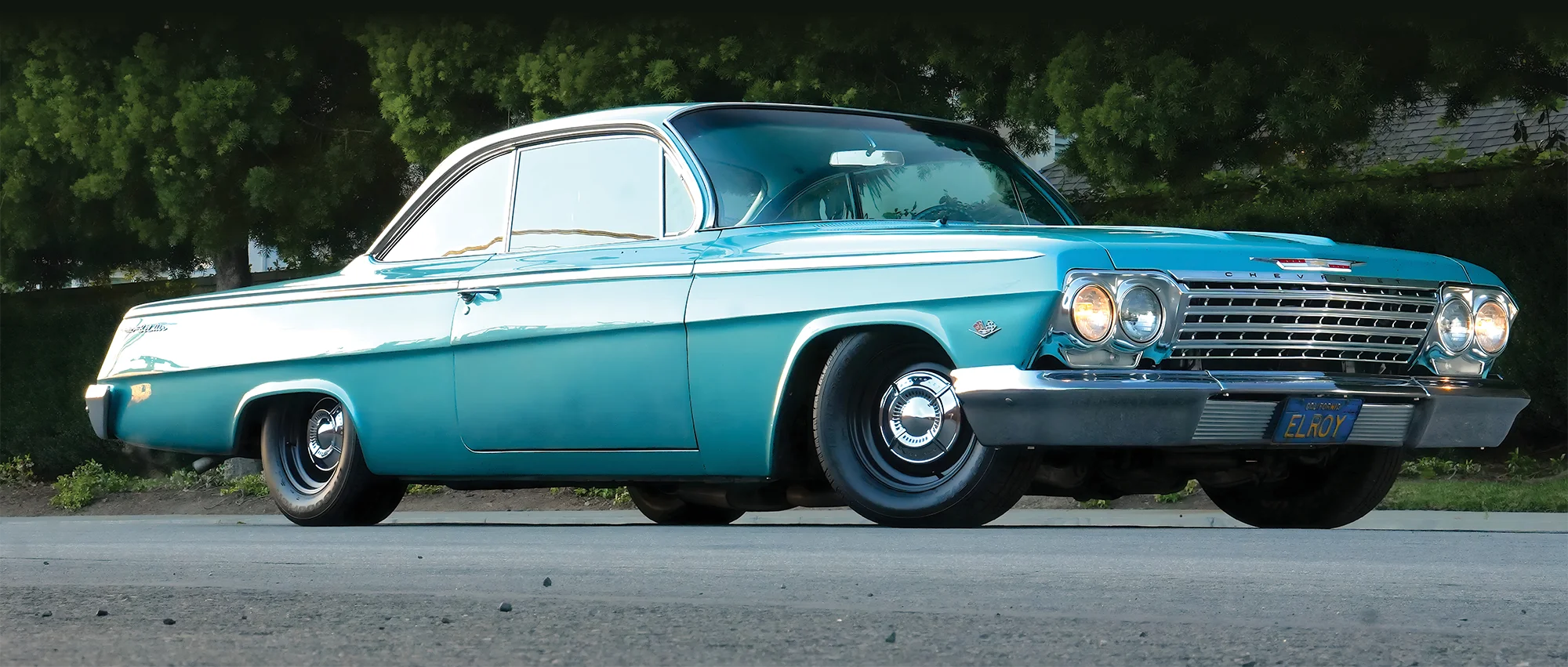

Scott didn’t stumble into this car, he hunted it down. “I previously had a 1963 station wagon and loved the A-pillars on the ’62, how it curved,” he says. “Once I saw one and realized how unique it was, I kind of couldn’t look away.” He’d been a ’60s Chevy guy for years, but the bubbletop was the one that got under his skin. “This thing eluded me for about 10 years,” he says. “I didn’t even know it existed, and then I ran across one and found out how clean the lines were with the roof and the body style. Once I realized this was out there, I couldn’t think about anything else.”
His California story starts long before the bubbletop. In 1992, at 21, he packed everything he owned into a 1966 Pontiac Catalina convertible (there’s your clue) and pointed it west. “My record collection was in the trunk. The convertible top was up, the back window zipped down, just listening to punk rock all the way across the country,” he says. “It ran like a champ. No overheating issues. I couldn’t believe how well it drove.” He told his parents he was leaving, his brother followed in his own car, and they landed in Huntington Beach like two kids chasing a postcard.
Cars came and went—a ’63 wagon, a ’65 Econoline window van, a handful of beach cruisers—but the bubbletop stayed lodged in his brain. He saved money, watched the market, and kept tabs on Boris Maryanovsky at Street Machinery in Ohio, a guy with a reputation for sniffing out clean, rust-free cars for people who actually care about what they’re buying. “I had [Maryanovsky] on the lookout for a bubbletop for years,” Scott says. “His prices were just really high. But I knew I was going to end up painting the whole thing anyway.”
Then he found it: a Twilight Turquoise ’62 that wasn’t a bubbletop yet but had the bones. “My wagon was seafoam green, and I really liked this Twilight Turquoise,” he says. “I saw this car for sale, and it was already the color I wanted. I was like, this is the car I’m gonna buy.” It was a formal-roof Bel Air, but Scott already knew about a guy in North Carolina—Dennis Hill—who had been converting cars to bubbletops for decades. “For 30 years this guy has been converting cars,” Scott says. “For what I paid for the car and had him do the roof conversion and repaint it is basically what you could buy a real bubbletop for in really poor condition.”
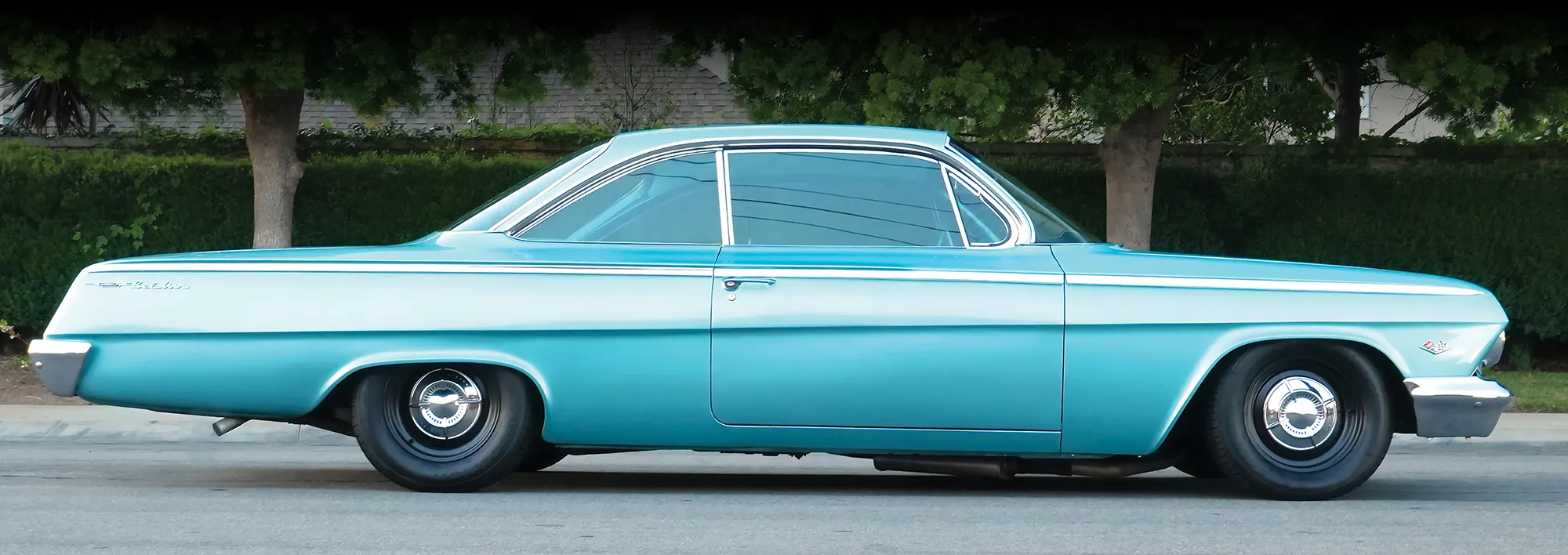
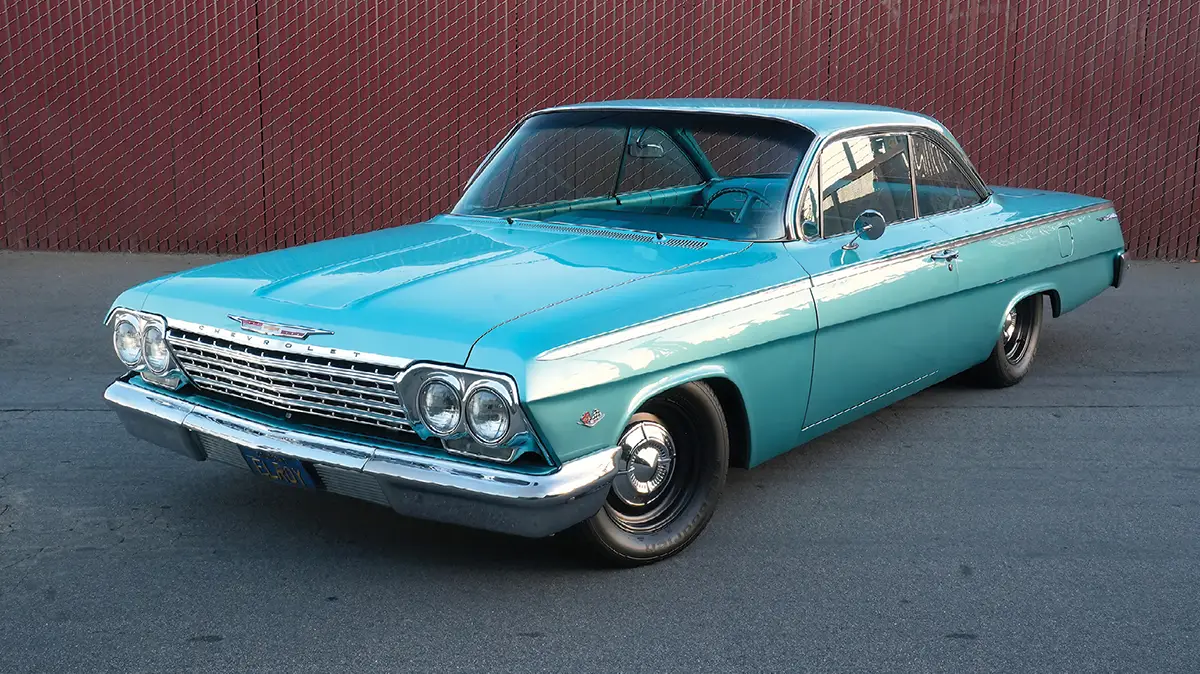
What sits in his garage now isn’t a “finished” car so much as the version he’s driving while he chips away at the rest. The sheet metal is stock, the Twilight Turquoise is the exact color he chased, and the Wheelsmith steelies and Ridetech setup give it the stance he pictured years ago. But Scott’s honest about where it stands: the look is locked in, but the details are still moving. “I’m not done with the transmission, engine, and drivetrain,” he says. “For me, it’s a blank canvas.”
Underhood is a straightforward 327 with a mild cam, a Holley 600, and Crane XR700 ignition—nothing wild, just a solid small-block to cruise with while he plans the bigger changes. Underneath, he’s already been busy. Scott built the new exhaust himself using 2.5-inch steel tubing and mandrel bends, welding it up so he could tuck everything tight into the X-frame. He moved the muffler under the back seat on the driver side and is setting up the passenger side to match. Shorty headers are next, mostly to gain a little more clearance and keep the whole system hidden until the long-term drivetrain plans take shape.
He’s about $68,000 into the car—$30K for the donor vehicle, $10K for the conversion, $20K for paint and chrome, and another $8K for interior. “If I was to buy a real bubbletop, the cheapest, reasonable one I could find was a complete basket case at $55,000,” he says. “I’d be well over $100 grand. For me, this makes way more sense because I can put a lot more money toward the engine and transmission I want.”

Before we wrap, he makes sure to thank the people who helped him get here. “My wife, Alice, for sure,” he says. “She thought I was absolutely crazy with this car.” And, of course, Boris Maryanovsky and Dennis Hill. “Hill is a true artist when it comes to replacing these tops. That kind of craftsmanship is hardly seen these days.”



VEHICLE: 1962 Chevy “Bubbletop”
TYPE: Factory 327ci small-block Chevy (originally a factory six-cylinder car), mild hydraulic street camshaft, Holley 600-cfm vacuum secondary, factory dual-plane intake, Crane XR700 ignition, approximately 310 hp
EXHAUST: Stock 327ci exhaust manifolds, SpinTech muffler, 2.5-inch custom exhaust
TRANSMISSION: Muncie M20 wide-ratio four-speed
REAR END: Original factory “3725899” 10-bolt, open differential, 3.70:1 gear ratio
CHASSIS: Factory X-frame
SUSPENSION: Ridetech airbags, 2-inch CPP drop spindles
WHEELS: Wheelsmith steelies 15×7 (front), 15×8 (rear)
TIRES: BFGoodrich Radial T/A, 235/60R15 (front), 245/60R15 (rear)
UPHOLSTERY: Upholstery by Ciadella Interiors and installed by Universal Auto Upholstery (Costa Mesa, CA)
SEATS: Stock
STEERING: Stock
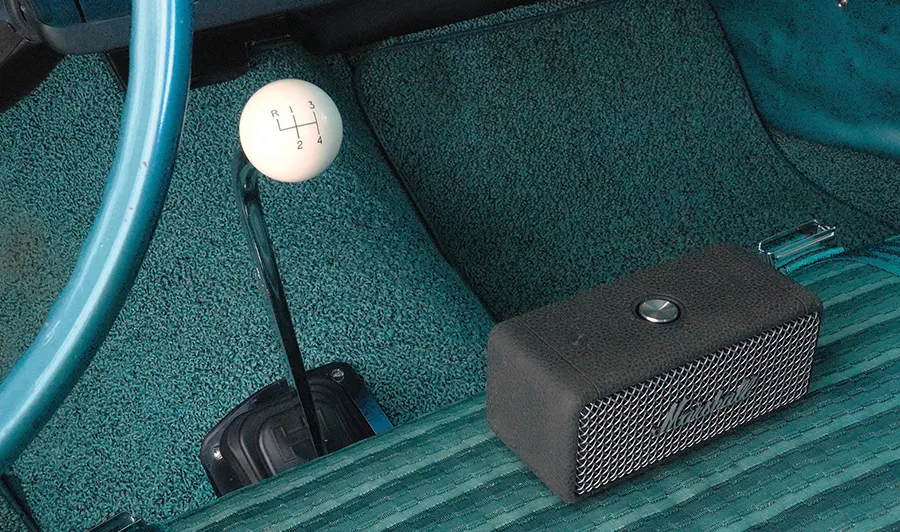
SHIFTER: Hurst
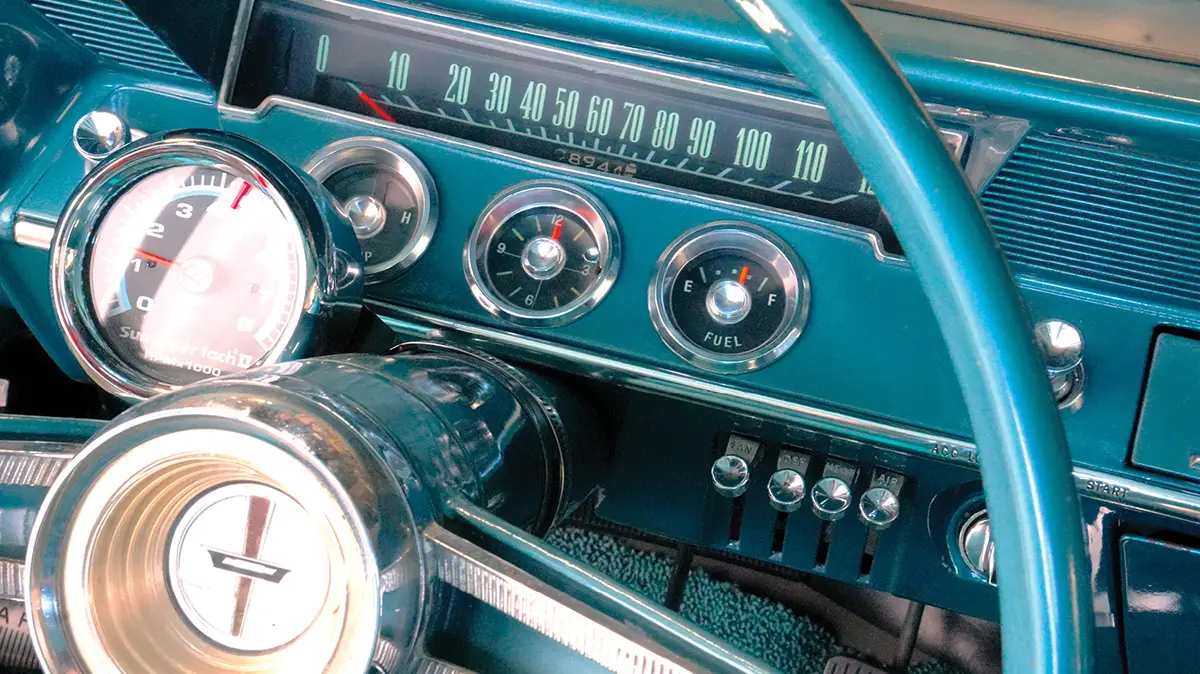
DASH: Original
AUDIO: Marshall portable Bluetooth speaker
BODYWORK: Bubbletop conversion by Dennis Hill (Jack’s Auto Body Shop, Lexington, NC)
PAINT: Twilight Turquois by Boris Maryanovsky at Street Machinery (Cleveland, OH)