

ACP department heading TECH
InTheGarageMedia.com
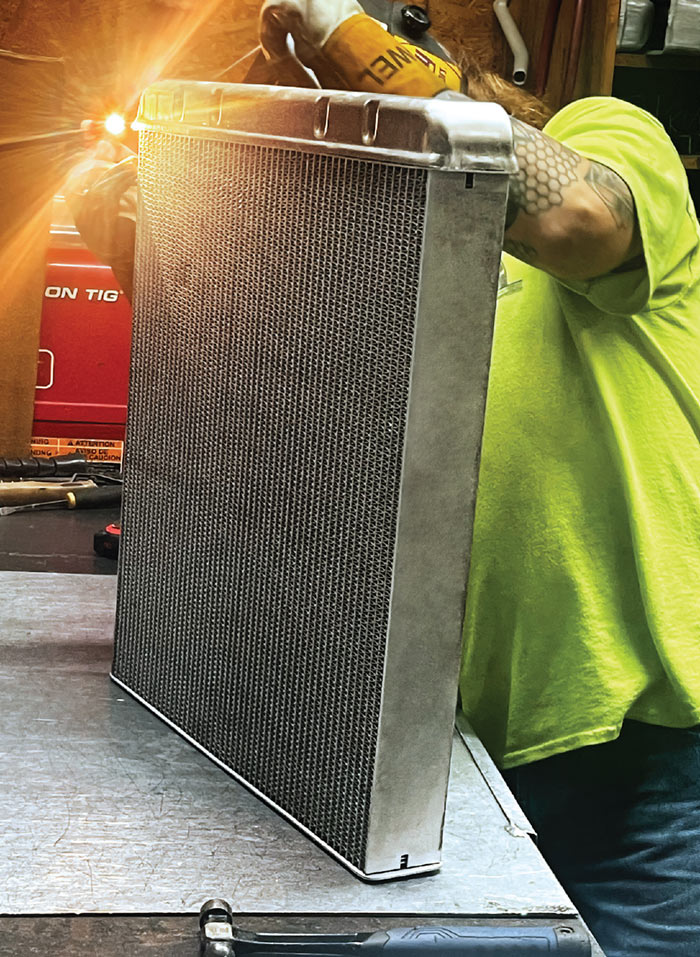
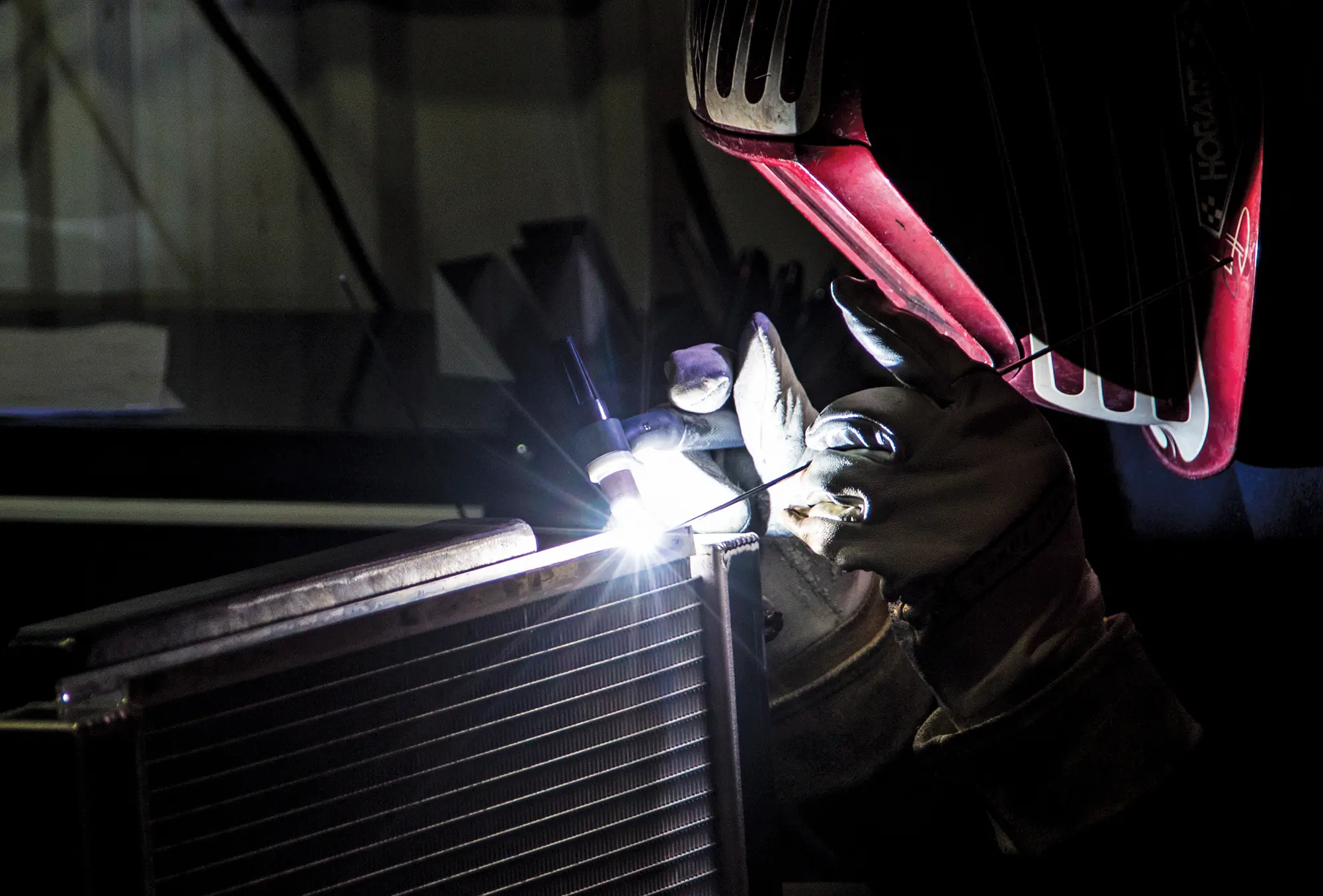
TIG welding an aluminum radiator for precision cooling system fabrication
Keeping Your Hot Rod Cool typography

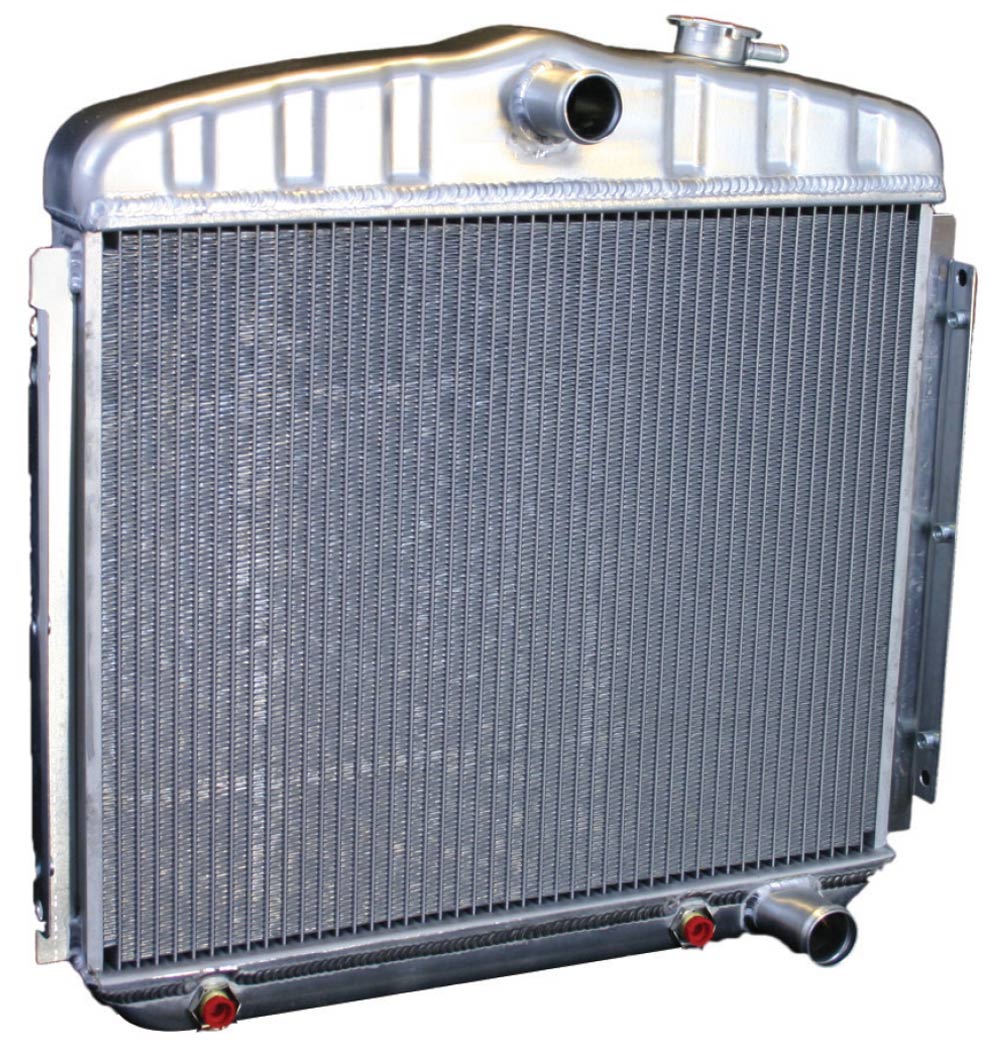
1. For strength and durability AFCO aluminum radiators have TIG-welded tanks and fittings.

Keeping Your Hot Rod Cool typography
Part 1: What You Need to Know About Cooling System Components
By Ron Ceridono
Images by The Author
and Courtesy of The Manufacturers
T

here’s nothing cooler than taking your hot rod out for a cruise. On the other hand, there’s nothing worse than driving a hot rod with one eye on the road and the other on the temperature gauge as it climbs up the scale. That’s because overheating an engine always comes with consequences—it may be as simple as having to clean up the mess from dumping coolant out the overflow to substantial engine damage. Severe overheating can cause pistons to expand enough to scuff or even seize in the cylinders, rings can lose tension, stick, or literally weld bits of themselves to the cylinder walls, exhaust valves may stick in their guides, heads can warp, head gaskets can develop compression and water leaks, and blocks and heads can crack. In short, a good engine can become an even better boat anchor if it gets too hot. But thanks to a number of experts on the subject, we’re going to help you keep your hot rod cool.

How Hot is Too Hot?

It’s a lousy pun but engine operating temperature really is a hot topic. Although the hotter an engine runs the more efficient it becomes, there is a practical limit, primarily because the internal components can only tolerate so much heat. Due to the composition of today’s fuels, 180 degrees is considered the minimum operating temperature for efficient combustion even for vintage engines on the street. Most experts agree that 190 degrees is a safe operating temperature for modern engines and for contemporary fuel-injected crate engines, 195 to 220 degrees is considered the norm.
Radiator Types
All radiators share the same basic parts, a pair of tanks, a core that consists of tubes that connect the tanks, and the fins between the tubes. For years downflow radiators were used, as they had the tanks at the top and bottom of the cores with vertical tubes connecting them; these radiators were taller than they were wide. As automotive styling dictated lower hood profiles, less height was available for a radiator, which led to the introduction of the crossflow design that is wider than it is tall. By placing the tanks on the sides of the radiator the horizontal tubes could be long enough to provide adequate cooling. All things being equal (tube length and fin count) downflow and crossflow, radiators are the same in their ability to cool.

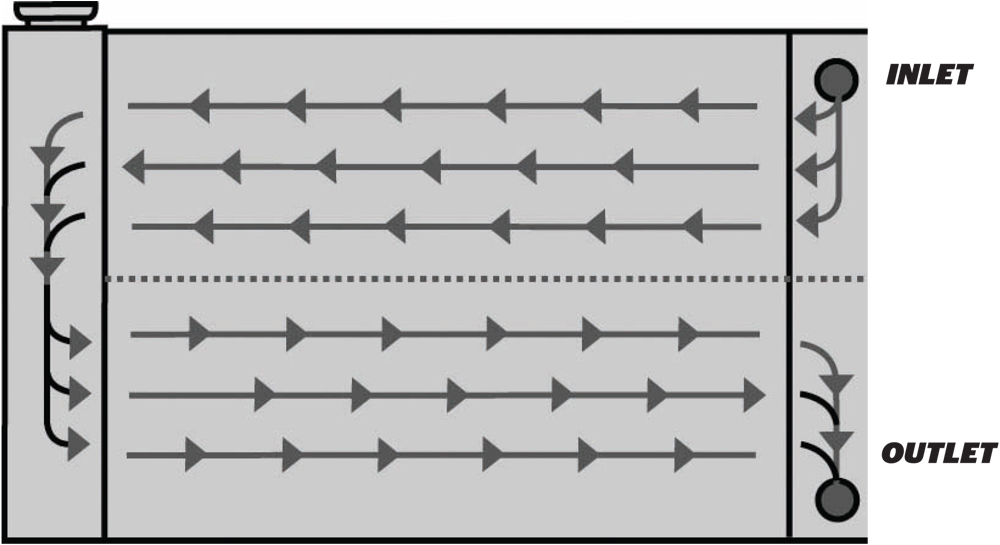
A relatively new development in radiator technology is the multi-pass configuration. By placing baffles in the tanks, the core is “divided” and coolant is redirected to make two, or in some cases three, passes through the core. Double-pass radiators are often used for LS swaps, so both the inlet and outlet can be on the same side of the radiator.

The Aluminum vs. Copper/Brass Debate
There has been considerable discussion concerning the effectiveness of copper/brass radiators (copper is used for the fins and brass is used for the tanks) and aluminum radiators. When comparing the thermal conductivity of the two materials (measured in [BTU/hr.ft degrees F], copper is rated at 231, aluminum 136, which means copper conducts heat better than aluminum. That being said, there is an equalizing factor; the lead solder used to attach the copper fins to the tubes is a very poor conductor of heat, so some efficiency of a copper core is lost. Aluminum radiator cores have the tubes brazed to the tubes with aluminum so there is no impediment to heat transfer.

Basically, the situation is this: the advantage of a copper core is offset by the solder that holds everything together, so manufacturers try to minimize its impact by carefully controlling the amount applied. On the other hand, aluminum radiator manufacturers use larger tubes that result in fewer gaps between the fins to increase the efficiency of aluminum cores. We’ve used both with excellent results, so the choice most often comes down to personal preference, appearance, and price point.

Tube Size & Fin Count
While all radiator cores appear to be similar in design, the size of the tubes and the number of fins per inch varies. Modern copper/brass radiators usually have 1/2-inch tubes, while aluminum radiators use 1-, 1 1/4-, or 1 1/2-inch tubes. Copper/brass radiators typically have three or four rows of tubes, while aluminum radiators typically have two.

Another important factor that figures in radiator efficiency is the number of fins per inch count. A higher fin count will increase the ability of a radiator to cool, but only up to a point. If the fin spacing is too close, airflow may be restricted, which will reduce cooling capacity. For all-around driving, 14 to 16 fins per is commonly used.

LS Steam Ports

LS engine swaps are certainly popular, but there is a cooling system issue that must be addressed. Unlike the venerable small-block Chevy that had the thermostat high up in the intake manifold, the LS thermostat is in the water pump housing, which is located low on the engine. As a result, air can get trapped in the system, which disrupts the flow of coolant, which in turn can cause overheating. To cure the problem, GM provided ports that connect to the radiator allowing the air to escape. As LS swaps are so popular, most radiator manufacturers offer radiators with steam connections for the same purpose.
Choosing a Radiator
There are a number of considerations to be made when choosing a radiator. For restorations, exact replacements are available, which in most cases are an improvement over the OEM design. For restomods, radiators that look like the original but have additional cooling capacity are also available. For high-performance applications the basic rule of thumb is this: get the biggest, most efficient radiator you can fit in the space available as you’ll never regret having more cooling capacity than necessary.

We’ve just scratched the surface on the subject of cooling systems, so if we haven’t answered all your questions, stick around, there’s more to come.
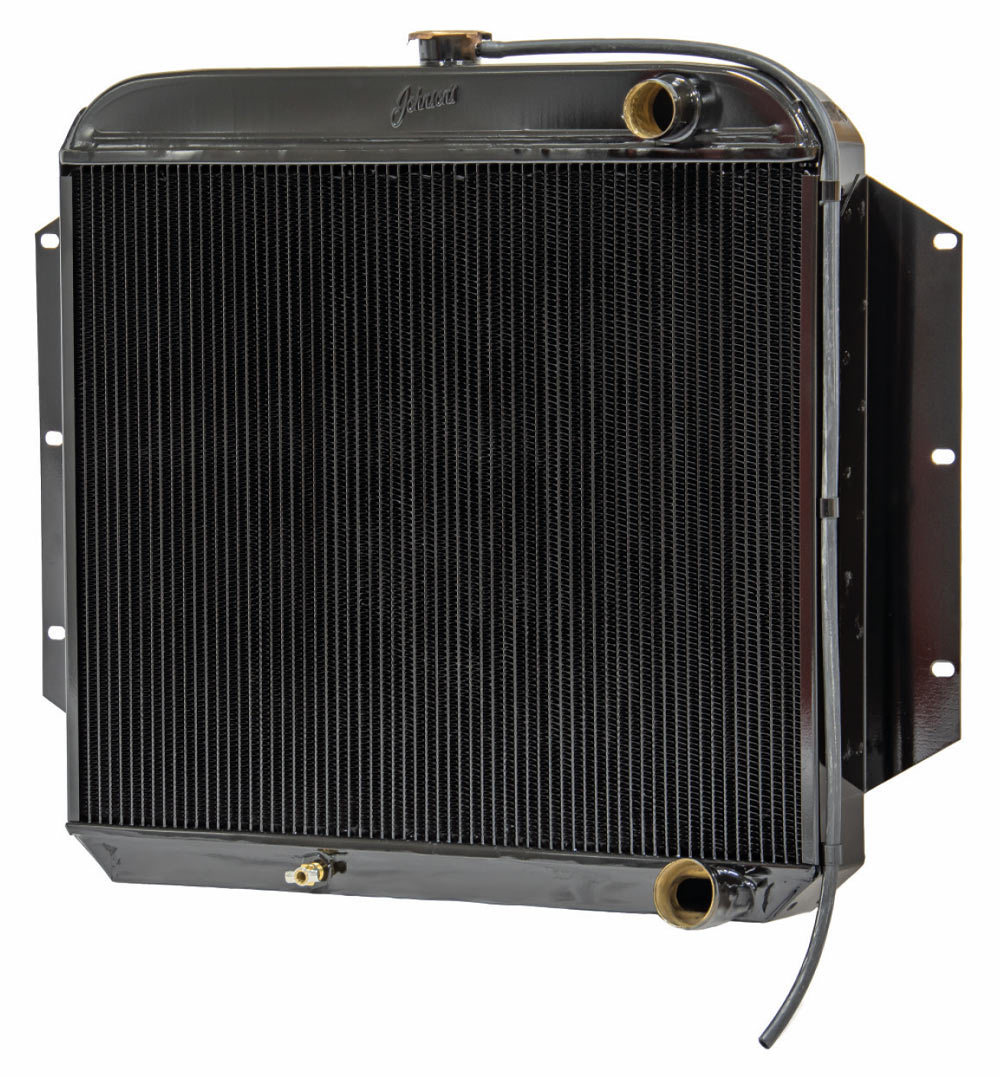
black-painted high-performance radiator designed for classic car cooling
2. Johnson’s Radiator Works (formerly Walker Radiator) uses copper brass construction with four-row cores exclusively. This example is a downflow for a 1959-63 Chevrolet.
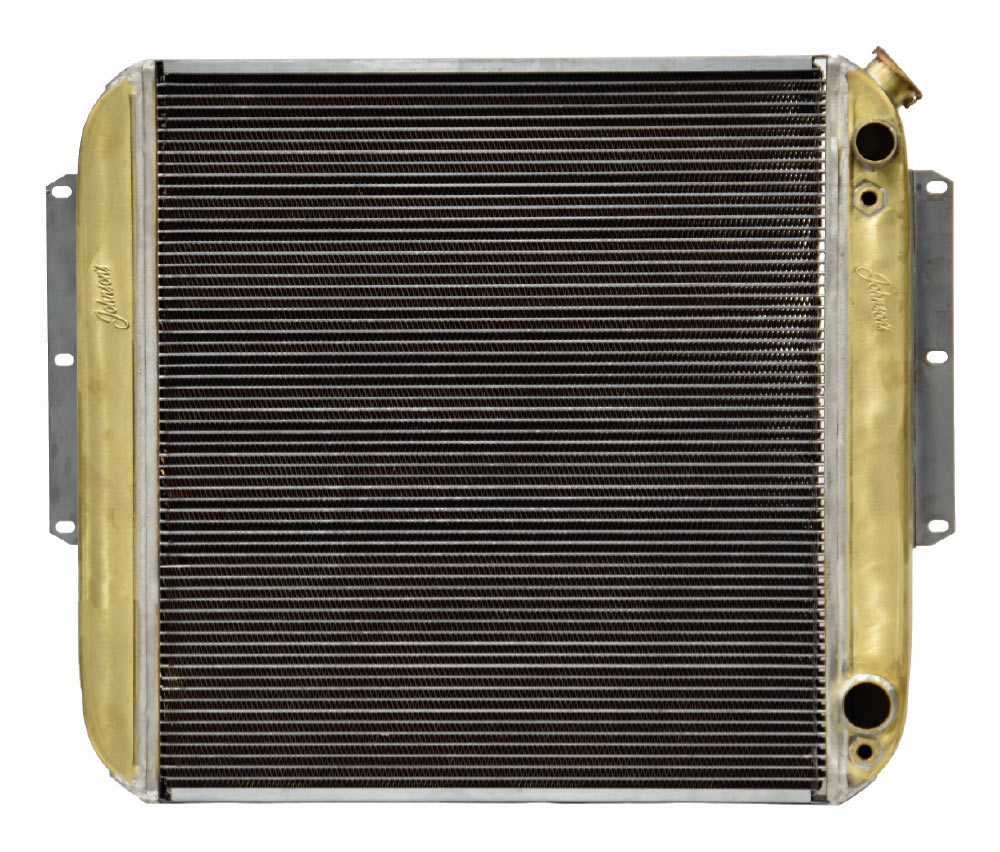
brass and copper radiator with vintage-style construction for classic vehicle applications
3. This crossflow copper/brass radiator from Johnson’s for 1959-63 Chevrolets provides clearance for aftermarket power steering. Crossflow radiators for LS engines have the hoses on the same side and a steam port below the upper hose connection.
fin-to-tube solder thickness
4. Johnson’s makes everything in-house, including the tubes and louvered fins for the cores. To minimize the effect of the solder and maximize efficiency of the core, fin-to-tube solder thickness is held to 0.0006 inch.
copper cooling fins arranged for radiator heat dissipation efficiency
5. The fins for a copper core radiators have small louvers that create turbulence in the airflow; as a result louvered fins dissipate heat more effectively than smooth fins.
worker assembling copper radiator cores in a manufacturing facility
6. Copper cores are assembled alternating rows of louvers with tubes that are covered with a thin coat of solder.
copper-brass radiator core in a high-temperature brazing oven for final assembly
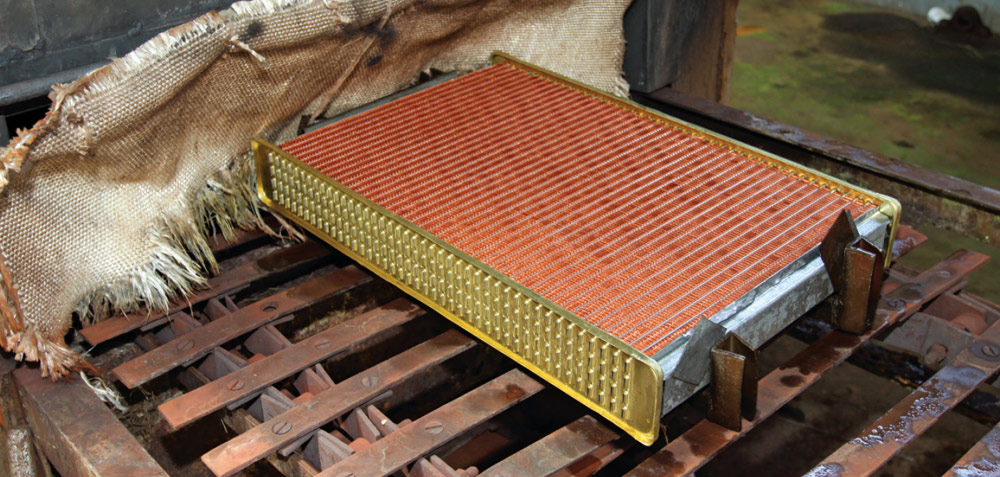
7. With the headers attached to the tubes, the core is put through an oven that melts the solder on the tubes.
stacked radiators with brass tanks prepared for final assembly
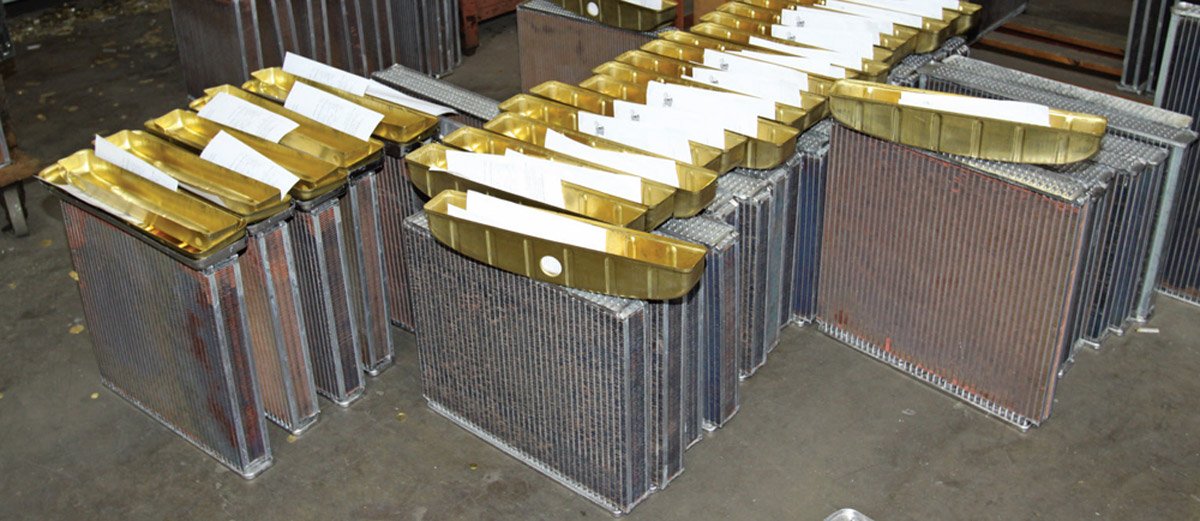
8. This is why they’re called copper/brass radiators; these copper cores will have the brass tanks soldered in place.
close-up of aluminum radiator core with high-efficiency tube and fin design
9. DeWitts builds copper/brass and aluminum radiators. This is the header of a copper/brass radiator; note the size of the four rows of tubes.
detailed view of extruded aluminum cooling fins in a high-performance radiator
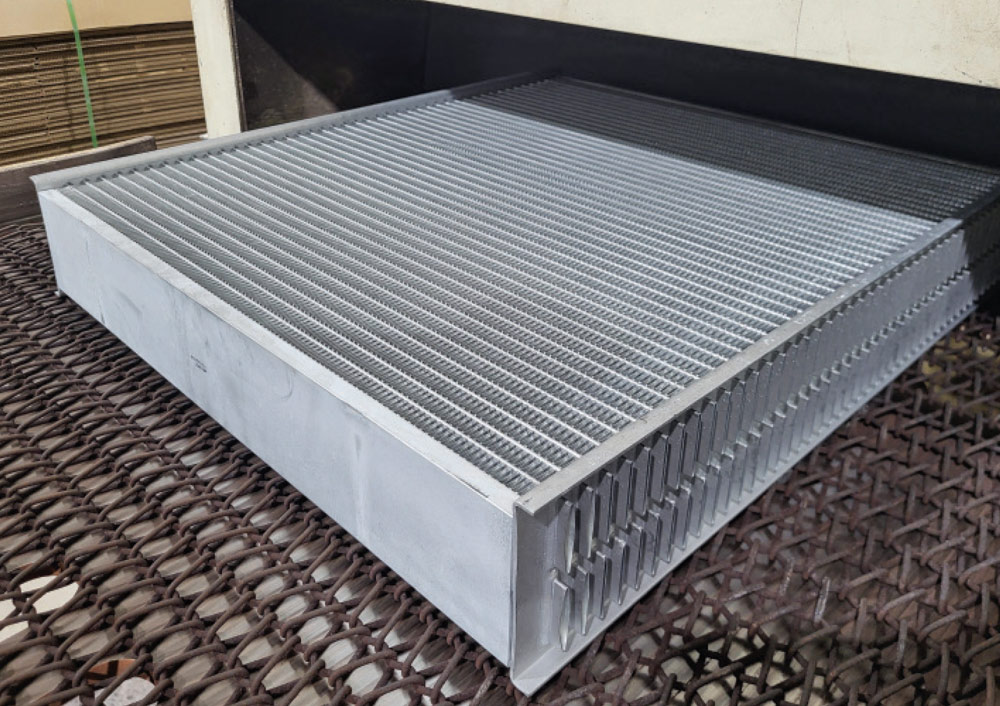
10. By comparison, this is the header of an aluminum radiator with two rows of 1-inch tubes.
aluminum radiator core fresh from the brazing oven for high-performance cooling
11. DeWitts aluminum radiator cores are brazed in a furnace to join the tubes, fin, and headers. This brazing process is commonly referred to as CAB (Controlled Atmosphere Brazing).
polished aluminum crossflow radiator with high-efficiency cooling fins
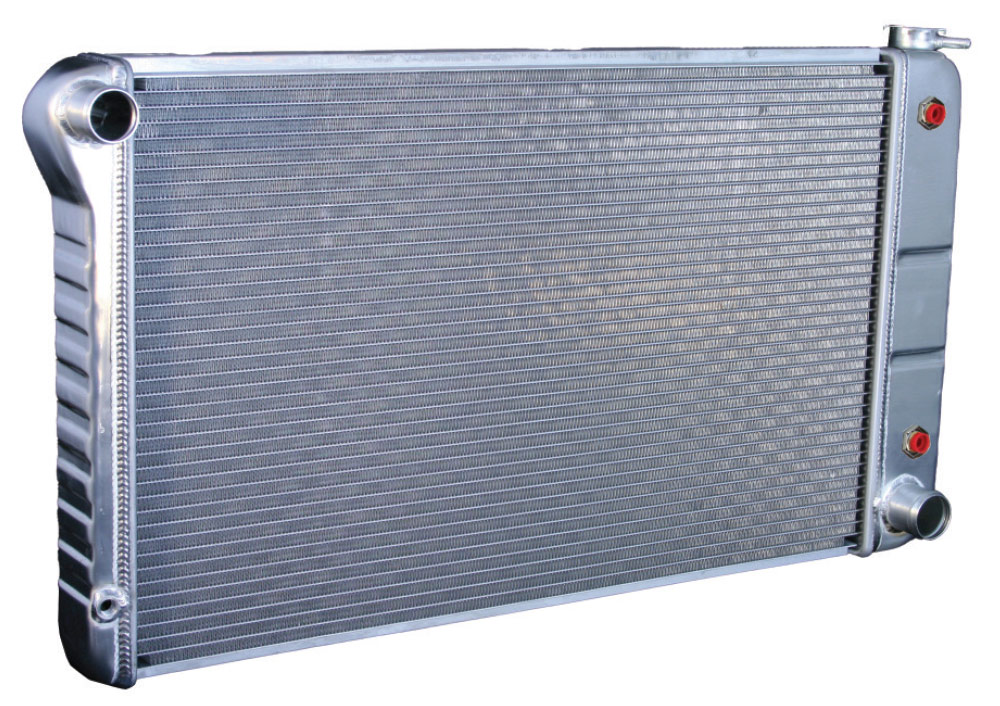
12. DeWitts Direct-Fit Pro-Series Aluminum Radiators fit like the original while providing a 25 percent increase in cooling performance. This example is for 1968-72 Chevelles.
vintage-style aluminum radiator with a top-fill tank for classic cars
13. DeWitts Direct Fit Pro Series radiators for 1955-57 Chevys have two rows of 1-inch tubes. The HP series has two rows of 1.25-inch tubes.
black-painted transmission cooler with high-efficiency tube-and-fin design
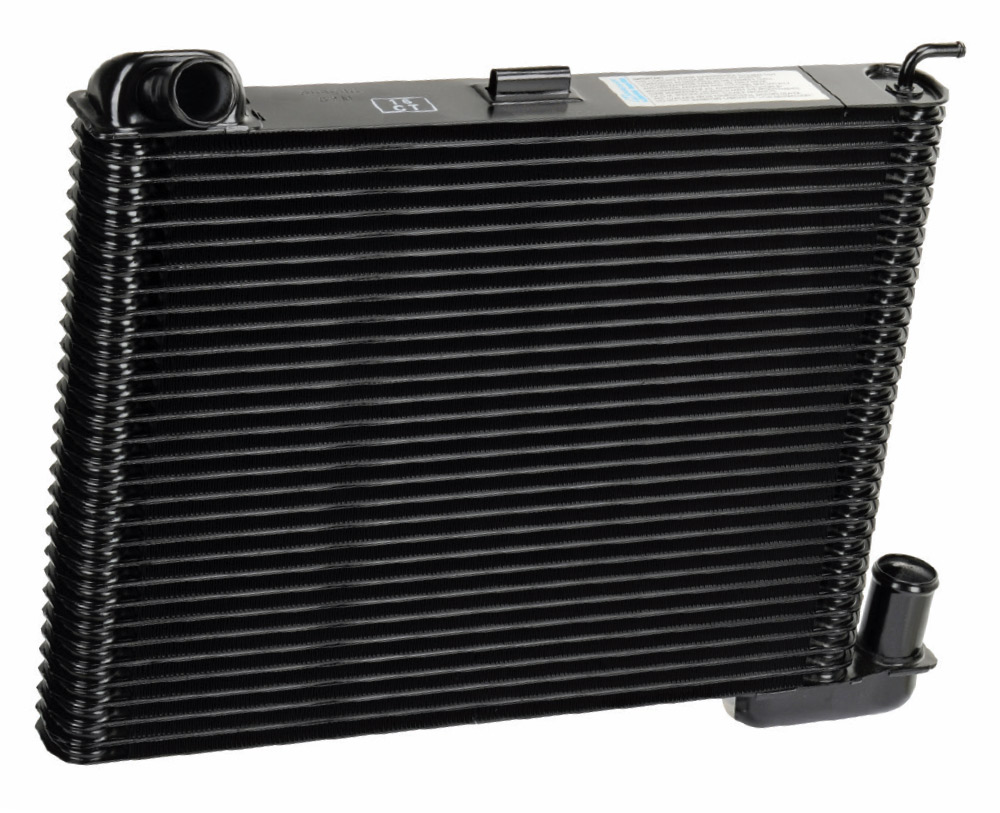
14. DeWitts offers Harrison stacked-plate-style restoration radiators for C2 Corvettes. They are available with the original GM PN 3155316, specific date codes, correct-appearing inspection stamp, and a reproduction maintenance decal. A “non-detailed” model in natural aluminum is also available.
restored vintage Harrison aluminum coolant overflow tank
15. DeWitts can also provide reproduction Corvette surge tanks that are made from the original tooling. They have the correct Harrison part number and can have the car’s date code added.
precision aluminum radiator core assembly in a manufacturing press
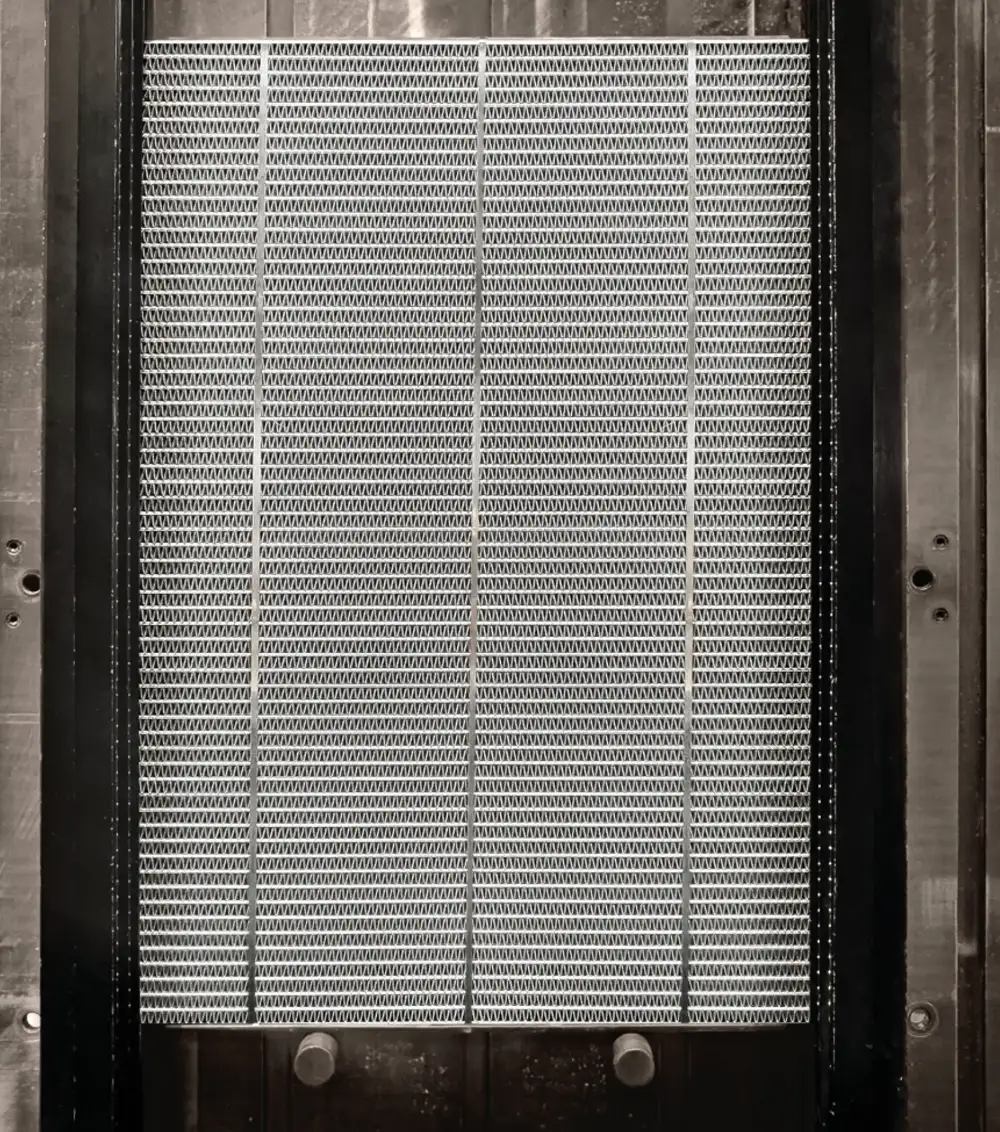
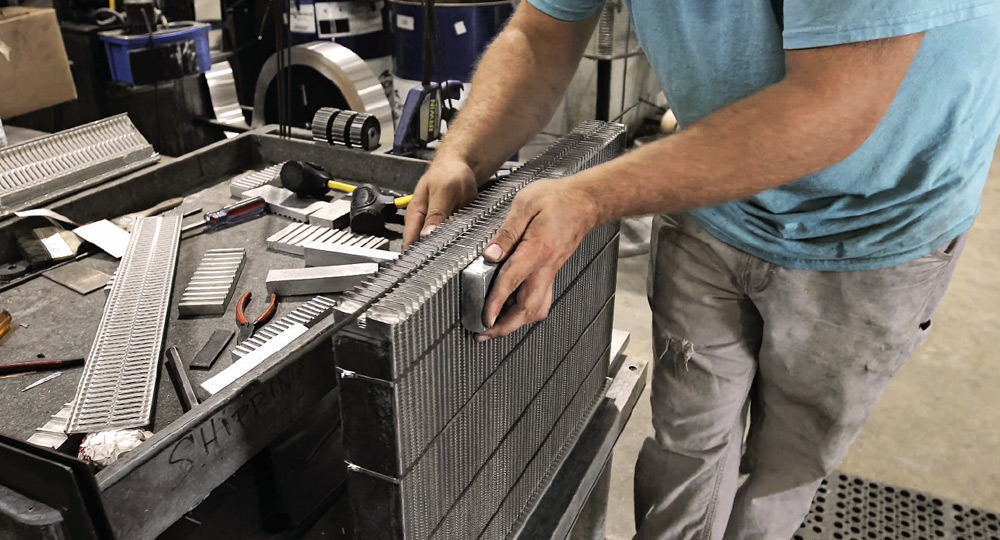
16. This is a U.S. aluminum radiator core being assembled. Modern high-efficiency copper cores have tubes on 3/8 centers 14 to 16 fins per inch.
worker assembling an all-aluminum radiator core for high-performance applications
17. This diagram from AFCO shows how coolant flows through a double-pass radiator. A triple-pass radiator provides one more path through the core.
close-up of aluminum radiator core construction with extruded cooling tubes
18. As U.S Radiator explains it, a standard aluminum core uses 1-inch tubes, while a copper core uses 1/2-inch tubes. So, a two-row aluminum core is equivalent to a four-row copper brass.
TIG welding an aluminum radiator for a custom cooling system
19. Here the header is being installed on the core. Aluminum tubes are stronger so they can be bigger than the ½-inch tube used in copper/brass radiators.
classic black-painted brass and copper radiator by U.S. Radiator
20. The tanks on U.S. aluminum radiators are TIG welding with no epoxy sealer.
U.S. Radiator polished aluminum dual-pass radiator for high-performance cooling
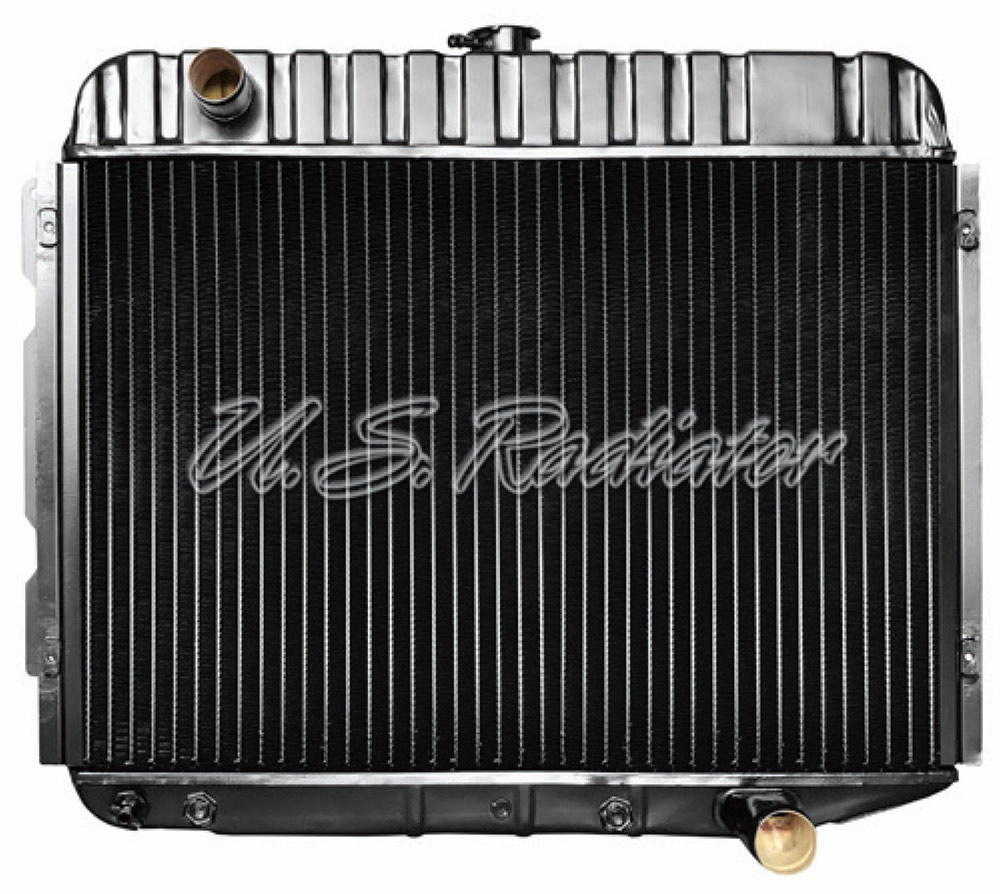
21. This is a copper/brass U.S. Radiator. Most are available with standard cores (1/2-inch tubes on 9/16-inch centers) high-efficiency cores (1/2-inch tubes on 3/8-inch centers), multiple-pass cores, or Optima cores (1/2-inch tubes on 5/16-inch centers).
diagram illustrating coolant flow in a dual-pass aluminum radiator
22. Aluminum U.S Radiators crossflow radiators are available with high efficiency or high-efficiency triple pass cores.
Speedway Motors aluminum crossflow radiator with TIG-welded construction
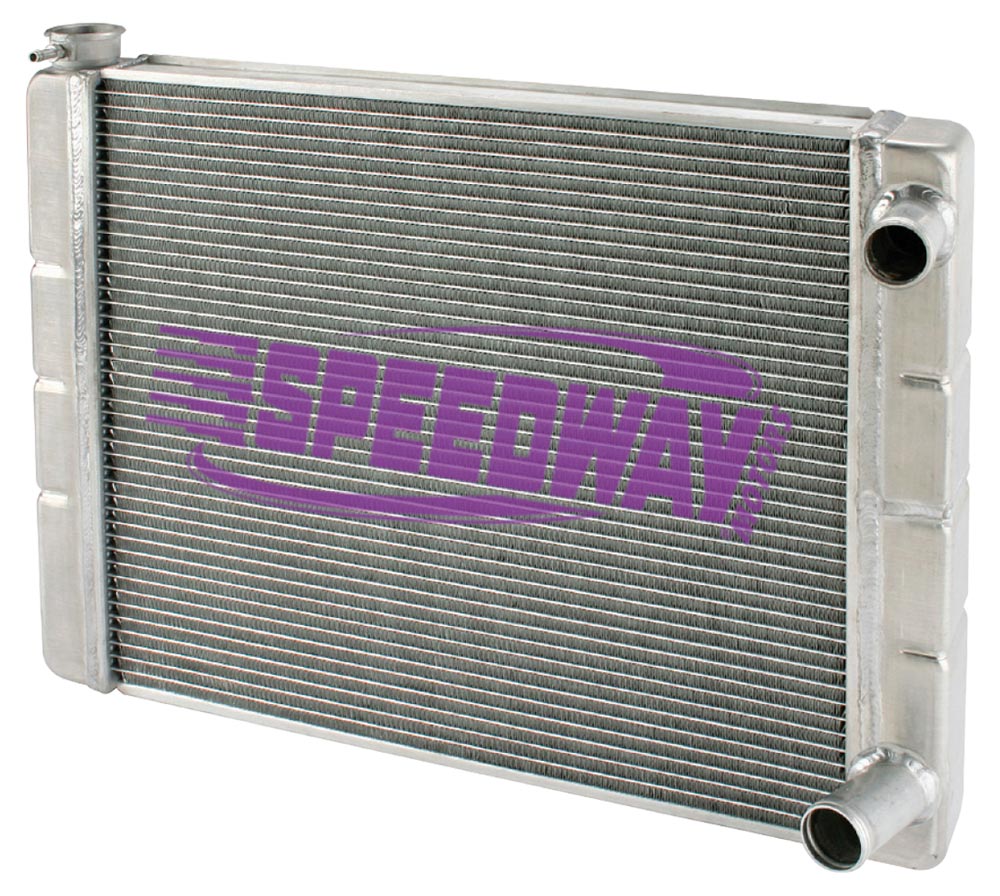
23. Speedway Motors offers a variety of aluminum radiators. The inlet and outlet on the same side indicates this is a double-pass design.
SOURCES