

 TECH
TECH
 Photography BY THE AUTHOR
nless you are an oil geek and make it a habit of staying current on API specifications and what is happening in the ever-changing world of engine lubricants, it’s likely there are a few technical tidbits in this story that should be of interest to you regarding the oil you’re using in your performance street car engine.
API testing showed that these reduced levels of ZDDP did not significantly increase engine wear because most all production engines by the mid ’90s employed roller tappets. However, when performance engine builders used this same oil for their flat tappet camshaft engines, that’s when the troubles began.
The most pronounced issue occurred with breaking in these flat tappet camshafts. Most everyone knows now that they must use a quality break-in oil like AMSOIL’s specialty break-in oil that employs a higher ZDDP content intended to offer sufficient protection for the initial wear-in period.
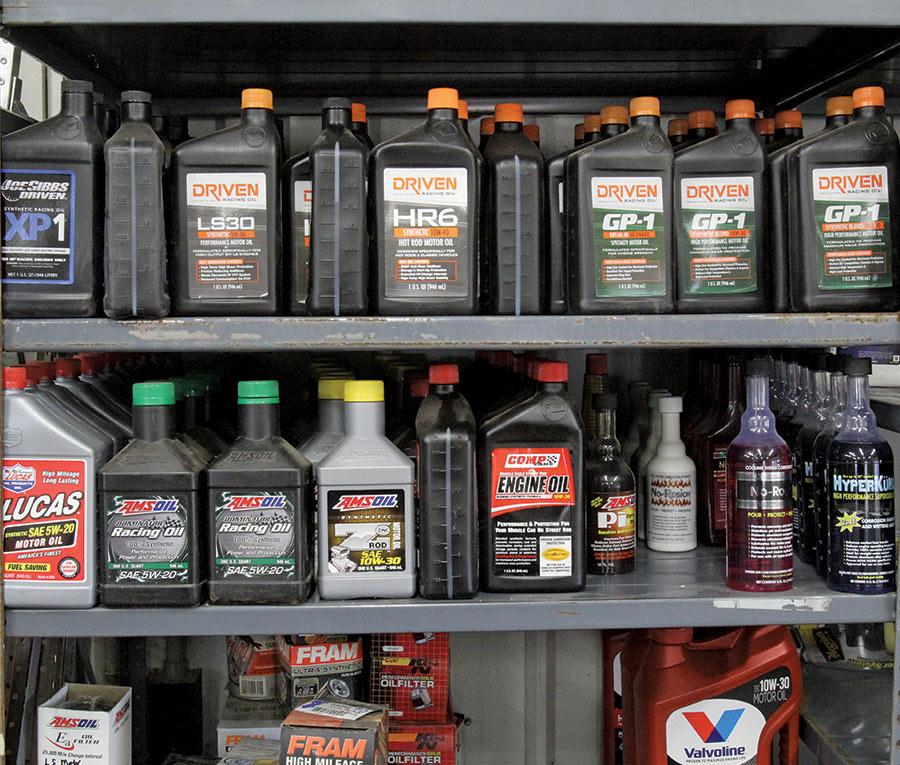
To prevent this eventual failure, it’s best to use a properly formulated “hot rod” oil, of which there are many. Among them are several from companies like AMSOIL’s Z-Rod, Driven Racing’s selections, along with others such as Comp’s oil in 10W-30, 10W-40, and 20W-50 viscosities. These oils are often more expensive than regular API-spec oil but certainly worth it when it extends engine life. Furthermore, the AMSOIL Z-Rod is a full synthetic compared to conventional oil for the other brands.
Among the factors that affect the selection of a good high-performance engine lubricant is the question of conventional versus synthetic oil. As a quick definition, conventional oil is minimally refined from crude oil extracted from the ground. Synthetic base oil is engineered for performance, including improved physical and oxidative properties.
Synthetic base oil offers substantial protection improvements over conventional oil that can offer some interesting opportunities for performance engines. Our friend and oil engineer Lake Speed Jr. performed a test several years ago abusing a 383ci small-block Chevy on the dyno to test a synthetic against a conventional oil with the same additive package. The test abused the small-block at under 4,000 rpm, wide-open throttle (WOT) conditions at oil temperatures above 250 degrees F. The test revealed substantial and visually impressive bearing wear on rod and main bearings using conventional oil while the synthetic oil of the same viscosity revealed much less wear. An independent testing house performed a similar test using AMSOIL 100 percent synthetic 5W-30 oil simulating 100,000 miles worth of wear and found similar results. These tests fully reinforce the concept that synthetic oil can radically reduce engine wear and extend engine life.
There are performance advantages to using a synthetic blend oil, but it’s near impossible to determine the percentages since the various manufacturers prefer not to discuss this on the packaging. Generally, this is because the percentages are very low.
Other major advantages of a synthetic base oil is that its high and low temperature performance and oxidative stability. This stability can lead to improved deposit prevention, which reduces sludge buildup. A common misconception is that oil “wears out.” The proper explanation as to why engine oil eventually needs changing is because the additive package is depleted.
As an example, AMSOIL offers a Signature Series synthetic in which AMSOIL increases the drain interval to 25,000 miles, one year, or 700 hours of operating time. A major advantage to synthetic base oil has the ability to exceed industry standards for performance characteristics. By using high-quality synthetic base oil, the AMSOIL Signature Series offers the opportunity to extend the drain interval. This may not necessarily appeal to a performance engine enthusiast, but the opportunity to use higher quality oil is certainly an advantage even if you don’t use it to its fullest capacity.
It’s best to first detail what the numbers mean. Viscosity is the reference to how well oil will flow at a certain temperature. The first number in multi-viscosity oil like 10W-30 refers to the viscosity rating of the oil when laboratory tested at a cold temperature of -13 degrees F based on the ASTM D5293 cold-cranking test. The “W” does not refer to “weight” but instead references “Winter” for the first number. A smaller number first like 5W-30 would indicate that the oil would flow more freely at cold temperature than a 10W-30.
It’s important to note that any oil will thin as the temperature increases. The goal for any oil is to maintain as much film protection as possible to prevent the crankshaft journal from contacting its bearing surface. This becomes difficult as the temperature increases and the oil becomes thin. Synthetic base oils offer more stability but will still thin out with temperature.
The second number indicates the viscosity of the oil when tested at 212 degrees F (100 degrees C) using the ASTM D445 standard. It’s common that any oil will lose viscosity when exposed to higher temperatures. To protect the engine, thicker oil with a higher viscosity is generally used when the engine runs at higher operating temperatures. A larger number indicates that when the oil thins it will still provide the protection needed at this higher temperature. However, going too thick can lead to oil starvation and a lack of lubrication.
Multi-viscosity oils use a complex combination of base oils and additives like viscosity modifiers designed to provide the desired viscosity range. Both base oils and viscosity modifiers have the ability to flex throughout the band of operating temperatures but its viscosity ranges are significant in multi-grade products like a 0W-40 or 5W-50. Viscosity modifiers have the ability to shrink in cooler temperatures, allowing for faster flow and then can expand when exposed to hotter temperatures to provide the optimal viscosity across the full operating temperature range. This produces oil that can flow properly at very low temperatures while still able to protect the engine when oil temperatures reach beyond 200 degrees F.

The major influencers for choosing a specific viscosity oil are a combination of bearing clearance and operating temperature. A drag racing engine that does not see high oil temperatures could use a thinner oil compared to an endurance engine that sees operating temperatures of 250 degrees F or higher. The endurance engine would be better suited to a higher viscosity oil to better handle the greater thermal demands on the lubricant.
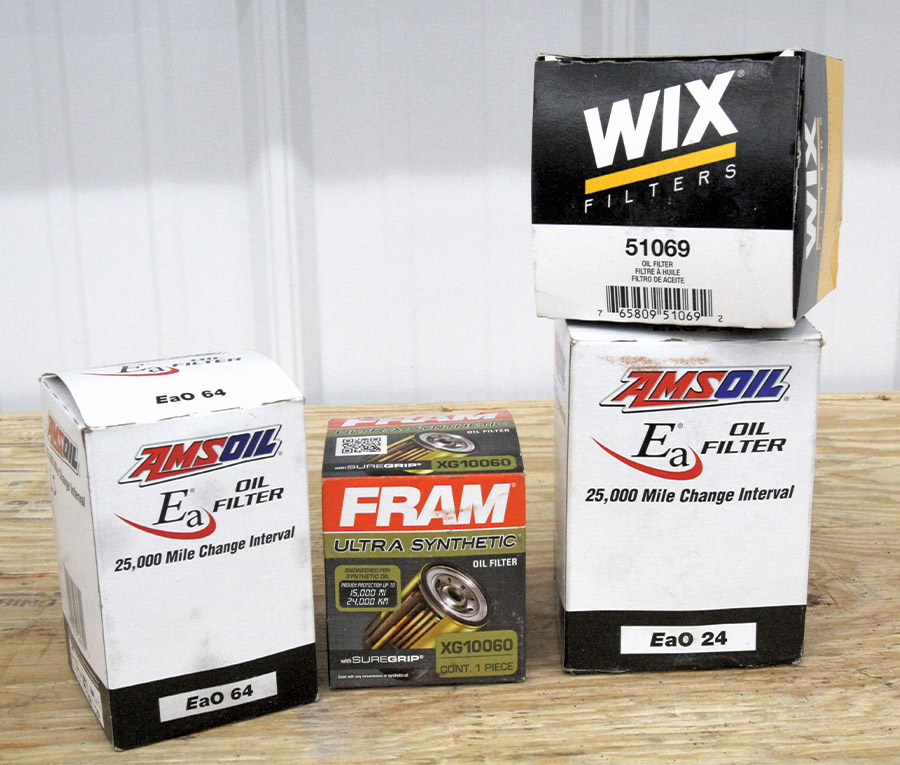
Since clean oil is better than dirty oil, filters are a necessary part of any engine application. One question that occurs from time to time is the use of reusable mesh filters. They may claim to filter down to let’s say 20 microns, but the key to filter performance evaluation is the efficiency number. Most quality filters like an AMSOIL, Fram, or Wix will offer efficiency numbers that will tell you how well the filter removes dirt. For example, AMSOIL’s filter is capable of 99 percent efficiency at removing dirt as small as 20 microns. A micron is one millionth of a meter or 0.000039 inch. This means that all but 1 percent of all 10 micron or larger debris will be filtered out of the oil. Since that dirt is much smaller than the bearing clearances, the engine should be well protected.
The issue with reusable filters is that if they claim trapping a 10-micron piece of dirt, they will not claim an efficiency number even close to what these paper filters can deliver. So, the smart option is to use a good paper filter and avoid the fancy, reusable ones. Plus, consider the dirty solvent you will be immersing that reusable filter in while it is being “cleaned.” This step might actually make the filter dirtier than it was when installed in the engine.
There’s far more to the subject of high-performance lubrication than we’ve touched on here but this should give you a solid knowledge base from which to make your next oil decisions. It’s a slippery subject, but one that we geek out on from time to time!




 SOURCES