

ACP department heading TECH
InTheGarageMedia.com
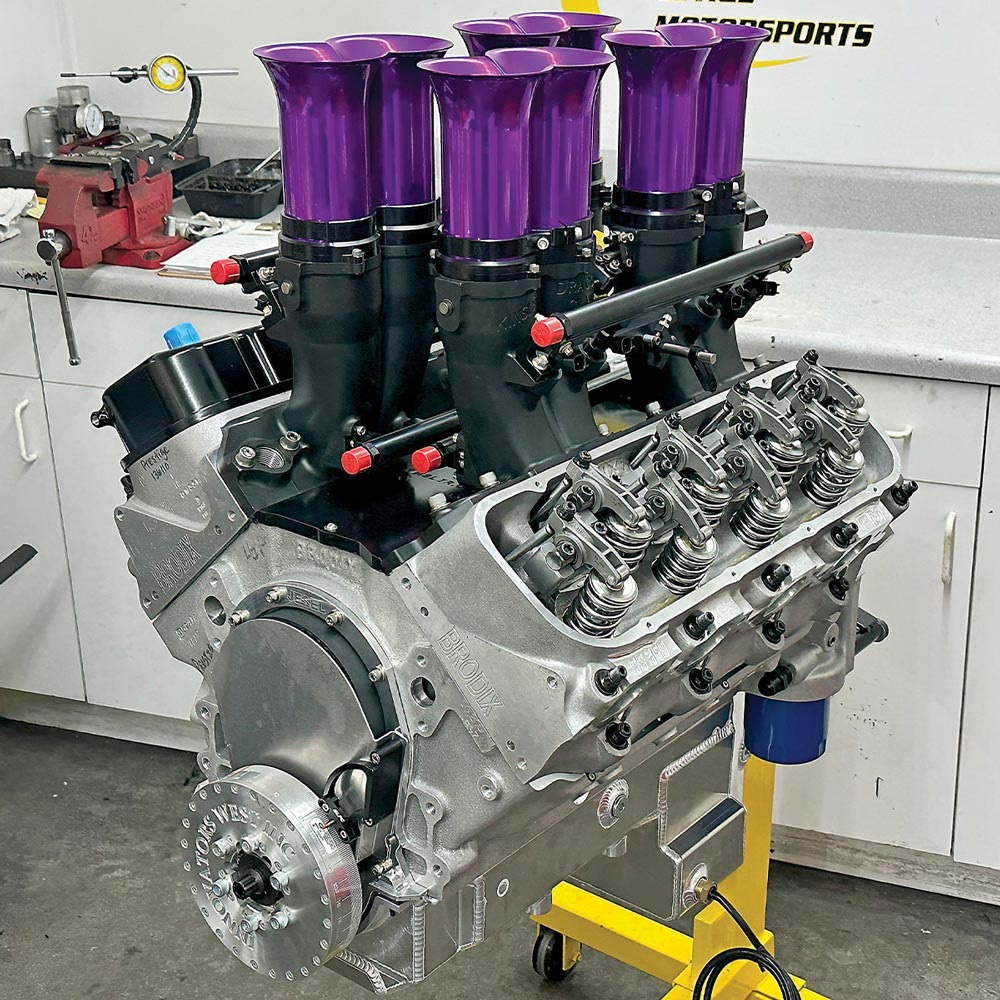
Prestige Motorsports' 582ci big-block Chevy engine on a stand. It features a gray block and a Kinsler Fuel Injection intake manifold with eight distinctive, vibrant purple velocity stacks.
1. Prestige Motorsports’ 582ci big-block not only looks fantastic with its stock-injected intake from Kinsler Fuel Injection but it also makes big power on pump gas.
Big Power, Low Weight
This All-Aluminum Big-Block is Built to Provide Big, Reliable Power for a Famous Sports Car Replica
By Jeff Huneycutt Images by The Author
I

n the 1960s, many of Lola Cars’ most successful racing machines were powered by Chevrolet small- and big-block V-8 engines. Company founder Eric Broadley recognized early on the advantages of building his lightweight British racers around potent, reliable American V-8s. Despite being a relatively young constructor, Lola quickly earned a winning reputation, thanks in large part to the performance of its Chevy-powered cars.

The Lola T70, introduced in 1965, was designed from the outset to accept large American V-8 power. In 1966, driving a Chevy-powered T70 Spyder, John Surtees captured the inaugural Can-Am championship, winning all but one race that season. Lola T70s claimed five of the six Can-Am races that year in a dominant showing against rivals like McLaren and Chaparral. These machines also proved their endurance capabilities; a Team Penske Lola T70 Mk3B, backed by a 5.0L Chevrolet, scored a celebrated overall victory at the 1969 24 Hours of Daytona. Throughout the late ’60s, Chevy-powered Lolas regularly challenged factory teams, such as Porsche, Ferrari, and Ford, underscoring Lola’s ability to blend British engineering with American horsepower.

By the end of the 1960s, the success of Chevy-powered Lola cars had firmly entrenched the company among racing’s elite constructors. Although they did experience greater success in the U.S. than Europe, the big, high-compression engines struggled with the poorer fuels over there but were allowed to burn Avgas in the States. Models like the thundering Lola T70 sports racer and the versatile Lola T142 formula car demonstrated Lola’s knack for pairing British chassis ingenuity with American V-8 muscle. Plus, the cars were just beautiful. There’s something magical about the silhouettes in sports cars from the ’60s.

Of course, any original Lola T70 MkIII you come across will probably be in an automotive museum but just like with the Shelby Cobra there is a healthy replica industry that can replicate the look and feel of these beautiful cars without the million-dollar budget it would take to acquire an original. That’s exactly what this big-block engine build is all about. Prestige Motorsports, out of Concord, North Carolina, got the call to build an engine for a customer’s 1969 Lola T70 Mk3B replica build from Replica Race Cars out of Fraser, Michigan. 

Obviously, going into a car that celebrates the heritage of one of the great race cars from the golden age of sports car racing the engine could be no lightweight when it came to horsepower. But it also absolutely had to be a lightweight when it came to … weight. Even if it made tons of horsepower, a cast-iron pig that would make the Lola wallow through the turns just wasn’t acceptable. 

So, Prestige came up with a plan to build an all-aluminum, 582ci big-block that pumps out 900 hp (on pump gas!) without adding any extra pounds to the fiberglass-bodied car. Oh, and it has to keep that old-school vibe.

The crown jewels of this build are the very tall velocity stacks from Kinsler Fuel Injection. This is not a mechanical fuel injection setup like Kinsler is famous for with Sprint Car racing but instead is an EFI port injection system with a Holley ECU controlling everything. What’s interesting is Kinsler’s engineers gave the engine builders at Prestige the heads up that running all eight velocity stacks the same height could result in dips in power along the rpm band. (Something about harmonics of air pressure/flow or something that’s way above our heads.) 

And that’s exactly what we saw on the engine dyno. With the 6-inch velocity stacks on the individual runner fuel injection we saw an aggressive dip in power between 4,800 and 5,100 rpm. But the guys at Prestige expected it and swapped in four 8-inch-long velocity stacks on cylinders 2, 3, 7, and 6 and ran it again. The mixed lengths of the velocity stacks not only looked cool but actually did a great job of fixing the problem. Power delivery was smooth across the pull and low-end power actually increased (although we did lose power from 5,000 to 5,700 rpm). Overall, average torque and horsepower still went up by 6.1 and 3.1, respectively. So, the mix is not only an incredible look, it’s also the better way to go in this application. That’s a win-win in our book.
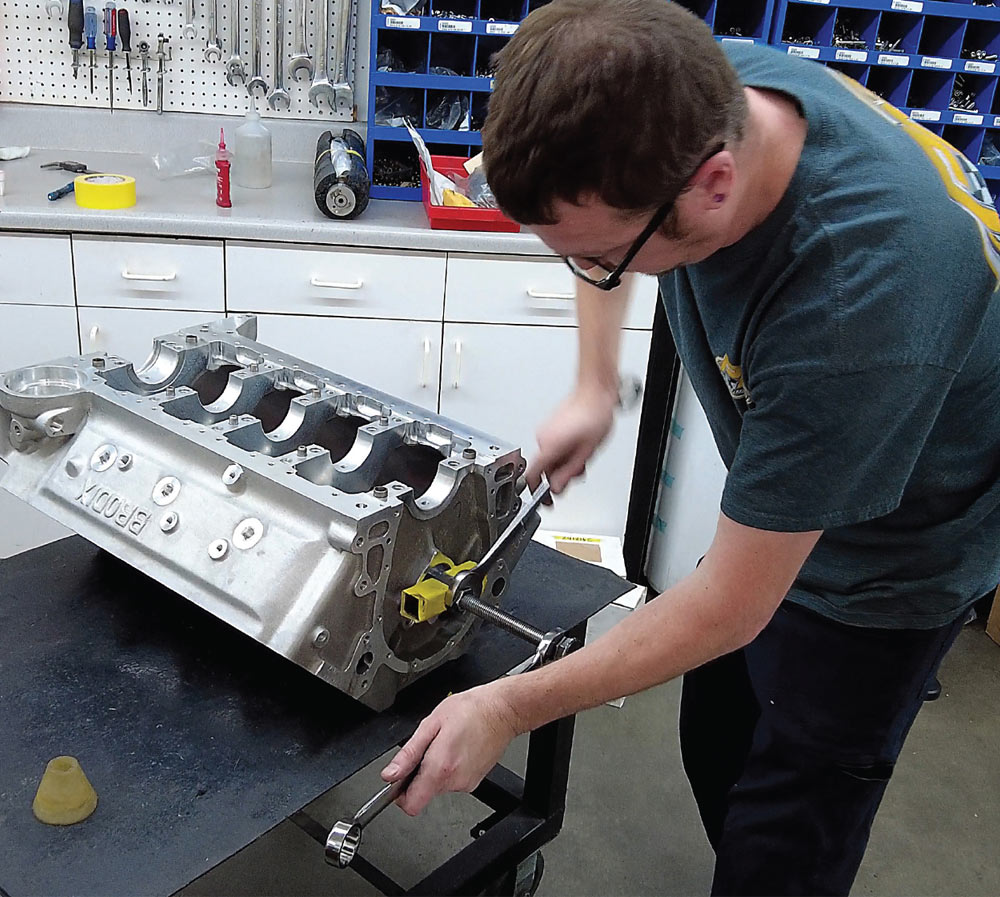
Mechanic Darin Beaver uses a specialized tool to press large cam bearings into a bare, silver Brodix 10.2-inch tall-deck aluminum engine block on a workbench.
2. The block is a 10.2-inch tall-deck aluminum block from Brodix that cuts over 50 pounds versus a cast-iron block. This particular block has been ordered with a raised cam tunnel and a 60mm cam bore. Large cam bearings can be difficult to drive in and keep square, so Prestige’s Darin Beaver pressed each in with a special tool.
A heavy-duty Callies forged steel crankshaft with a 4.375-inch stroke rests on a workshop bench. The crankshaft has a polished, silver finish on the journals and darker counterweights.
3. The crankshaft is a forging from Callies with 4.375 inches of stroke.
A view inside the crankcase of a tall-deck block showing the installed crankshaft and connecting rods. A Moroso billet internal oil pump is visible near the front, securing optimal oil pressure.
4. To squeeze that much stroke in the block and also keep a nice, long connecting rod for an optimal rod/stroke ratio, Prestige went with a tall-deck block. You’ll notice that they are also using one of Moroso’s billet internal oil pumps for optimal oil pressure even under the harshest conditions.
Close-up view of a Moroso fabricated aluminum road-race, wet-sump oil pan with an 8-quart capacity, showing the fully welded and segmented internal windage tray.
5. Speaking of Moroso, they also produced this fully fabricated road-race, wet-sump oil pan with a big 8-quart capacity and a fully segmented windage tray to help move excess oil quickly and efficiently away from the crankshaft and into the sump.
Close-up of the aluminum engine block deck showing three large 4.600-inch JE pistons installed in the bores. The pistons have a small 10cc dome to achieve a 10.7:1 compression ratio.
6. Combined with the 4.375-inch stroke, the custom pistons from JE are 4.600 inches in diameter to make those 582 ci. There is also a small, 10cc dome to bring the compression ratio up to 10.7:1.
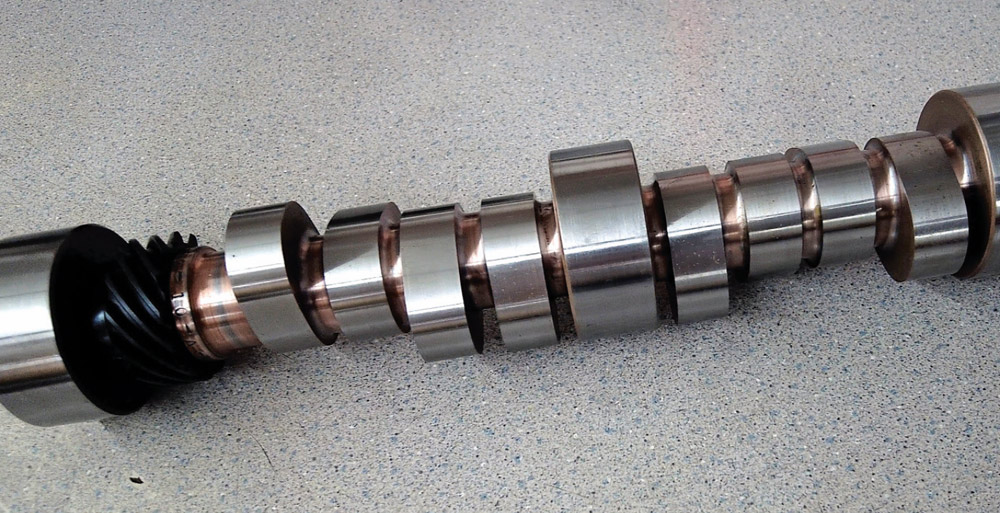
A close-up view of the Comp Cams steel solid roller camshaft, ground with 271/282 degrees of duration at 0.050 inch lift, featuring polished lobes and a helical gear.
7. The camshaft is a steel solid roller from Comp Cams. It’s been ground with 271 degrees of duration for the intakes and 282 for the exhausts at 0.050 inch of tappet lift. Gross valve lift is 0.743 and 0.750, respectively.
The front of the Brodix block showing the installed Jesel belt timing set. A durable black toothed belt connects the large adjustable cam gear and the lower crank gear.
8. That camshaft is spun by a durable and dependable belt timing set from Jesel. Since this engine will see road miles as well as track days, Prestige will hand-fabricate a simple aluminum cover for it to keep any road debris from getting under the belt.
Close-up of the engine block's lifter valley as a mechanic installs a large, silver solid tie-bar roller lifter from BAM into one of the 0.842-diameter lifter bores.
9. The 0.842-diameter lifter bores are filled with a set of solid tie-bar roller lifters from BAM.
Close-up of a Brodix aluminum cylinder head face. The fully CNC-cut 121cc combustion chambers feature large stainless steel Ferrea intake (2.300-inch) and exhaust (1.880-inch) valves.
10. Like the block, the cylinder heads are also Brodix castings. They are fully CNC cut with 121cc combustion chambers and 350cc intake runners. The valves are stainless steel from Ferrea that measure out at 2.300 inches for the intakes and 1.880 for the exhausts.
Prestige Motorsports' lead engine assembler, "Senior," using a torque wrench to tighten the nuts on the Brodix head studs, securing the cylinder heads to the large engine block.
11. Prestige’s lead engine assembler is nicknamed simply “Senior.” He runs down the nuts on the Brodix-specific head studs and secures the heads to the block at 70 ft-lb.
Close-up of the valvetrain showing the installed Crower 1.7:1 rocker arms and the polished Manley valvesprings, rated at approximately 700 pounds over the nose.
12. The rocker arms are ultra stiff units from Crower that keep the stock 1.7:1 ratio. They activate a set of polished valvesprings from Manley rated at approximately 700 pounds over the nose.
The partially assembled Kinsler Fuel Injection EFI intake on the big-block engine. The black manifold plate shows injectors and two large intake runners ready for final assembly.
13. Here, the Kinsler Fuel Injection intake is just going together. This will be an EFI system, and not mechanical fuel injection like these engines were outfitted with back in the day for improved tuneability with a Holley ECU handling engine controls. So, it comes with all the tricks for modern computer controls. For example, the tube running the length of the intakes on the inside isn’t a fuel rail but a balance port to harmonize intake pulses across each port.
Mechanic "Senior" installs the second bank of four black intake runners onto the Kinsler Fuel Injection manifold of the big-block Chevy engine.
14. Senior drops on the second set of intakes.
Close-up view down the dual throats of the intake throttle body. The throttle butterflies are open, showing the smooth airflow path into the engine.
15. With the butterflies open you can see how smoothly air and fuel can flow down through the intake and into the combustion chamber.
The underside of a custom-fabricated aluminum valve cover, showing the polished interior and the integrated oiler tube designed to cool the valvesprings.
16. The custom valve covers are fabricated with integrated spring oilers. You can see the bar running along the length of the underside of the valve cover. It provides a constant jet of cooling oil to each of the valvesprings, which can be tremendously helpful during long, high-rpm track sessions.
The Kinsler stack-injected big-block Chevy engine, featuring mixed-height purple velocity stacks and black "LOLA" valve covers, running on the Prestige Motorsports dyno.
17. On the dyno we tested first with eight 6-inch velocity stacks on the stack injection intake and saw a pretty severe dip in power. Kinsler warned us ahead of time that this might happen, so we followed their advice and put on four of the stacks for longer 8-inch units. This not only fixed the dip, but everybody who has seen this setup immediately comments on the look of the mixed height stacks.
The completed 582ci big-block Chevy engine on a pallet, featuring mixed-height purple velocity stacks, black "LOLA" valve covers, and a billet coolant return collector.
18. Off the dyno and ready to go to the owner. The mixed 6- and 8-inch velocity stacks were a big winner and look fantastic. The large pipe coming out from above the valley plate is the coolant return. It pulls hot coolant from both cylinder heads at both the front and rear to reduce the chance of detonation-causing hot spots. They route to a billet four-into-one aluminum collector at the front of the engine.
Dyno result chart
18. Off the dyno and ready to go to the owner. The mixed 6- and 8-inch velocity stacks were a big winner and look fantastic. The large pipe coming out from above the valley plate is the coolant return. It pulls hot coolant from both cylinder heads at both the front and rear to reduce the chance of detonation-causing hot spots. They route to a billet four-into-one aluminum collector at the front of the engine.