
 TECH
TECH
 Images by THE AUTHOR
e humans are great at adapting; it might be one of our greatest gifts, but it also might be one of our biggest blind spots. How the heck does this seemingly random insight have anything to do with stopping your Chevy muscle car? As it turns out, quite a lot.
When hopping into a 50-plus-year-old Camaro you just snagged off Facebook Marketplace, your brain tells you to expect less than perfect–especially in the stopping department. Technology has improved in newer cars, old parts wear out, and the reasonable expectation is that driving a classic car will come with compromises. Or maybe you just bought an absolute gem of a Chevelle restomod at an auction. It’s fitted with all the latest and greatest parts from reputable aftermarket brands, so you expect it to be the best it can be. After the first testdrive around the block, you might notice the brakes are a little more “touchy” than you’re used to. Or maybe you rolled past the first stop sign because they took more effort than you expected. But, after a couple of weekend cruises, you’ve all but forgotten that there might be something a little off about your Chevy’s brakes.
All is fine and dandy for a while (remember, we are quite adaptable), but then, a couple months later, you’re driving through a school zone and you see a kid start to run into the road after a ball. You go for the brakes as quick and hard as you can. If your Chevy’s brakes were too touchy, you’re about to lock up two or more tires, which equal lack of control and longer stopping distances. If your brakes were too hard, you might be doing a two-foot stand trying to slow the car down, with little control over the outcome of the situation.
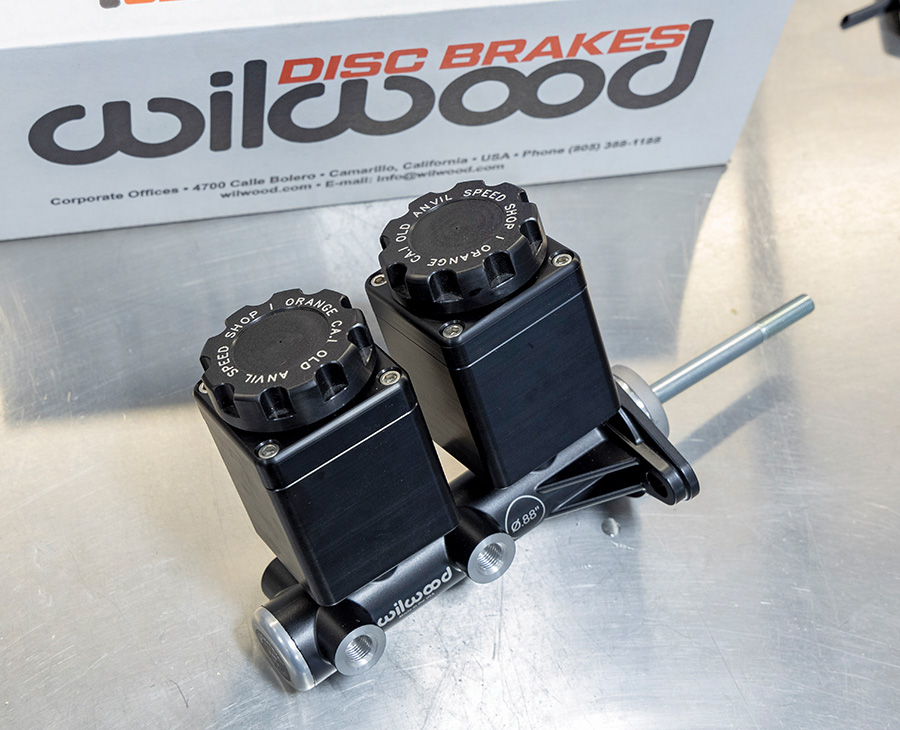
What you want are brakes that are predictable and manageable even in the most panicked situations. Assuming you have decent tires with enough grip to handle a quick stop and a braking system that is bled properly, the next most important factor to consider is the master cylinder. And that is what this article is all about.
Manual (non-assisted) brakes are simple and effective when set up properly. Manual brakes can offer a consistent brake pedal feel without requiring excessive pedal effort. The most common issue is a master cylinder with a bore diameter that is too large, or an incorrect pedal ratio that leads to a hard pedal.
Another important consideration is the brake pedal’s ratio, basically this is simply a matter of leverage. In operation, applying 100 pounds of pressure to a brake pedal with a 5:1 ratio would result in applying 500 pounds of pressure to the master cylinder. Increasing that ratio to 6:1 would result in 600 pounds of pressure applied to the master cylinder.
While it seems to fly in the face of logic, a smaller bore master cylinder will produce more hydraulic system pressure than one with a larger bore; we certainly proved that by comparing the performance of two different master cylinders. Without getting into mind-numbing math, the attached Wilwood chart shows the relationship between master cylinder bore size and system pressure and the difference the increased leverage a longer brake pedal can make. Choose your brake components wisely and you won’t have to guess if your car will come to a quick stop when you need it to.